

Live updates: Follow the latest on Israel-Gaza
David Miliband, president and chief executive of the International Rescue Committee, has described the situation in Gaza “as beyond grave”.
In an interview with The National, the former UK foreign secretary said: “The current situation, especially in northern Gaza, is catastrophic because there simply isn't enough aid reaching Gaza and the aid that does reach isn't reaching the people in the greatest need.”
The IRC is one of several NGOs working on the ground through local partners in areas including the treatment of malnutrition, addressing child protection issues, supporting water and sanitation.
He stressed that “the heartbreaking stories are not only of people under threat from the fighting, they're also under threat from simple lack of food and water to allow them to survive”.
Global experts, who work under the integrated food security phase classification of the independent Famine Review Committee, have warned there is a high risk of famine in northern Gaza.
Mr Miliband said: “The international phase classification system is … quite conservative. It doesn't throw the word famine around easily. There are five grades of food insecurity. And so for this warning that famine is effectively here … that we have days, not weeks, should be seen in the context of a quite careful international body, but also the international evidence that when famine is declared, there are often people already dying.”
With the devastating conditions in Gaza, “there's not just the threat of a famine, but also the associated diseases that go with this catastrophic situation in respect of the water and health system, which has been so destroyed”, said Mr Miliband.
Humanitarian organisations have been warning for months of the level of humanitarian suffering, with more than 90 per cent of Gaza’s population displaced by Israel’s military assault. However, international organisations are also careful about appearing political or biased. Mr Miliband clarified that “our humanitarian appeal, not a political appeal, but a humanitarian appeal” is to allow aid in.
He spoke of the need for two immediate actions, firstly to allow the flow of water and food into Gaza, and secondly to allow for an immediate ceasefire. He said that despite repeated calls for a ceasefire, including by the UN Security Council, it has yet to materialise. And while he acknowledged that the talks for a ceasefire are linked to hostage negotiations, he said “the humanitarian issue needs to be addressed in and of itself”.
Civilians caught up in conflict

Mr Miliband stressed that “international humanitarian law is not biased between different parties, it is not conditional all”. He added: “It's very, very clear that the right for civilians is not to be targeted, to receive aid … those are absolute.” Those obligations are on states and non-state actors, he said. And while there has been concern that more blame is directed at Israel for stopping aid from reaching those in dire need in Gaza, Mr Miliband responded: “As humanitarians, we are not prosecutors, we're not a legal authority, but we are on the receiving end. And what we can say without any fear of contradiction is that the clients that we serve are not having their rights. Those rights to aid, those rights to life and limb are not being sustained in the current conflict.”
In addition to the war in Gaza, the war in Lebanon has led to a quarter of the population – a million people – to be displaced in six weeks. Mr Miliband said: “This is a tumult of a very significant kind. And, obviously, the displacement is just the tip of the iceberg.”
The IRC also works on the ground in Lebanon, where Mr Miliband said “lives are being turned upside-down. And that affects our own staff, as well as the clients we have”.
The IRC refers to beneficiaries of its services as “clients”. The IRC now works in numerous areas of Lebanon, including in the north and in Mount Lebanon, in health services and child protection, although previously it was largely focused on education and livelihoods issues, helping its clients sustain jobs and incomes.
The issue of allowing for aid to be delivered to civilians – and the violations of international humanitarian law – is being replicated in a number of conflicts, including in Sudan. Mr Miliband explained that “this issue of the flow of aid that we were talking about in Gaza is not only a Gaza issue”, and is a major problem in Sudan, one of the worst humanitarian disasters in the world.
Addressing global crises
-

Palestinians rush to intercept humanitarian aid packages as they land in the northern Gaza Strip, dropped by a UAE plane in a joint effort with Egypt. All photos: AFP -
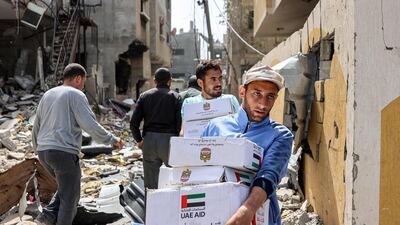
Men carry boxes of aid through the rubble of damaged buildings after the airdrop -
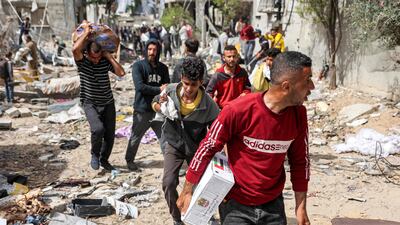
The packages are a lifeline for many amid the continuing war in the Gaza Strip -
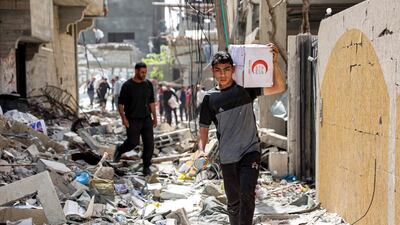
A youth carries a box of aid to his family -
The additional supplies – including food – were sent by parachute into remote areas -
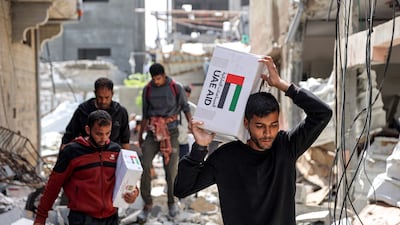
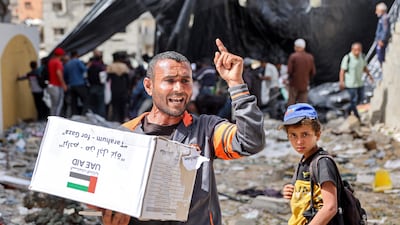
The UAE has been donating humanitarian relief to Gaza since shortly after the latest war began -
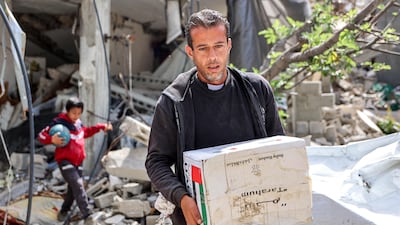
A man collects this aid package from the UAE-Egypt airdrop


Mr Miliband said: “We mustn't fall into the trap of thinking that numbers are everything, but numbers matter … 26 million people in Sudan are in humanitarian need. That means they need NGOs to support them in order to survive … 11 million people are now displaced inside the country.”
With two million people trapped in Darfur “who are facing famine like conditions … famine is becoming something that is also in danger of being normalised”, he added, explaining “It's not that there isn't enough food in the world, it's the political will to actually get the food to the people who need it”.
With regional and global powers involved in the conflict, Mr Miliband said “this is a really fundamental challenge to regional powers as well as to global”.
A similar challenge is present in Yemen, which has not had the same attention as Sudan and Palestine this year, despite being the target of air strikes from a coalition that includes the US and UK. Mr Miliband stressed the importance of helping the people of Yemen but also resolving its many challenges. “Amid the geopolitics of Yemen, let's not forget the local politics, which is the root of quite a lot of the trouble,” he said.
The challenge to humanitarian law should be met by both global and regional powers, according to Mr Miliband. “The global order is not the same as the global order of 20 years ago, never mind 40 years ago,” he said.
“The new global order is one in which countries like [the UAE] in the region have a lot of power in this system.” In what he calls a “multi-aligned world”, countries in the region have an important role to play. “It’s also important to recognise that this is not a western-run system any more, there's a new global distribution of political power in which a whole range of states have a lot of influence,” he said.
The UAE has worked hard on the issue of humanitarian action and recently announced the Erth Zayed Philanthropies to expand its humanitarian and development efforts. This month, Dr Anwar Gargash, diplomatic adviser to President Sheikh Mohamed, gave a speech in which he called for humanitarian decision making to be prioritised, saying the humanitarian cost of political actions was too high.
Mr Miliband said Dr Gargash’s speech was “really a very important leadership contribution to the debate”.
“The need to address the humanitarian plight is something that is not just a real requirement here in Gaza, in Lebanon, in Yemen … but also around the world, whether in Sudan or further afield,” he said.
Stressing the need to meet the “humanitarian imperative”, Mr Miliband said Dr Gargash “called on all of us to work in a different way to recognise that humanitarian loss cannot just be collateral damage from political decisions”.
“This kind of leadership is desperately needed in the modern world because we're seeing a retreat from humanitarian principles, not the advance of humanitarian principles,” he said.
One of the main issues the IRC works on is that of refugees. With more and more European countries tightening their asylum policies and with US president-elect Donald Trump saying he will deport asylum seekers, humanitarians are sounding the alarm on the rights of refugees. “My appeal is to live up to the legal and moral commitments that they've made as signatories to the Refugee Convention, which guarantees rights for refugees”, Mr Miliband said.
Arab countries are largely not signed up to the UN Refugee Convention, largely due to the Palestinian refugee issue that dates back decades. “I would appeal to Gulf countries to sign up to the UN Refugee Convention,” Mr Miliband said. “But the United States is a signatory to the Refugee Convention, and what it says above all is that you shouldn't send people back to danger, you shouldn't send people back where it's not safe”.
Migration is an increasingly polarising issue in western politics but one that affects countries around the world. Mr Miliband stressed that “the refugee issue is manageable if you decide to manage it. And our appeal to the new (American) administration would be let's manage this issue effectively because it is manageable”.
“The choice in the modern world is not whether people move or not. It's whether they move in legal, safe, orderly fashion or in undocumented, illegal, unsafe and disorderly fashion – and that's a global challenge,” he said. Organisations like IRC will have to navigate how this challenge will be met, affecting millions around the world.

