
Live updates: Follow the latest on Israel-Gaza
Almost a year has passed since the events of October 7, 2023, and for many families displaced from Gaza, the situation has only deteriorated.
Despite a feeling of immense gratitude for the love, support and shelter provided, this is the case for Palestinians taking refuge in Abu Dhabi's Emirates Humanitarian City.
Gaza's borders are sealed. There is no way in or out of the besieged enclave, leaving residents in a state of constant fear and uncertainty. Families separated by the conflict are scattered across different countries, their lives upended and futures uncertain.
More than 41,000 people have been killed and thousands remain trapped in Gaza, living in makeshift shelters and tents, struggling for water as winter approaches, with the flow of food, medicine and fuel supplies severely restricted.
For those who have found refuge in the UAE, the daily reports of more death and destruction back home not only haunt them, but instil a sense that returning is no longer an option, that the time has come to rebuild their lives away from Gaza.
Lives altered

Sabreen Mady and her daughter Lama arrived in the UAE on December 19, with Lama requiring urgent surgery on her hip. She spent three months in a wheelchair and has only recently started walking again but, for Sabreen, her daughter's recovery is just a small solace amid the chaos her family continues to endure.
“Our entire lives have changed. We are in three countries, not one. Twenty-five of our family members died, and those remaining are injured. Some are in Egypt, and others in Italy,” she told The National. “It has gone from bad to worse. Every day there are more deaths, more missiles. Life in Gaza isn’t guaranteed. The borders are closed. There is no way for me to go back. There is no plane to take me.”
Jamal Al Najar, 58, recalled how October 7 shattered his family's dreams as his son, Amjad, was planning to get married in July 2024. Amjad, 21, was seriously injured by shrapnel that became lodged in his left ureter and damaged his spine.
“Our lives are now very sad, very difficult, but without the UAE, its people, and their kindness, and President Sheikh Mohamed, my son wouldn’t be walking on his legs today or even alive. We thank God we are here,” Mr Al Najar said.
Reflecting on a possible return to Gaza, he continued: “There is no hope. Where is the hope? Where will we go? Even if we want to go back, what will we go back to? My kids in Gaza are in a tent. I was in a respectable, clean house, now I’ll go back to a tent. There aren't even toilets there. There are no landmarks. If I go now, I won’t be able to recognise it.”
About 2,000 patients are being housed at EHC as part of the UAE's humanitarian operations in solidarity with Palestinians. About 150 medical appointments are carried out each day, with a team of more than 50 doctors, nurses, therapists and administrators on site. A school serving more than 400 children has also been established.
Ibtesam Abu Nada, 49, a pharmacist, came with one of her daughters to the UAE for breast cancer treatment on March 26. She described the painful separation from her relatives who are now scattered and isolated.
The mother of four daughters said: “The situation is very hard. We are dispersed. Do you know what it’s like for a family to be in more than one country? My husband remained in the north. He’s an engineer working at the Ministry of Health, so when we were displaced, he refused to move and stayed in Sheikh Radwan.
“We moved and went to Deir Al Balah. After Deir Al Balah, we went to Khan Younis, and from there to Rafah. Two of my daughters remained in Khan Younis. One went to Egypt so her sisters could follow her later, but then the border closed, so one daughter remained alone in Egypt.
“Their father is in the north, and two are in Khan Younis. We follow the news daily, and there is no step forward. When we feel there is some hope, we go backwards.”
Watch: Gazan patients offered psychiatric care
Grateful but still praying
Alaa Al Nawajha, 30, is living in EHC with her daughter Jana, who has a weak immune system and requires a bone marrow transplant. Jana’s father, her donor, remains stuck in Gaza.
“I’m very tired. Neither my daughter nor I are able to cope with the new situation. Being separated from our family in Gaza is very hard,” Ms Al Nawajha said. “They are all our family. We feel like there is hope, and then suddenly that hope dies. The UAE took us in, and we are grateful, but we are now living in the unknown.
“We are praying to God that the situation will improve but, as human beings, we aren’t able to endure it for much longer,” she added. “Our hearts have gone weak. I can’t listen to the news of more deaths, every day more deaths and destruction. It is so hard. God willing, things will improve.”
For Jaser Abu Mousa, 45, the conflict was less of a surprise. The father of four was a political analyst who worked for the Swiss embassy in the enclave, and recalls drafting reports in the months preceding the attack that suggested “something was coming”.
Family and friends were at his Gaza home on October 15 when it was hit by two Israeli missiles. Two of his sons, his wife and other family members were killed. “I was very scared, and every night I thought it would be our last,” he said. “The first body I saw was my wife’s. There were body parts all over.
“The situation gets worse every day. My mother and sister are still in Gaza,” said Mr Abu Mousa, who arrived in the UAE on December 8.
“This is the reason I don’t sleep at night. I was in Switzerland once and was asked what I thought of the situation in Gaza. I answered that Hamas found legitimacy for its existence by calling themselves the resistance to Israel, and Israel found legitimacy to suffocate Gaza and kill its people by calling themselves defenders fighting terrorism.
“There is an unholy marriage between the two, and the victim is Gaza. It has been a year now, and I don’t see any light, at least not in the next two months.”
The Israel-Gaza war – one year on
-
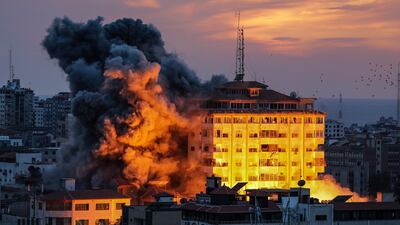
Smoke rises after Israeli air strikes targeted Palestine Tower in Gaza city on October 7, 2023. EPA -
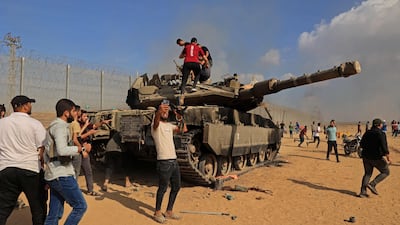
Palestinians take control of an Israeli Merkava battle tank after crossing the border fence with Israel from Khan Yunis in the southern Gaza Strip on October 7, 2023. AFP -
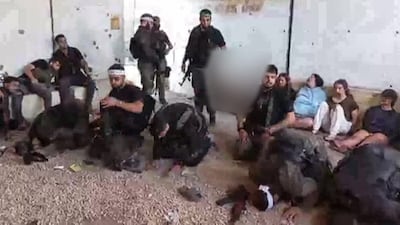
This video grab from footage released by the Israeli Hostage and Missing Families Forum campaign group on May 22 shows what the group described as Israeli female soldiers being captured by Palestinian Hamas militants during the October 7, 2023, attack on Israel. AFP -
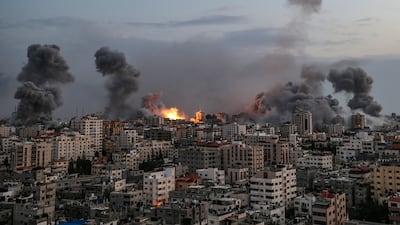
Smoke rises following an Israeli air strike in Gaza city on October 9, 2023. EPA -
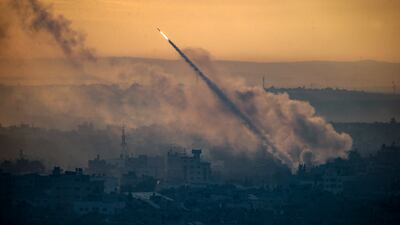
A rocket is launched from the coastal Gaza strip towards Israel by militants of the Ezz Al-Din Al Qassam militia, the military wing of Hamas movement, in Gaza city. EPA -

Israel's Iron Dome anti-missile system intercepts rockets launched from the Gaza Strip, as seen from the city of Ashkelon, Israel, on October 9, 2023. Reuters -

Lightning strikes as smoke billows following an Israeli air strike in Gaza city on October 9, 2023. AFP -
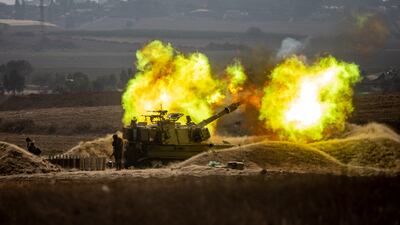
An Israeli artillery unit fires at an area along the border with Gaza, southern Israel, on October 11, 2023. EPA -

Ultra-Orthodox Jewish people carry their belongings before boarding a ship for US nationals and their immediate family members, as they leave Israel headed for Cyprus. Reuters -
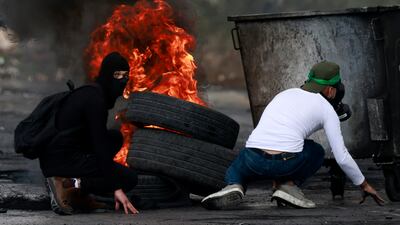
Palestinian youths take cover behind a rubbish container as they clash with Israeli forces at the northern entrance of the West Bank city of Ramallah near the Israeli settlement of Beit El on October 20, 2023. AFP -

A man mourns as he attends a funeral of Palestinians killed in Israeli strikes in Khan Younis in the southern Gaza Strip on October 24, 2023. Reuters -
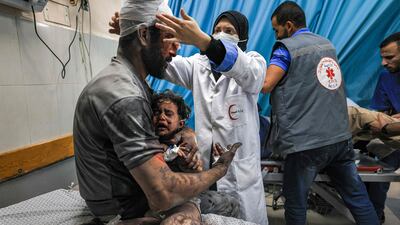
A man holds a child, survivors of Israeli bombardment, as they are treated at a trauma ward at Nasser hospital in Khan Yunis in the southern Gaza Strip on October 24, 2023. AFP -

People search for survivors and the bodies of victims through the rubble of buildings destroyed during Israeli bombardment in Khan Yunis in the southern Gaza Strip on October 26, 2023. AFP -

Anti-war protesters raise their 'bloody' hands behind US Secretary of State Antony Blinken during a Senate Appropriations Committee hearing on President Biden's $106 billion national security supplemental funding request to support Israel and Ukraine, as well as bolster border security, on Capitol Hill in Washington on October 31, 2023. Reuters -
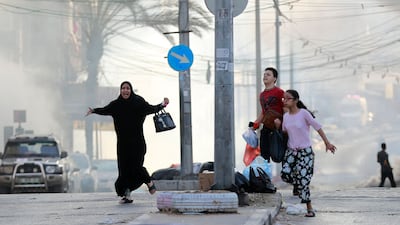
Palestinians run for cover after a strike near the Al Shifa hospital in Gaza city on November 1, 2023. AFP -
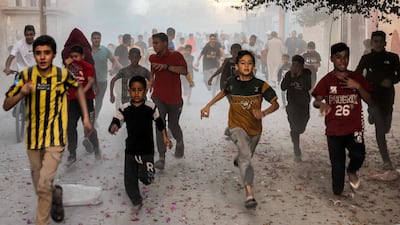
Palestinian children run as they flee from Israeli bombardment in Rafah in the southern Gaza Strip on November 6, 2023. AFP -
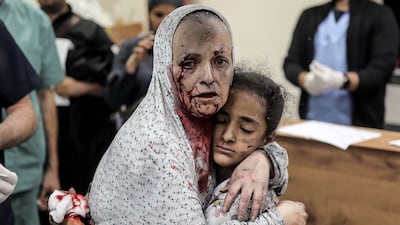
An injured Palestinian woman covered in dust and blood hugs an injured girl child at the hospital following the Israeli bombardment of Khan Yunis in the southern Gaza Strip on November 15, 2023. AFP -
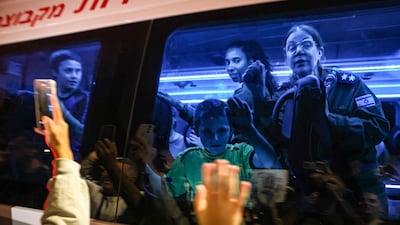
Hostages released by Hamas Gal, left, and Tal Almog-Goldstein, second left, stand in a bus transporting them to an army base in Ofakim in southern Israel after they were released by the Palestinian militant group from the Gaza Strip on November 26, 2023. AFP -
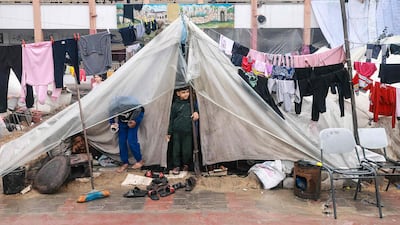
Palestinian boys stand in their makeshift tent at a camp set up on a schoolyard in Rafah in the southern Gaza Strip where most civilians have taken refuge, on December 13, 2023. AFP -
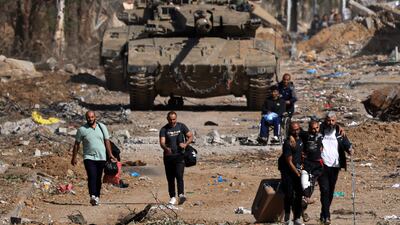
Palestinians fleeing the north through the Salaheddin road in the Zeitoun district on the southern outskirts of Gaza city, walk past Israeli army tanks on November 24, 2023. AFP -
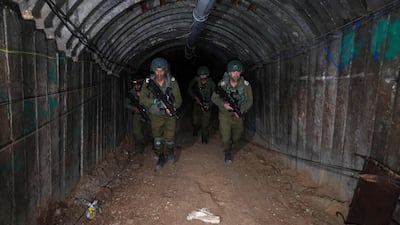
In this picture taken during a media tour organised by the Israeli military on December 15, 2023, soldiers visit a tunnel that Hamas reportedly used to attack Israel through the Erez border crossing on October 7. AFP -

Jewish protesters block the passage of aid trucks being sent to Gaza in Ashdod, Israel on February 1, 2024. Reuters -
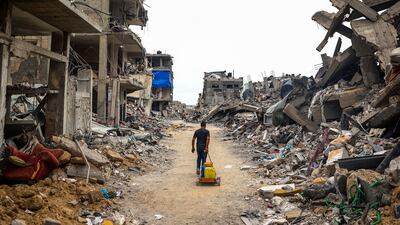
A man pulls water containers as he walks past destroyed buildings in Khan Younis on May 5, 2024. AFP -
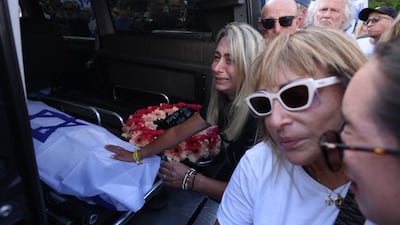
Relatives of Hanan Yablonka, one of the Israeli hostages held in the Gaza Strip since the October 7, 2023 attack by Palestinian Hamas militants, mourn during his funeral in Tel Aviv on May 26. AFP -

Humanitarian aid packages land after being dropped from a plane in Al Mawasi district of Khan Younis, on May 30, 2024. Reuters -
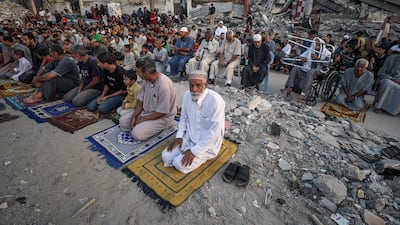
Palestinians attend Eid al-Adha prayer in Khan Younis town, southern Gaza strip, on June 16. EPA -
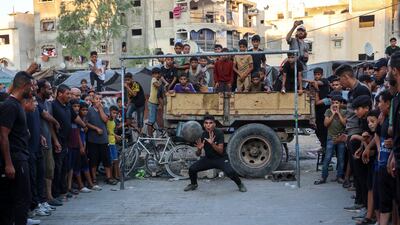
Displaced Palestinians play football in Jabalia on July 23, 2024. AFP -
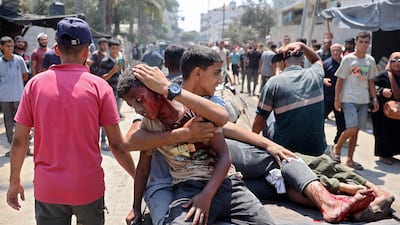
Palestinians injured in an Israeli strike on a school ride on the back of a cart in Deir Al Balah on July 27, 2024. AFP -
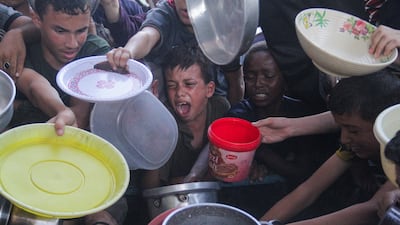
Palestinians gather to receive food cooked by a charity kitchen, amid the Israel-Hamas conflict, in the northern Gaza Strip, September 11. Reuters -

Palestinians survey the damage at the site of Israeli strikes on a displacement camp in Khan Younis on September 10, 2024. AFP -
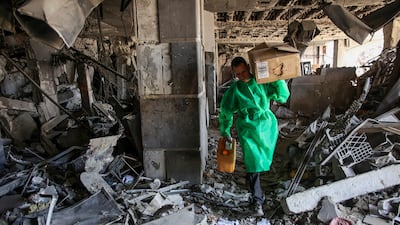
A medical staff member carries supplies through a destroyed section of Al Shifa hospital in Gaza city on September 17. AFP -
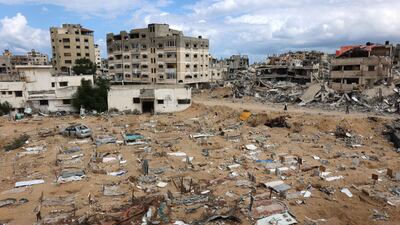
People walk past makeshift graves in Gaza city on September 17. AFP



