


The UAE’s new early weather warning system will help save lives amid a growing threat posed by climate change, a senior UAE official has said.
Dr Mohamed Al Ebri, director of the meteorology department at the National Centre of Meteorology, said it was important to be able to warn the public about potential weather hazards when they were abroad.
Speaking to The National on Tuesday, Dr Al Ebri said creating the system had been challenging but it was an important development.
“Because of climate change, natural disasters and severe weather have increased in severity and frequency,” said Dr Al Ebri. “We wanted to warn citizens and residents who are abroad. This is very important to save lives.”
The Ministry of Foreign Affairs and the NCM on Friday launched the “early warning system for all”, which is now up and running.
The ministry will operate the 24/7 platform that is fed data from the NCM and a network of weather stations across the world to monitor global weather hazards.
It identifies extreme events using a colour-coded system, issues predictions for the next few days, and helps inform any decision to trigger an alert to Emiratis and residents who are abroad at the time.
Severe floods in Spain and the devastating Turkey-Syria earthquake, as well as approaching tropical storms, are examples of where such an alert could prove critical but the system could operate in any country where there is a hazard.
How the system works
More details are expected but if there is an earthquake, for example; an alert flashes on screen; gives the location; details about the event; severity; details on potential aftershocks; and then ministry teams can trigger a warning if needed, giving advice on what people should do such as take action, be careful or avoid.
“The result is a pop-up that flashes, so immediately the ministry’s operation room sees," said Dr Al Ebri. "But also the severity of the incident."
The system is open for Emiratis and residents, and alerts are sent by text message to a person’s phone. Dr Al Ebri said people must have a UAE-registered mobile phone to receive alerts.
The interface was created for the ministry but Dr Al Ebri said it could in the future assist other countries looking to build their own early warning system. “It is very, very useful."

Global priority
Early warning systems have become a global priority to save lives in the face of more extreme weather events.
The UN in 2022 launched a plan to put every person in range of early warning weather systems within five years, as natural disasters have grown more powerful and frequent that scientists say the pattern is linked to climate change.
These systems are seen as crucial in helping people deal with potentially lethal events such as wildfires, drought and floods. It called for an investment of $3.1 billion between 2023 and 2027, equivalent to a cost of only 50 cents per person per year.
“People in Africa, South Asia, South and Central America, and the inhabitants of small island states are 15 times more likely to die from climate disasters,” said UN Secretary General Antonio Guterres at the time.
“These disasters displace three times more people than war. And the situation is getting worse. Countries with limited early warning coverage have disaster mortality eight times higher than countries with high coverage.”
A World Meteorological Organisation (WMO) study in 2023 found only half of the world’s countries had adequate early warning systems.
Celeste Saulo, secretary general of the WMO, said boosting global warning systems was a priority for her term as head of the UN weather agency. The first woman and South American to lead the UN weather agency took up her post in January and said 30 less-developed countries susceptible to extreme weather had been identified for such systems to be developed.
“Adapting to climate change is not a choice but an essential necessity,” she said in January. “It is about building resilient communities, especially in the most vulnerable regions, capable of resisting to and recovering from climate-related disasters.”
The UAE has stepped up efforts in recent years to bolster its response to emergencies. The National Emergency, Crisis and Disaster Management Authority developed an early warning system for situations that affect the UAE.
Alerts are regular sent across numerous channels when the UAE is faced with an emergency and phone alerts are common during these times.
“Early warning systems are very important in the case of extreme weather events as they can provide the needed time to act and save lives and belongings,” said Dr Diana Francis, an assistant professor and head of the Environmental and Geophysical Science (Engeos) Lab at Khalifa University in Abu Dhabi.
Dr Francis said it was important to receive accurate information from a trusted source. “It is something similar to the security alert nationals of a given country will get in case of security/war issues in the country they are in," she said. "This new system is specifically for weather and natural hazard events.”
Climate change in the Middle East - in pictures
-

Flooding in the Al Barsha area of Dubai. Chris Whiteoak / The National -
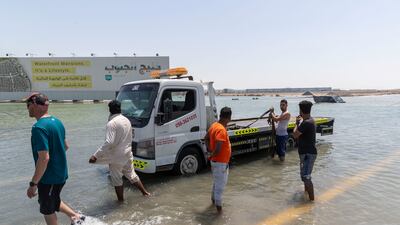
Vehicles being recovered near Al Maktoum airport in Dubai. Antonie Robertson / The National -

Flooding in the Al Barsha area of Dubai. Chris Whiteoak / The National -
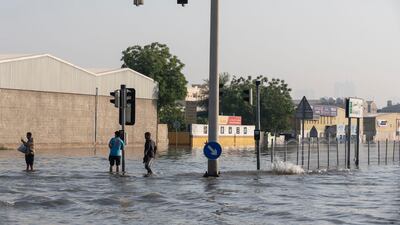
Flooding along Sheikh Zayed Road in Dubai. Antonie Robertson / The National -
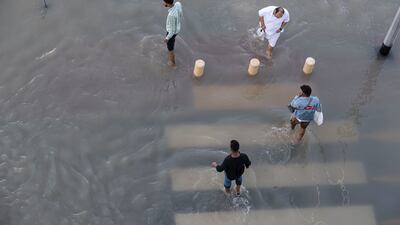
Flooding along Sheikh Zayed Road in Dubai. Antonie Robertson / The National -

Cars move through floodwater in Al Qudra, Dubai. Chris Whiteoak / The National -

Flooding on Dubai's Al Khail Road. Chris Whiteoak / The National -
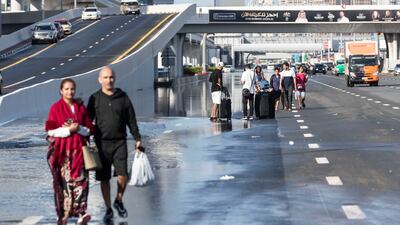
People abandon their cars on Sheikh Zayed Road due to heavy rain. Antonie Robertson/The National -

Flooding on Al Khail Road. Chris Whiteoak / The National -
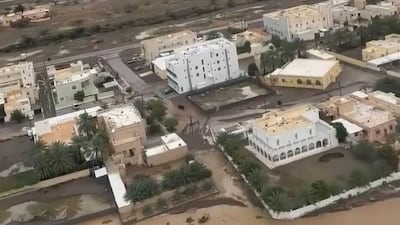
Flooding in Oman. Photo: Royal Oman Police -

A damaged car in Derna, Libya. Reuters -
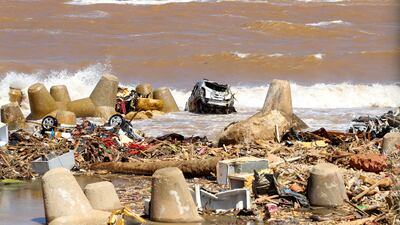
A destroyed vehicle in Derna. AFP -

Abdul Salam Ibrahim Al-Qadi walks on rubble in front of his house, searching for his missing father and brother, in Derna. Reuters -

An aerial view of the destruction in Derna. Reuters -
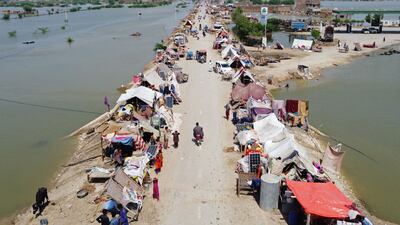
Flood-affected people taking refuge in a makeshift camp after heavy monsoon rains in Jaffarabad district of Balochistan province. AFP -
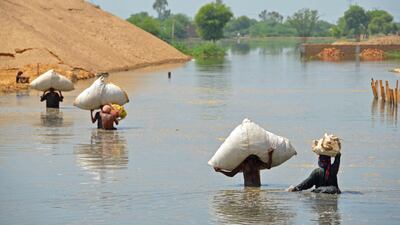
Internally displaced flood-affected people shift husk for their animals in a flood-hit area following heavy rains in Dera Allah Yar in Balochistan. AFP -
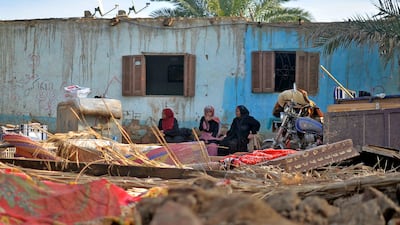
The aftermath of flooding in Egypt's southern city of Aswan, 920 kilometres south of the capital. AFP -

The Nile River from the top of Famine Stela, or Rock of Starvation, Egypt. Reuters -

Volunteers search for people in need following heavy rainfall in east Mosul, Iraq, in March 2020. Reuters -

People clean up after floods in Duhok, Iraq, on March 19. Reuters



