


The new UK government has a clear ambition to reconnect with the world, the British ambassador to the UAE has said.
Edward Hobart said it was important to move into a new era “beyond the Brexit conversation” that has defined the past few years.
Speaking to The National following the Labour Party’s landslide election victory, Mr Hobart said there was now an opportunity to reinvigorate the bilateral relationship between the UK and UAE.
“It is an important kind of reset for the government and the civil service in supporting the government,” Mr Hobart said on Tuesday.
In a wide-ranging interview, Mr Hobart reflected on the fresh priorities, how the bilateral relationship will strengthen, and the key issues both sides need to work on.
President Sheikh Mohamed has spoken to the new British Prime Minister, Keir Starmer, since Thursday's election, while David Lammy’s first call as Foreign Secretary on Friday was to Sheikh Abdullah bin Zayed, UAE Minister of Foreign Affairs.
“The government was formed at about midday on Friday,” said Mr Hobart. “He was appointed in the afternoon and he picked the phone up and spoke to Sheikh Abdullah. Sheikh Abdullah was available to take the call, which was great.”
Post-Brexit era
The new administration takes power after years of turmoil dominated by Brexit, the fallout from Covid-19 and successive Conservative Party prime ministers who struggled to get a grip on the situation. Rejoining the EU is currently not on the cards, however, the envoy said.
“I think the government's been clear that they're not going back into the European Union,” said Mr Hobart. “That's not part of their agenda but they want to have a better relationship with the European Union.”
Mr Hobart said the phrase the new Foreign Secretary has been using in this regard is “reconnect with the world”.
When asked if the upheaval of the past few years had eroded the UK’s global standing, Mr Hobart said others could judge whether the country had been up or down over the past few years, but his job was to identify strengths.
UK's new priorities
The government has said it will focus on five areas – economic growth, making Britain a clean energy superpower, tackling crime, boosting opportunities, and improving the National Health Service. Mr Hobart said two of those – energy and growth – are particularly relevant for the relationship with the UAE.
He cited the UAE's presidency of Cop28 and how it is a long-term investor in the UK renewable sector. Adnoc and BP work on hydrogen projects, for example, and both countries aim to invest more globally in renewables, “so there's a story there already but I see that as being something that will be enhanced”.
In terms of growth, the UAE is the UK’s largest trading partner in the region and its 19th largest trading partner globally. Bilateral trade last year was more than £24 billion.

The envoy said he hoped the two countries' relationship would strengthen regionally as they needed to work together on many issues, such as “getting more humanitarian aid into Gaza, helping move towards a peace process [and] tackling the humanitarian situation and impending crisis in Sudan”.
Mr Hobart said Gaza is a major foreign policy issue. The human suffering had been “horrific” since October 7 and working out a ceasefire is crucial, he said.
He highlighted Mr Starmer’s call to Israeli Prime Minister Benjamin Netanyahu at the weekend, in which he called for an immediate ceasefire and the entry of more humanitarian aid.
Mr Hobart said he did not see any diminishing of support for Ukraine “in terms of defending them from the Russian attack on their territory”. It was a “huge strain on Europe” but the ambassador said there was a risk that what happens in Ukraine “could take place in other places if we don't support the Ukrainians”.
The shift of power in Downing Street happens in just hours, often seeming abrupt, but preparations had been going on behind the scenes for some time, he said. Future ministers had been preparing, visiting countries and laying the groundwork to ensure a smooth transfer.
“Policies might change,” he said. “But … the civil service doesn't change and in lots of foreign policy areas, there's quite a lot of continuity between governments.”
The decisions are made by the politicians, he said, and diplomats had to listen to them, provide them with honest advice and then respond to what direction they are given, as ultimately they serve them and the British public.
“There is a bit of agility needed there, which can be challenge,” he added.
Warm and historic ties
The relationship between the UK and UAE is deep-rooted. British officials and residents played a vital role in building up the country from the days of the Trucial States to the modern UAE.
Today, around 130,000 British residents call the UAE home, with many of them voting in last week's UK election. Additionally, there are 1.4 million visitors from the UK to the Emirates each year.
Mr Hobart said increasingly these visitors are not only tourists but also people doing business and living part of their lives in the UAE.
The UK has also made it easier for Emiratis to travel to the UK under the Electronic Travel Authorisation, a visa-free process that opened in February. Statistics for February and March show 7,684 successful applicants. This is expected to have risen rise sharply since.
“The first place that we rolled [the scheme] out to was this region,” said Mr Hobart. “It is a good sign.”
Mr Hobart only took up his post last year. Since then he has seen Cop28 and now a change in the UK government in what are supposedly the quieter months of a UAE summer.
The next major event will be the King’s Speech on July 17, which will set out how the Labour government intends to deliver the change it promised in its election campaign.
New appointments expected
The envoy said Mr Lammy is expected to meet Sheikh Abdullah soon, and he also expected to see the appointment of a minister with responsibility for the region.
The early call between Sheikh Mohamed and Mr Starmer demonstrated the countries' close relationship stretching back many years and the “importance of that relationship now”.
“There's a growth element to it,” Mr Hobart said. “There's an energy transition element to it. There's also a regional security element to it and there's a people element to it. This is one of our largest expatriate populations.”
Keir Starmer's first week as Prime Minister – in pictures
-
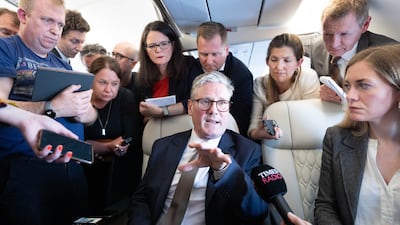
UK Prime Minister Sir Keir Starmer talks to journalists as he travels on-board a plane to Washington to attend a Nato summit. Getty Images -

Mr Starmer and his wife Victoria board the plane at Stansted Airport, north of London. AFP -
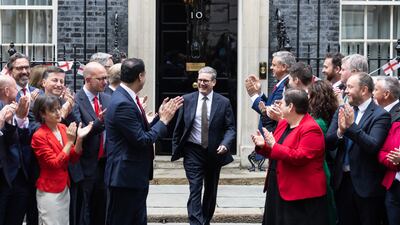
Mr Starmer meets UK legislators from the Scottish Labour Party at 10 Downing Street. Bloomberg -
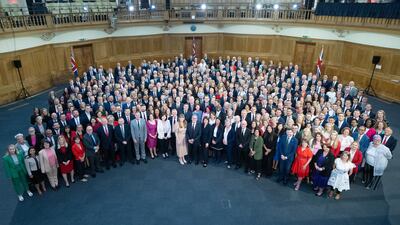
Mr Starmer, centre front, stands with Labour Party MPs at Church House in Westminster, central London. PA -

Mr Starmer and First Minister of Wales Vaughan Gething during a visit to the Senedd in Cardiff, Wales. Getty Images -

Mr Starmer with First Minister of Northern Ireland Michelle O'Neill and Deputy First Minister of Northern Ireland Emma Little-Pengelly at Stormont Castle, in Belfast. Reuters -
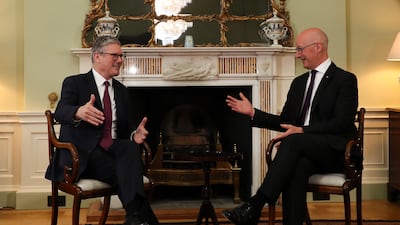
Mr Starmer meets Scottish First Minister and SNP leader John Swinney during a visit to Edinburgh. Getty Images -
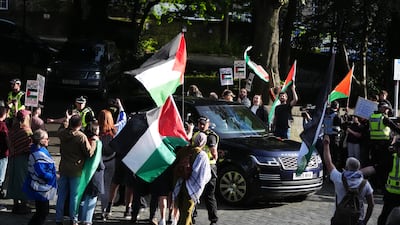
Pro-Palestinian protesters surround the convoy carrying Mr Starmer as it leaves Bute House in Edinburgh. PA -
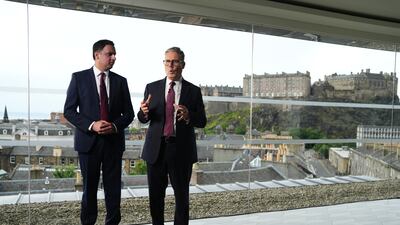
Mr Starmer and Scottish Labour Leader Anas Sarwar during an event in Edinburgh to welcome new Labour MPs in Scotland. PA -
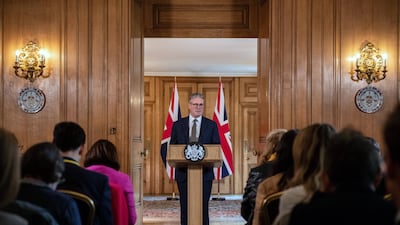
Mr Starmer delivers a news conference after his first cabinet meeting at Downing Street. EPA -
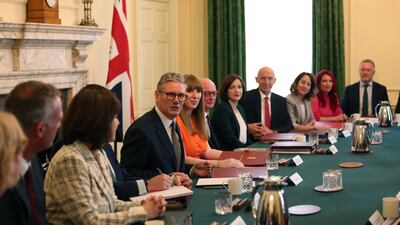
Mr Starmer chairs his first meeting of the Cabinet in Downing Street. EPA -
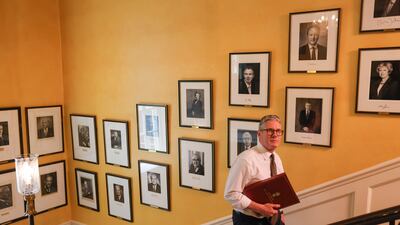
Mr Starmer walks up the steps inside 10 Downing Street. Photo: No 10 Downing Street -

Mr Starmer speaks on the phone with US President Joe Biden from his office. Photo: No 10 Downing Street -
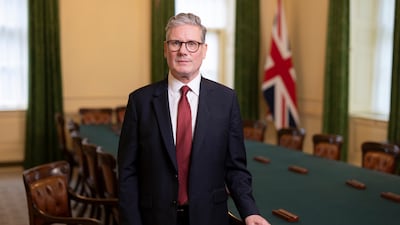
Mr Starmer poses for his official portrait upon his appointment by King Charles III. Photo: No 10 Downing Street



