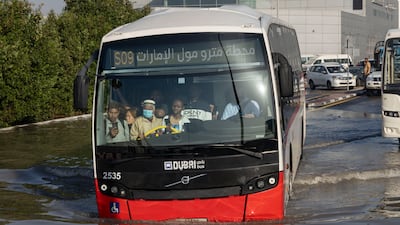
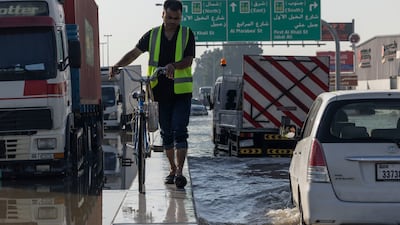
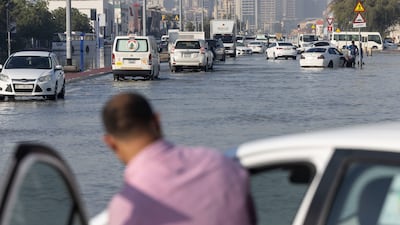
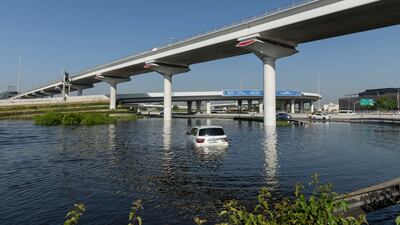
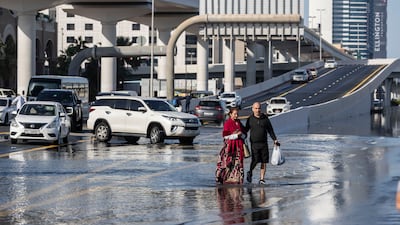
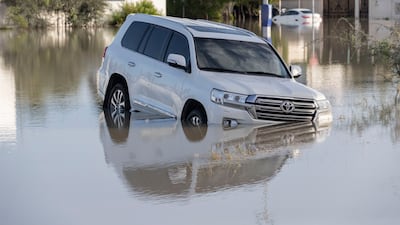
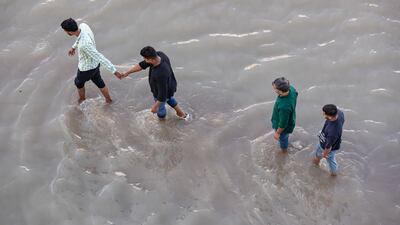
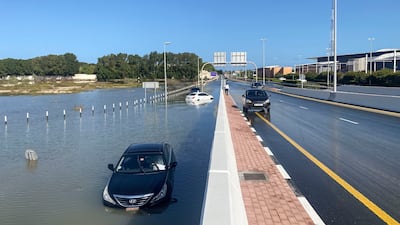
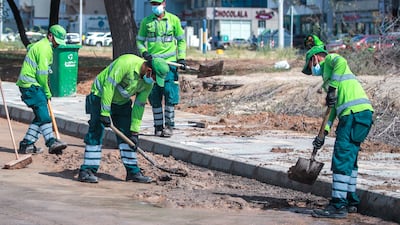
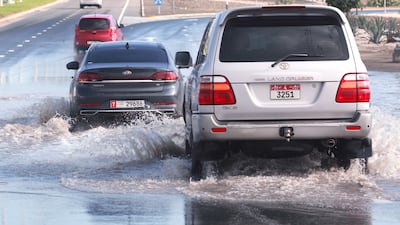
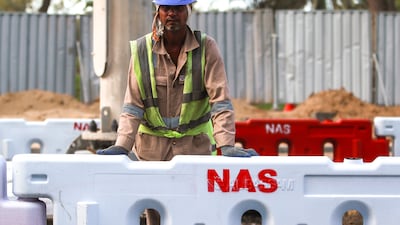
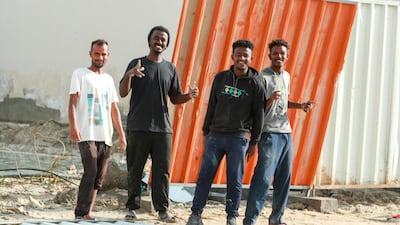
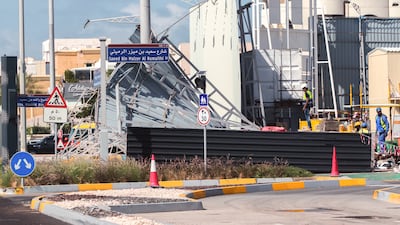
Flooded roads in Dubai after Tuesday's rain. Antonie Robertson / The National

Cloud seeding did not take place during torrential rain, UAE weather centre says


John Dennehy
  • English
  • Arabic

UAE weather live: Emirates hit by severe storms

The UAE’s weather bureau has said no cloud seeding missions took place during Tuesday’s torrential rain.

A representative for the National Centre of Meteorology confirmed to The National on Wednesday that its seeding planes had not approached the storm that saw waves of heavy rain inundating areas of the country.

Many people took to social media to speculate that the country’s cloud seeding programme – a process that attempts to coax more rain from a cloud – was responsible for the deluge.

“The NCM didn't conduct any seeding operations during this event,” it said in a statement.

We take the safety of our people, pilots and aircraft very seriously
The National Centre of Meteorology

“One of the basic principles of cloud seeding is that you have to target clouds in its early stage before it rains. If you have a severe thunderstorm situation then it is too late to conduct any seeding operation.

“We take the safety of our people, pilots and aircraft very seriously. NCM doesn't conduct cloud seeding operations during extreme weather events.”

Some reports on Tuesday attributed comments to an NCM forecaster stating seeding had taken place.

However, the bureau said planes had been in the air in the days running up to the storm but they had only “taken samples” and had not been seeding clouds.

The NCM oversees the seeding programme and has previously stated several times that it is too dangerous to use seeding planes during severe weather.

It has also previously stated that, during bouts of unsettled weather when seeding does take place, the process would not create thunderstorms.

“Some say we are responsible for storms. We are not responsible for this,” an NCM forecaster previously told The National.

“Aircraft do not go inside storm clouds if they are strong or dangerous,” the forecaster said. “All we do is try to strengthen some clouds.”

  • Persistent flooding along the D65 exit from Sheikh Zayed Road in April 16, 2024, leading into Al Quoz. Antonie Robertson / The National
    Persistent flooding along the D65 exit from Sheikh Zayed Road in April 16, 2024, leading into Al Quoz. Antonie Robertson / The National
  • Delays took place as work continued to clear roads of excess water. Antonie Robertson / The National
    Delays took place as work continued to clear roads of excess water. Antonie Robertson / The National
  • Many drivers had no choice but to abandon their waterlogged vehicles and take their chances on foot due to the record rainfall. Antonie Robertson / The National
    Many drivers had no choice but to abandon their waterlogged vehicles and take their chances on foot due to the record rainfall. Antonie Robertson / The National
  • The UAE was hit by unprecedented flooding on April 16, 2024, than it would expect to receive in more than a year, official figures revealed. Antonie Robertson / The National
    The UAE was hit by unprecedented flooding on April 16, 2024, than it would expect to receive in more than a year, official figures revealed. Antonie Robertson / The National
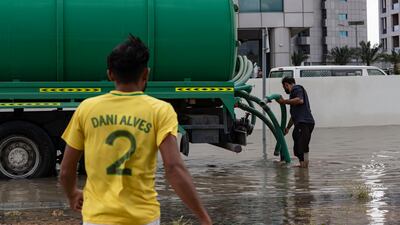
  • Standing water is removed in Dubai after a major storm. Antonie Robertson / The National
    Standing water is removed in Dubai after a major storm. Antonie Robertson / The National
  • Many cars were abandoned in Dubai due to the flooding. Antonie Robertson / The National
    Many cars were abandoned in Dubai due to the flooding. Antonie Robertson / The National
  • There was significant damage in parts of Dubai. Antonie Robertson / The National
    There was significant damage in parts of Dubai. Antonie Robertson / The National
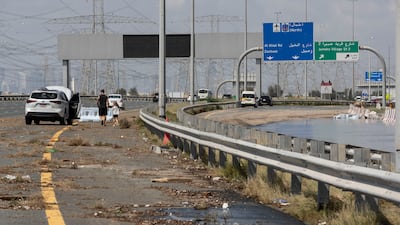
  • The aftermath of heavy flooding in Dubai, with debris and abandoned cars on the street. Antonie Robertson / The National
    The aftermath of heavy flooding in Dubai, with debris and abandoned cars on the street. Antonie Robertson / The National
  • Some roads remained waterlogged in parts of Dubai after the storm. Antonie Robertson / The National
    Some roads remained waterlogged in parts of Dubai after the storm. Antonie Robertson / The National
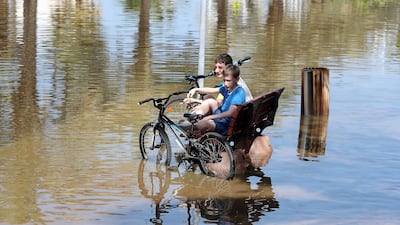
  • Children play with their bicycles along a waterlogged street in Dubai's Al Furjan district. Pawan Singh / The National
    Children play with their bicycles along a waterlogged street in Dubai's Al Furjan district. Pawan Singh / The National
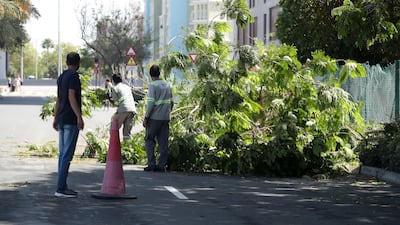
  • Workers cut a tree uprooted by heavy rains on Tuesday in Dubai. Pawan Singh / The National
    Workers cut a tree uprooted by heavy rains on Tuesday in Dubai. Pawan Singh / The National
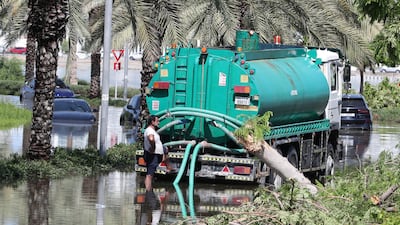
  • Water is drained from a flooded road in Al Furjan after the storm. Pawan Singh / The National
    Water is drained from a flooded road in Al Furjan after the storm. Pawan Singh / The National
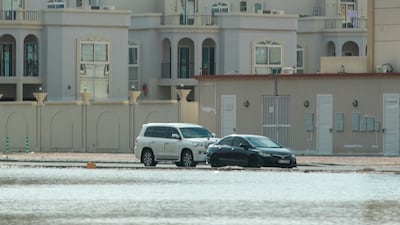
  • A flooded street in Khalifa City, Abu Dhabi, after the rain. Victor Besa / The National
    A flooded street in Khalifa City, Abu Dhabi, after the rain. Victor Besa / The National
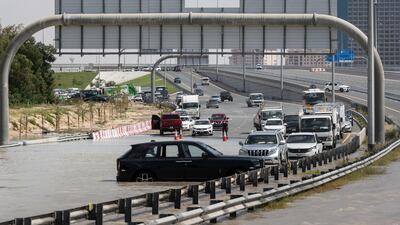
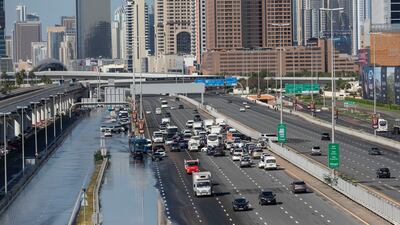
  • Heavy rain in Dubai made parts of Sheikh Zayed Road impassable. Antonie Robertson/The National
    Heavy rain in Dubai made parts of Sheikh Zayed Road impassable. Antonie Robertson/The National
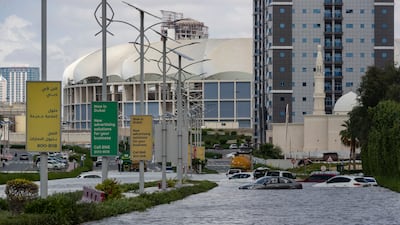
  • The storm left cars marooned on flooded streets. Antonie Robertson/ The National
    The storm left cars marooned on flooded streets. Antonie Robertson/ The National
  • Many areas became impassable due to the flooding. Antonie Robertson / The National
    Many areas became impassable due to the flooding. Antonie Robertson / The National
  • Drivers abandoned their cars at the side of roads amid high floodwaters. Antonie Robertson/ The National
    Drivers abandoned their cars at the side of roads amid high floodwaters. Antonie Robertson/ The National
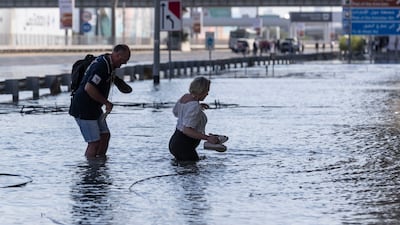
  • People attempt to navigate the floodwaters in Dubai. Antonie Robertson/The National
    People attempt to navigate the floodwaters in Dubai. Antonie Robertson/The National
  • A flooded section of road near Sheikh Zayed motorway after heavy rain. Antonie Robertson / The National
    A flooded section of road near Sheikh Zayed motorway after heavy rain. Antonie Robertson / The National
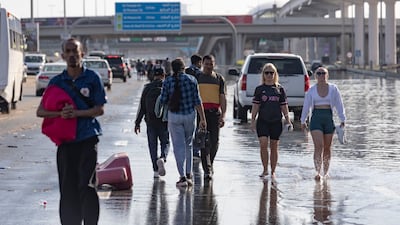
  • People in Dubai walk from their cars after high floodwaters made the road impassable. Antonie Robertson / The National
    People in Dubai walk from their cars after high floodwaters made the road impassable. Antonie Robertson / The National
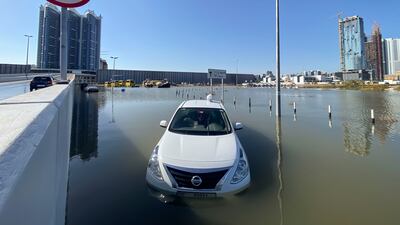
  • A partially submerged car following the heavy rain. Antonie Robertson/The National
    A partially submerged car following the heavy rain. Antonie Robertson/The National
  • Recovery work gets under way after the rain in central Abu Dhabi. Victor Besa / The National
    Recovery work gets under way after the rain in central Abu Dhabi. Victor Besa / The National
  • Large puddles and areas of water in Al Bandar in Abu Dhabi. Victor Besa / The National
    Large puddles and areas of water in Al Bandar in Abu Dhabi. Victor Besa / The National
  • Work begins after the rain in central Abu Dhabi. Victor Besa / The National
    Work begins after the rain in central Abu Dhabi. Victor Besa / The National
  • Recovery work gets under way in Khalifa City in Abu Dhabi. Victor Besa / The National
    Recovery work gets under way in Khalifa City in Abu Dhabi. Victor Besa / The National
  • Some minor damage in Khalifa City in Abu Dhabi. Victor Besa / The National
    Some minor damage in Khalifa City in Abu Dhabi. Victor Besa / The National
  • A man washes away debris after the rain in Khalifa City in Abu Dhabi. Victor Besa / The National
    A man washes away debris after the rain in Khalifa City in Abu Dhabi. Victor Besa / The National
  • Work gets under way after heavy rain hit Abu Dhabi. Victor Besa / The National
    Work gets under way after heavy rain hit Abu Dhabi. Victor Besa / The National
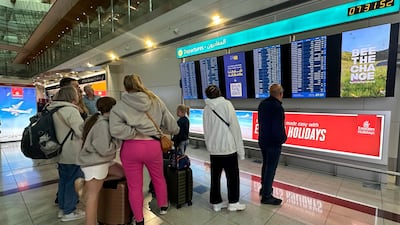
  • Passengers check flight information on screens at the Dubai International Airport. AFP
    Passengers check flight information on screens at the Dubai International Airport. AFP
  • A worker cuts through a downed tree with a chainsaw after a major storm in Dubai. AP
    A worker cuts through a downed tree with a chainsaw after a major storm in Dubai. AP
  • A car drives through floodwaters in Dubai. AP
    A car drives through floodwaters in Dubai. AP

The NCM, meanwhile, had warned from the weekend of unstable conditions that were expected to persist until Wednesday. It had predicted the worst of the weather to hit on Monday and Tuesday.

A forecaster told The National on Wednesday that ferocious rains that hit the country were caused by a warm and humid air mass from the Arabian Sea that met a cold air mass from the north-west.

“This makes for instability,” the forecaster said. “And this caused towering convective clouds over the UAE starting in the west and moving gradually to Abu Dhabi, Al Ain and then north.”

The rains came in waves over the country, hitting a torrential peak on Tuesday that brought chaos to parts of the UAE, flooding homes, submerging cars, stranding residents and delaying flights.

The country has been lashed by more rain since Sunday than it would expect to receive over several decades, official figures reveal.

The last of the rain only finished on Wednesday but the system is now moving east.

“The country is set to experience more stable weather from tonight,” the forecaster said.

“It was a very strong episode. I had not seen this type of occurrence in a long time.”

The UAE’s cloud-seeding programme started in the 1990s and is based in Al Ain.

When experts see a cloud that is suitable, a small plane is dispatched from Al Ain to “seed” the cloud, typically with salt flares that naturally attract water.

The aim is to enhance rain, not to create it. It is hard to quantify exactly how much rain falls as a result of the process.

The NCM, which overseas the operation, has said more research is needed to determine its true impact.


Ten tax points to be aware of in 2026

1. Domestic VAT refund amendments: request your refund within five years

If a business does not apply for the refund on time, they lose their credit.

2. E-invoicing in the UAE

Businesses should continue preparing for the implementation of e-invoicing in the UAE, with 2026 a preparation and transition period ahead of phased mandatory adoption. 

3. More tax audits

Tax authorities are increasingly using data already available across multiple filings to identify audit risks. 

4. More beneficial VAT and excise tax penalty regime

Tax disputes are expected to become more frequent and more structured, with clearer administrative objection and appeal processes. The UAE has adopted a new penalty regime for VAT and excise disputes, which now mirrors the penalty regime for corporate tax.

5. Greater emphasis on statutory audit

There is a greater need for the accuracy of financial statements. The International Financial Reporting Standards standards need to be strictly adhered to and, as a result, the quality of the audits will need to increase.

6. Further transfer pricing enforcement

Transfer pricing enforcement, which refers to the practice of establishing prices for internal transactions between related entities, is expected to broaden in scope. The UAE will shortly open the possibility to negotiate advance pricing agreements, or essentially rulings for transfer pricing purposes. 

7. Limited time periods for audits

Recent amendments also introduce a default five-year limitation period for tax audits and assessments, subject to specific statutory exceptions. While the standard audit and assessment period is five years, this may be extended to up to 15 years in cases involving fraud or tax evasion. 

8. Pillar 2 implementation 

Many multinational groups will begin to feel the practical effect of the Domestic Minimum Top-Up Tax (DMTT), the UAE's implementation of the OECD’s global minimum tax under Pillar 2. While the rules apply for financial years starting on or after January 1, 2025, it is 2026 that marks the transition to an operational phase.

9. Reduced compliance obligations for imported goods and services

Businesses that apply the reverse-charge mechanism for VAT purposes in the UAE may benefit from reduced compliance obligations. 

10. Substance and CbC reporting focus

Tax authorities are expected to continue strengthening the enforcement of economic substance and Country-by-Country (CbC) reporting frameworks. In the UAE, these regimes are increasingly being used as risk-assessment tools, providing tax authorities with a comprehensive view of multinational groups’ global footprints and enabling them to assess whether profits are aligned with real economic activity. 

Contributed by Thomas Vanhee and Hend Rashwan, Aurifer

MATCH INFO

Uefa Champions League semi-final, first leg
Bayern Munich v Real Madrid

When: April 25, 10.45pm kick-off (UAE)
Where: Allianz Arena, Munich
Live: BeIN Sports HD
Second leg: May 1, Santiago Bernabeu, Madrid

The Perfect Couple

Starring: Nicole Kidman, Liev Schreiber, Jack Reynor

Creator: Jenna Lamia

Rating: 3/5

Jetour T1 specs

Engine: 2-litre turbocharged

Power: 254hp

Torque: 390Nm

Price: From Dh126,000

Available: Now

The five pillars of Islam

1. Fasting

2. Prayer

3. Hajj

4. Shahada

5. Zakat 

COMPANY PROFILE
Name: HyperSpace
 
Started: 2020
 
Founders: Alexander Heller, Rama Allen and Desi Gonzalez
 
Based: Dubai, UAE
 
Sector: Entertainment 
 
Number of staff: 210 
 
Investment raised: $75 million from investors including Galaxy Interactive, Riyadh Season, Sega Ventures and Apis Venture Partners
Who's who in Yemen conflict

Houthis: Iran-backed rebels who occupy Sanaa and run unrecognised government

Yemeni government: Exiled government in Aden led by eight-member Presidential Leadership Council

Southern Transitional Council: Faction in Yemeni government that seeks autonomy for the south

Habrish 'rebels': Tribal-backed forces feuding with STC over control of oil in government territory

ARGYLLE
%3Cp%3EDirector%3A%20Matthew%20Vaughn%3C%2Fp%3E%0A%3Cp%3EStarring%3A%20Bryce%20Dallas%20Howard%2C%20Sam%20Rockwell%2C%20John%20Cena%3C%2Fp%3E%0A%3Cp%3ERating%3A%203%2F5%3C%2Fp%3E%0A
The years Ramadan fell in May

1987

1954

1921

1888

Try out the test yourself

Q1 Suppose you had $100 in a savings account and the interest rate was 2 per cent per year. After five years, how much do you think you would have in the account if you left the money to grow?
a) More than $102
b) Exactly $102
c) Less than $102
d) Do not know
e) Refuse to answer

Q2 Imagine that the interest rate on your savings account was 1 per cent per year and inflation was 2 per cent per year. After one year, how much would you be able to buy with the money in this account?
a) More than today
b) Exactly the same as today
c) Less than today
d) Do not know
e) Refuse to answer

Q4 Do you think that the following statement is true or false? “Buying a single company stock usually provides a safer return than a stock mutual fund.”
a) True
b) False
d) Do not know
e) Refuse to answer

The “Big Three” financial literacy questions were created by Professors Annamaria Lusardi of the George Washington School of Business and Olivia Mitchell, of the Wharton School of the University of Pennsylvania. 

Answers: Q1 More than $102 (compound interest). Q2 Less than today (inflation). Q3 False (diversification).

Updated: April 17, 2024, 2:54 PM