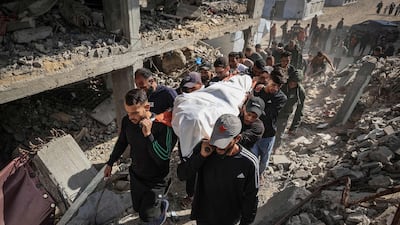

The Israeli army has said it “eliminated” at least seven people it claimed were Hamas operatives in the past week, including some who allegedly participated in the attacks on October 7, 2023.
Hamas on Thursday confirmed that Gaza's Deputy Minister of Education, Khaled Mahmoud Abu Nada, had been killed with his wife in an attack on a residential building in Deir Al Balah. It also confirmed that the head of the group's internal security apparatus, Mohammad Abu Al Awf, had been killed the day before, along with his wife and three children, in another targeted attack.
In a separate incident on Friday, witnesses said Hamas political chief Khalil Al Hayya's son was among those targeted in an attack on a residential apartment in Gaza. Hamas called it an “attempted assassination”, indicating the son had survived. Local media named him as Ezzeddin Al Hayya.
Khalil Al Hayya had on Thursday called on Palestinian political factions to unite to face the continuing Israeli violations of a ceasefire agreement brokered in October 2025. Hamas has not officially launched an attack on Israel or Israeli forces since.
Israel's army also claimed it took measures to “mitigate harm to civilians”. At least 1,679 people have been killed and 6,100 injured in Israeli attacks since the ceasefire, bringing the total death toll of Palestinians in Gaza since the war broke out to more than 74,000.
“Israel’s deliberate daily massacres and assassinations in Gaza and pushing the displaced Palestinians into a congested and unlivable 30 per cent of an already densely populated small strip of land under siege are not only evidence of depravity and criminality; they are manifestations of an ongoing genocide,” said veteran Palestinian politician, academic and activist Hanan Ashrawi.
Humanitarian conditions remain dire, particularly as a season of rain and lower temperatures looms for the enclave, where most of the population of more than two million has been displaced in the face of Israeli attacks. At least 80 per cent of Gaza's buildings have been damaged since the conflict began with the Hamas-led attacks in 2023.
Danny Citrinowicz, senior fellow at Israel's Institute for National Security Studies and a former senior Israeli military intelligence commander, says he is not surprised at the developments. “I don't see this as a new development, but rather as a continuation of [Israeli Prime Minister Benjamin] Netanyahu's existing policy towards Gaza,” he told The National.
The Israeli government has also been criticised for not moving forward with plans agreed on under the Board of Peace. The board's senior adviser Josh Gruenbaum told Israeli outlet Ynet on Friday that the body “will hand the keys” of Gaza to the UN if Israel continues to obstruct plans to rebuild the enclave.
“In my assessment, Netanyahu has never been genuinely committed to implementing Trump's plan in its entirety, particularly its political components and the transition towards a sustainable postwar arrangement in Gaza,” Mr Citrinowicz added.
Mr Netanyahu has long branded himself as a security-first prime minister. Israel's campaign in Gaza indicates Mr Netanyahu has not changed his stance, especially under public scrutiny for the apparent security failures during the October 7 attacks in which around 1,200 people were killed in Israel.
“He likely sees these operations as a means of reinforcing his security credentials, both domestically and internationally, particularly in light of the damage that October 7 inflicted on his reputation. Whether this translates into actual political gains is another question,” Mr Citrinowicz said.

