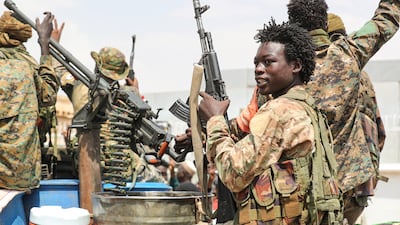
Sudan has been left out of a new group of African countries at the intergovernmental body that aims to eliminate chemical weapons amid scrutiny of army attacks during the country's civil war.
An African slate comprising Morocco, Angola, Cameroon, Tanzania and Tunisia of the Organisation for the Execution Council of the Prohibition of Chemical Weapons (OPCW) was approved on Tuesday by the Conference of the States Parties.
It replaces the previous representation that included Sudan's army-aligned authorities.

The development comes as the OPCW examines allegations of chemical weapons use by the Sudanese Armed Forces in the conflict with the paramilitary Rapid Support Forces, which erupted in April 2023.
OPCW director general Sabrina Dallafior said on Tuesday that Sudan's situation was before the body's executive council, with some members requesting clarification under an article of the Chemical Weapons Convention.
She added that she had met Sudanese representatives and offered technical assistance to support a national investigation, and that the organisation was awaiting its findings.
“It is disappointing that despite concerns being raised in the OPCW and media reporting of the allegations, so far, no detailed information has been shared with the secretariat,” Ms Dallafior said. She urged members to share any relevant evidence, even if it was done so confidentially.
The allegations gained prominence in January 2025, when The New York Times reported that US officials had concluded the army had used chemical weapons on at least two occasions against the RSF in 2024. Washington formally determined in May 2025 that Sudan's government had used chemical weapons in violation of international law and announced sanctions.
Subsequent investigations by The New York Times and The Washington Post in September outlined how the army, led by Gen Abdel Fattah Al Burhan, developed a chemical weapons programme, tested bombs in the country's desert and built up a secret stockpile before attempting to conceal the operation and cover its tracks.
The dossier of evidence included photographs, videos and messages documenting how the military developed and produced chemical weapons over a six-month period in 2024.
The war between the army and the RSF, now in its fourth year, has created one of the world’s worst humanitarian crises, killing at least 59,000 people, displacing about 14 million and pushing parts of the country into famine, according to aid organisations. Both sides have been accused by the UN of war crimes and human rights violations.

