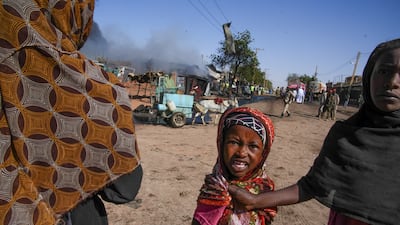

The Sudanese army and allied forces are advancing towards a key Rapid Support Forces stronghold in West Kordofan, a region increasingly affected by deadly drone attacks, displacement and worsening humanitarian conditions.
The Sudanese Armed Forces, led by Gen Abdel Fattah Al Burhan, captured Al Khuway last week and have since pushed towards Al Nuhud, a major RSF-held city and an important commercial centre in the state, according to conflict monitor Acled. They were reported to have advanced to within about 60km of Al Nuhud by Tuesday, it said in an analysis.
Since the beginning of November, the SAF and allied groups have regained control of more than 30 villages and towns across North and West Kordofan, said Ali Mahmoud Ali, Acled's Sudan analyst. The latest advances have put pressure on RSF positions in territory the paramilitary group has controlled since May 2025, threatening areas it has used to launch attacks against army-held positions, he said.

The developments come as the UN warns of a sharp rise in civilian casualties from drone attacks across Sudan. Acled said the SAF’s advances have been supported by extensive ground operations and air strikes.
“The current operations are part of a campaign that started in July 2026, when SAF launched an offensive linking Khartoum with Al Obeid through the Exports Road. The army then expanded to villages north of the Exports Road, heading west towards Mazrub and Sodari, and from there SAF made its first advances in West Kordofan by controlling Iyal Bakhit,” he added.
On Tuesday, the army and their allies reportedly advanced in three districts of West Kordofan as RSF fighters withdrew. Troops carried out operations in villages across Al Khuway and areas north and east of Al Nuhud and Abu Zabad. The SAF also said it had seized Al Saatat, north-east of Abu Zabad, on Monday.
Mr Ali claimed that battlefield losses and a wave of defections among RSF commanders were weakening the group’s internal structure and its ability to defend territory. This could leave it increasingly vulnerable to further army advances, potentially extending as far as Darfur, he added.

Civilian toll
Emergency Lawyers, a Sudanese rights group that tracks violence throughout the civil war, said an army air strike killed at least 13 people, including women and children, and destroyed several homes in the Abu Qalb area of Abu Zabad this week.
The war between the SAF and RSF has created one of the world’s worst humanitarian crises since it broke out in April 2023, killing at least 59,000 people, displacing around 14 million and pushing parts of the country into famine, according to aid organisations.

Much of the fighting has been concentrated in Darfur and Kordofan and recently shifted towards Blue Nile province. Both the SAF and the RSF have been accused by the UN of war crimes and human rights violations.
Drone warfare has emerged as a particularly deadly threat to civilians. More than 1,630 civilians were killed in drone strikes in Sudan between January and October, accounting for nearly 73 per cent of the 2,230 civilian deaths verified by the UN Human Rights Office during that period. The actual toll is likely to be higher, the office said in a report published on Wednesday.
At least 1,390 civilians were killed between January and June, with more than 80 per cent of those deaths attributed to drone strikes. A further 840 civilians were killed between July and October, including nearly 520 in drone attacks.
The Kordofan region accounted for more than two-thirds of documented civilian casualties, making it the worst-affected area, followed by Darfur, the UN said.
Markets, hospitals, schools, fuel supplies, water sources, displacement sites and civilian vehicles have all been hit, with some locations struck repeatedly. The attacks have further undermined access to food and essential services in areas already with severe humanitarian needs.
The UN report also documented 29 drone strikes attributed to the RSF against electricity facilities and fuel stations across 11 states between October 20 and November 4. The attacks caused widespread power cuts and fuel shortages, disrupting health care, water supplies and food production.
Last month, the UN Independent International Fact-Finding Mission for Sudan found that the SAF had significantly expanded its drone capabilities through foreign-supplied systems since late 2023, documenting at least four waves of attacks on hospitals, markets and other civilian locations where civilian presence was substantial or foreseeable.

