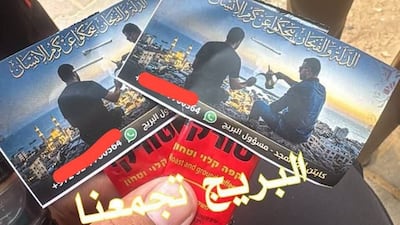

Israeli quadcopter drones have dropped leaflets with small packets of coffee and cigarettes attached over parts of the Gaza Strip, urging Palestinians to contact numbers said to belong to Israeli security services.
Residents reported the leaflets being dropped in Gaza city, Deir Al Balah and other areas. Some bore WhatsApp numbers and messages inviting residents of the territory to request assistance or provide information about Hamas and other Palestinian armed groups.
Others displayed the names and photographs of Palestinian figures killed in Israeli attacks since the war began in October 2023, or who are believed to remain Israeli targets.

The message printed on one the leaflets reads: “The coffee pot and cup speak of a person’s generosity.”
The distribution of cigarettes in particular provoked anger and ridicule among Palestinians, who said they remained scarce because Israel has been preventing their entry through official border crossings for more than a year.
Moamen Abu Ajwa, 35, a greengrocer displaced from Gaza city to Deir Al Balah, said drones dropped the leaflets over the city’s market around noon on Monday.
“A cigarette and packet of coffee were attached to each leaflet in an attempt to win people over and encourage them to make contact,” Mr Abu Ajwa told The National.
He said residents rushed to collect the leaflets, but only because of the items attached. “We did not do so because we wanted to contact the Israeli military, we did so to get the cigarettes.”

Mr Abu Ajwa described the combination of recruitment messages and small gifts as a contradiction. The leaflets promised assistance and what they described as a better life, he said, while also asking residents to provide information about members of Palestinian armed groups.
The leaflet campaign comes as most of Gaza's 2 million-plus population faces another winter without adequate shelter, clothing or supplies since the war began on October 7, 2023 with a deadly Hamas-led attack on Israel.
Israel continues to restrict the entry of essential items and carry out attacks in the territory despite a ceasefire agreement with Hamas in October reached last year. The overall Palestinian death toll since then has risen by more than 1,600 to nearly 75,000, most of them civilians, Gaza's Health Ministry said.
“Those who destroyed our homes, displaced us and left us to live in tents can’t suddenly claim to care about us or seek to improve our mood with coffee and a cigarette,” Mr Abu Ajwa said.
Leaflets were also reportedly dropped near Al Saraya and in the Nasser neighbourhood of Gaza city.
Amir Nofal, 29, a resident of Jabalia refugee camp, said he saw the leaflets falling near Al Saraya and people rushing to retrieve the attached items. Residents treated the messages with ridicule, he said, tearing up or burning the leaflets after taking the cigarettes and coffee.
“The Israeli military, which fires shells at us every day and shoots at us constantly, has suddenly become compassionate and concerned for our welfare?” he said.
He described the drops as an attempt to recruit collaborators while presenting Israel as concerned about the welfare of Gaza’s population.
“It is true that some vulnerable people may be susceptible to such tactics, but the overwhelming majority fully understand Israel’s objective and will not engage with it, regardless of how desperate their circumstances become,” he said.
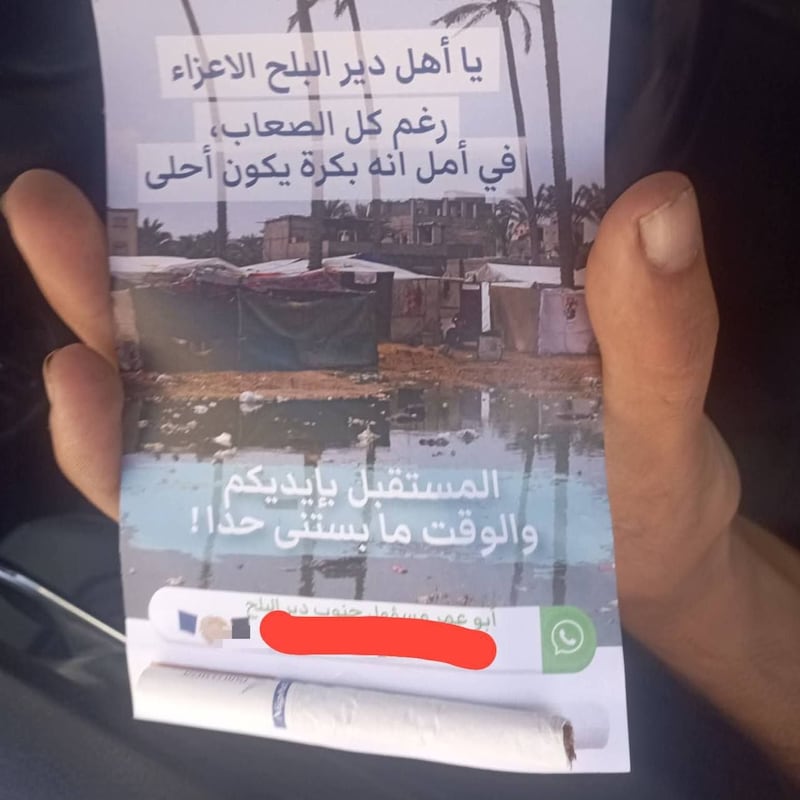
Palestinian security authorities have warned residents not to call the numbers printed on the leaflets.
An officer with Gaza’s Internal Security service said similar materials have been dropped in recent months with cigarettes, coffee or chocolate attached.
The officer claimed a small number of Palestinians seeking humanitarian assistance had contacted the advertised numbers and were subsequently drawn into working for Israeli intelligence without initially understanding what was happening.
“We have dealt with several such cases, but they remain limited and should not be generalised,” he told The National. “The overwhelming majority of Palestinians in Gaza are not deceived by Israel’s tactics and methods.”
The officer said images of people rushing towards the packages should not necessarily be interpreted as support of Israel or interest in co-operation. Instead, he said, the scenes reflected the extreme shortages facing Gaza’s population.
Mr Abu Ajwa said if Israel was concerned about living conditions in Gaza, it should allow supplies to enter through the border crossings rather than distribute items alongside recruitment appeals.
“Israel prevents cigarettes from entering through official channels while sending them to us with leaflets encouraging us to make contact,” he said. “It should open the crossings and allow all the necessities of life to enter Gaza.”

