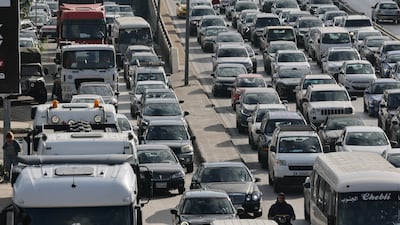

Protests by public transport drivers caused traffic chaos across Lebanon on Wednesday, as they demanded more government support, including fuel subsidies.
Taxi, bus and lorry drivers were among the transport workers staging demonstrations in the capital, Beirut, as well as the major cities of Tripoli, Sidon and Baalbek, and other areas.
The drivers accuse the state of failing to keep promises to support transport workers. They are also calling for action against unlicensed operators, particularly motorcycle taxis that offer a cheaper alternative as rising fuel prices push up fares for larger vehicles.

Vehicles operating as public transport are supposed to have a red licence plate that costs a substantial amount to obtain – a fee that unlicensed drivers do not pay. Foreign drivers working in transport, most of whom are from neighbouring Syria, are another sore point.
In Beirut, drivers parked their vehicles on the road linking Riad Al Solh to Martyr's Square on Wednesday morning, blocking the usually busy thoroughfare.
“It’s been a long time since we’ve seen something like this,” Bassam Tlaiss, the head of the powerful Land Transport Unions and Syndicates, told The National from Riad Al Solh Square, in front of the Grand Serail that houses Prime Minister Nawaf Salam's government headquarters.
“Today we are not just here, we are all over Lebanon,” he added. “It’s a peaceful movement and a message to our politicians and to the Lebanese state about the importance of applying this law in order to protect this sector.”

The protests triggered a widespread security response, although the demonstrations were peaceful and no clashes were reported.
“If the government had kept its promises, we wouldn't be in this situation,” Mr Tlaiss told a press conference. Wednesday's protest was “just the beginning”, he said. Protesters said they would demonstrate again in a week's time if their demands were not met.
A devastating economic crisis, which first became apparent in 2019, has pushed much of Lebanon's population below the poverty line and led to widespread inflation that salaries have not kept up with.
The conflict between Israel and the Lebanese armed group Hezbollah, which spiralled into all-out wars in 2024 and this year, has worsened the economic situation and displaced tens of thousands of people.

