
A Gulf consortium has started work to rebuild Syria's main road network, Transport Minister Yarub Badr told The National, as the country becomes a focal point of regional plans to bypass the Strait of Hormuz.
The consortium, composed of major Saudi, Qatari and Kuwaiti companies, has already dug up a section of the north-south motorway, known as the M5, south of Damascus, Mr Badr said. At least part of the costs of the project will be covered by a three-year, $670 million government allocation for roads, he added.
The M5 stretches from the Jordanian-Syrian border to Damascus and continues further north through Homs, Hama and Aleppo towards the border with Turkey. It also connects to the M4 motorway, the main road from Aleppo to the port city of Latakia.

“It will be a full rehabilitation”, Mr Badr said on the sidelines of an EU-Jordan investment conference, held near the Dead Sea on Thursday. The revamped M5 will have lighting, signs and safety rails that conform to international standards, he said.
After former president Bashar Al Assad's regime was toppled in December 2024 and western powers lifted sanctions, Gulf states moved quickly to invest in Syria’s future, offering diplomatic, financial and infrastructure support.
In April, Syria, Turkey and Jordan agreed to develop a “north-south” transport route, with a modernised motorway system that is to be linked to the Saudi rail network. Riyadh announced that a feasibility study for the railway was to be completed by the end of this year.
If the project goes forward, despite political and security issues, cargo would flow either by land directly to Europe, or to Syrian and Turkish ports, then on to Europe and beyond.
The UAE has also launched initiatives in Syria. In May, both countries convened the first bilateral business forum, with a large Emirati delegation of officials and businessmen arriving in the Syrian capital. In May, officials from the UAE and Abu Dhabi Ports Group also held talks with Syrian officials on a route linking the Emirates to Syria through Iraq.
The Gulf consortium comprises Kuwait’s Combined Group Contracting Company, Saudi Arabia's Al Rawaf Contracting Company, as well as Qatar's Al Jaber Group and Al Mohannadi Group, Mr Badr said. “Road links are the fastest to revitalise. Railways need more time,” Mr Badr said, adding that the World Bank is to provide $200 million to repair the most heavily damaged sections of Syria's railway network.
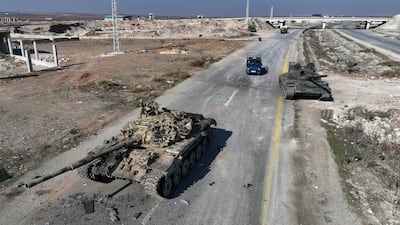
The 465km M5 starts from the Nasib border crossing with Jordan and links the major Syrian cities of Damascus, Homs, Hama and Aleppo. It was damaged during the civil war and sustained decades of neglect before the conflict. However, it was a main route for container traffic from Europe to the Middle East.

Two roads that branch from the M5 to the Baba Al Hawa and Bab Al Salama border crossings will also be restored, Mr Badr added.
The Iran war has thrust the Syrian route into the limelight after the Strait of Hormuz was blocked by Tehran, affecting supplies worldwide. The project coincides with a Syrian investment push to rebuild an economy devastated by 13 years of civil war.
In February, Syria embarked on a protectionist measure to revive its overland transport sector. The entry of goods and lorries from neighbouring countries was banned, delaying cargo traffic through border crossings.
A February 6 decree banned lorries from Turkey, Iraq, Jordan and Lebanon from entering Syria to deliver cargo. They were required to transfer the goods on to Syrian lorries at border crossings, which shippers said were not equipped to handle the change.
Mitigating measures were agreed to between Syria and Turkey, as well as Syria and Lebanon, while congestion continued at the Nasib crossing with Jordan. "The bottleneck at Nasib is related to customs procedures," Mr Badr said. "They need more effort to be solved."

