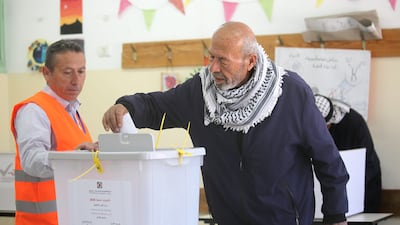

More Palestinians blame their leadership rather than Israel for the postponement of elections that were scheduled for this month, a poll has found.
Almost a third of Palestinians in the occupied West Bank said they held Mahmoud Abbas, the Palestinian Authority President, responsible for postponing the legislative elections last month. About one in five blamed Israel, said Obada Shtaya, co-founder of the Institute for Economic and Social Progress.
Two thirds of the West Bank population opposed the deferment, with most stating that “elections are a citizen’s right”, Mr Shtaya said, citing new polling that is set to be published by the International Society for Electrostatic Precipitation (ISESP) later on Tuesday.

A third of those surveyed believed postponing the poll was necessary, he said.
Mr Abbas blamed Israel when he cancelled elections planned for November 28 and rearranged them for September next year. He said conditions in East Jerusalem, the West Bank and Gaza Strip were not conducive to holding the vote, noting that Israel had not allowed election materials or international observers to enter Gaza.
Experts agree that Israeli settler violence in the West Bank and the humanitarian crisis in Gaza would have inhibited the electoral process, but highlight the growing frustration among Palestinian youth towards the political elite.
Mr Shtaya warned the postponement had led to “extreme levels of disappointment”.
“One of the major consequences of the postponement to the election is even less trust in the leadership or in any systematic institutional process [to] bring about change,” he said, speaking at foreign affairs think tank Chatham House in London.
“[This] is a really dangerous sign, of course, because elections were one of the few tools that are left out there for Palestinians to express themselves and also to bring about renewal,” he said.

Palestine’s political process has been frozen since Palestinians in Gaza elected Hamas as their leaders in 2006 – a result which the international community rejected, prompting a civil war between Hamas and Fatah the following year.
The last scheduled legislative elections in 2021 were postponed by the PA because of Israel’s refusal to allow Arab residents of Jerusalem to vote.
“Palestinian youth expressed frustration about the lack of space of political life, a lack of space for political access, for political activities,” said Zizette Darkazally, a fellow of Chatham House's Middle East and North Africa Programme.
“They said politics are monopolised by factions and an older generation, the old guard,” she said.
Of the 2.9 million eligible Palestinian voters, more than 45 per cent are aged between 18 and 35 – meaning they were not old enough to vote in the last 2006 election, Ms Darkazally said.
The PA's explicit commitment to elections is key to its relationship with western governments, many of which have recently become more vocal against Israel's occupation.
The postponement drew widespread condemnation from governments in the West. The foreign ministers of the UK, Australia, Canada and France issuing a joint statement calling on the PA to reconsider.
There is hope that sanctions imposed by western governments pm Israel's illegal settlement expansion could help create more favourable conditions for elections.
British Foreign Secretary Ed Miliband announced a new round of sanctions on Tuesday targeting eight Israeli construction and property development companies operating in the West Bank.
The UK government also imposed sanctions on the Israeli protest movement Tzav 9, which has organised demonstrations against humanitarian aid deliveries to Gaza.
That announcement came shortly before the deadlines for tenders to the controversial E1 settlement project in the West Bank and drew on the UK’s expansion of its Global Human Rights sanctions regime.
“The movements and mobilisation of people on the ground pushed some governments, including the UK government, to take some action against the Israeli policies. But is it enough?” said Ashraf Khatib, co-founder of the ROA Centre for Political and Strategic Studies.

