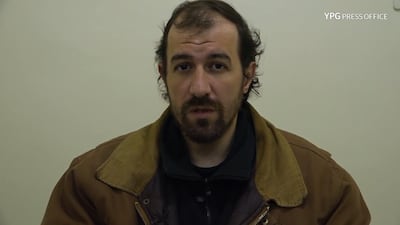

A Frenchman who converted to Islam before travelling to Syria in support of ISIS expressed contrition before a court in Iraq on Sunday, saying he regretted joining the group.
Thomas Barnouin, whose career as an extremist stretches back to the 2000s, appeared before the court in Baghdad almost nine years after he was captured by Kurdish forces in Syria.
Mr Barnouin, 45, is one of 47 French detainees transferred to Iraq last year. He is the first to appear in court whose involvement dates back to the Iraqi insurgency of the 2000s, marking a shift in the trials of French ISIS members. Ten other French nationals were sentenced to long prison terms last week.
A French citizen of Christian origin, the son of teachers from Toulouse, Mr Barnouin pleaded guilty at Karkh Criminal Court to belonging to ISIS and participating in terrorist acts threatening public peace and endangering lives. Speaking from a wooden defendant's cage, he said he was lured to Syria by propaganda about the war against Bashar Al Assad.
“In 2012 the propaganda was strong to fight against Bashar Al Assad within factions like Jabhat Al Nusra and Ahrar Al Sham,” he said, wearing an orange prison jumpsuit. “As we see it, it is a religious duty as a Muslim to defend your religion.”

He travelled to Syria to join ISIS in 2014 and was first deployed to Latakia on the coast, where fighting was taking place against the Assad government and other factions. Going by the codename Abu Ahmed Al Faransi, he said he was trained in Sharia and military matters.
By mid-2014, he was transferred to the translation office of Al Hayat Media Centre in Raqqa province – a major propaganda arm of ISIS. Like other French defendants who have appeared before the same court in recent weeks, Mr Barnouin sought to distance himself from the group's acts.
“There were assassinations and disputes inside the organisation. They were operating by the law of the jungle, not the law of God. I am convinced by this statement and not because I am in front of the court,” he said.
He said he was arrested more than once by ISIS for criticising the group. As a punishment, they transferred him to another province. “I started reading the whole system anew and with new eyes,” he told the judge.
He was later moved to Al Mayadeen where he worked as an imam. But he added: “Many foreigners came to Syria for the Syrian cause, and we were ignorant of many things on the ground”.

Earlier career
Mr Barnouin is part of a different generation from most of the 47 French citizens transferred from Syria to Iraq last year, most of whom were radicalised around 2013 or 2014.
He told the court he had been influenced by Wahhabism and Salafist thought since the late 1990s, before converting to Islam around 2000. He was first flagged by intelligence services in Toulouse in 2002.
In 2003, he left France to study theology, jurisprudence and Arabic in Madinah in Saudi Arabia. Instead of returning to France, he slipped into Syria via Jordan and tried to cross into Iraq to fight US and Iraqi government forces with an insurgent group, Al Mujahideen Army, according to evidence presented to the court last week.
He was arrested by the Syrian authorities and handed over to French authorities. In 2009 in Paris he was sentenced to five years in prison, one suspended, for belonging to the so-called Artigat network and recruiting young men for extremism.

Released in 2011, he reconstituted a cell in the Toulouse area before heading to Syria, it is alleged. He was captured in December 2017 by a Kurdish militia in Hasakah near the Iraqi border, along with six other French extremists.
Contrition in court
In court, he struck a contrite tone, echoing the denials heard from other French defendants who told the court they assumed administrative roles and never fought.
“I carry now my regret and my sorrows. I did not participate in criminal operations, and I condemned them,” Mr Barnouin said. “I deeply regret joining this organisation and I am ashamed before myself and my family and my children,” he said.
“I lived in this organisation, and I saw it from inside. This organisation used to torture opponents. I know the crimes of this organisation – it has no religion and no morals,” he added.
He also questioned his transfer to Iraq and his trial in a country he hadn't set foot in for years after his time in Kurdish detention.
“I spent nine years in detention and did not see my family or call them. I am as good as dead and the cell I am in is like a coffin. Certainly, the treatment here is better than in Syria, but why was I transferred to Iraq? Do I have the right to this question?” he said.
The judge, Mohammed Salman, replied: “Iraqi law allows us to try you for joining a terrorist group.” A verdict in Mr Barnouin's case is expected on November 18.

