Israel goes to the polls on Tuesday in one of the most momentous elections in its history as voters deliver their verdict on Prime Minister Benjamin Netanyahu's wartime leadership.
Mr Netanyahu is seeking re-election after a four-year term defined by the catastrophic security failure of the October 7, 2023 attacks, Israel's destructive war in Gaza and its subsequent campaigns in Lebanon, Iran and across the region.
Polls suggest a close race that could result in long coalition talks just as Middle East countries try to restore stability. Forecasters give Gadi Eisenkot, a former top general, the best chance of unseating Mr Netanyahu from a range of opposition candidates.

Voters from the country's Arab minority could play a key role. Political sources have told The National their turnout is expected to be “astronomical”. Senior opposition officials have also said there is a possibility of a coalition or agreement for a minority government with the Arab parties.
“After what they have witnessed over the past three years, they have understood the difference between bad and worse,” said an Israeli political observer, referring to the hard-right parties that have shaped Mr Netanyahu's government.
Voting centres close at 10pm Israeli time on Wednesday, when exit polls will give a first indication of the results. Preliminary results will emerge as votes are counted overnight.
Opposition supporters used the campaign's final days to call for a call for a formal inquiry into the October 7 attacks, something Mr Netanyahu has resisted.
He has countered with steps to underline his hardline security stance, from warning of a "second Holocaust" if Iran is allowed to rearm, to ordering an operation of questionable military value in the occupied West Bank.
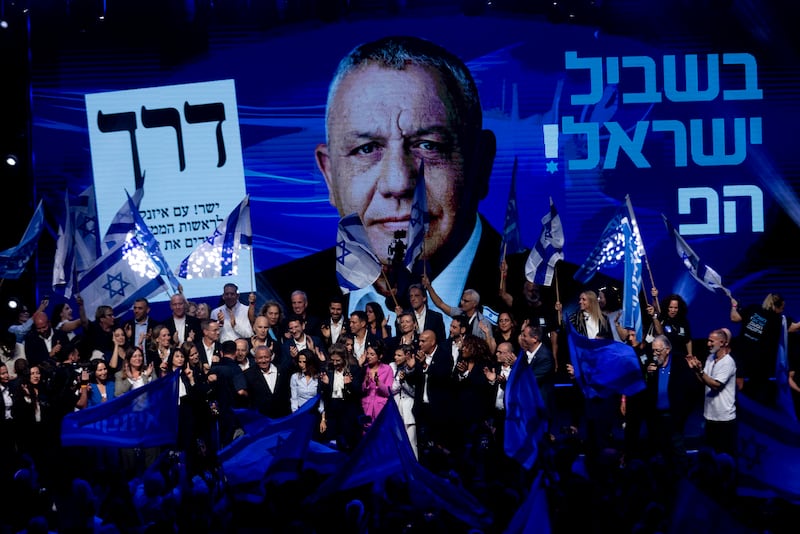
With Israel's standing abroad badly damaged, notably by its devastating campaign in Gaza and settlement expansion in the West Bank, Mr Netanyahu has quoted support from US President Donald Trump as a key sellling point. Mr Trump sent a late message of endorsement, hailing "a great relationship in winning together".
Mr Eisenkot has kept his policies vague, running on a brand of down-to-earth honesty. But most of the main candidates hold belligerent views towards Iran and few are enthusiastic about the idea of a Palestinian state, although some have offered hints of conciliation. An alliance of former prime ministers Naftali Bennett and Yair Lapid has declined in the polls.
Gazans have expressed little optimism about the vote. Palestinian political analyst Mustafa Ibrahim said he did not believe the situation would change significantly whether Mr Netanyahu wins or loses. Many Gazans are nonetheless hoping he loses, holding him responsible for mass destruction of the territory during a war that has killed more than 70,000 people.

About 7.3 million Israelis are eligible to vote for the 120-member Knesset. There are 36 parties running, although most are not expected to win enough votes to enter parliament.
Israel has a history of political deadlock. Between 2019 and 2022, the country held five elections as parties repeatedly struggled to form stable governments.
Mr Netanyahu – who has led Israel for all but 18 months since 2009 – would remain as a caretaker prime minister during a period of coalition talks. Some believe he might use such a deadlock to his advantage, possibly by initiating a new round of fighting with Iran.

“If Benjamin Netanyahu wins again, I’m genuinely scared for this country. I don’t think I have a future here,” Romy Schlegel-Cohen, 17, told The National in Tel Aviv's Hostage Square.
Reports claim Mr Netanyahu had been pushing for a joint US-Israeli strike on Iran before the election, which Mr Trump did not approve. Mr Eisenkot said he had “full trust” in the military.

