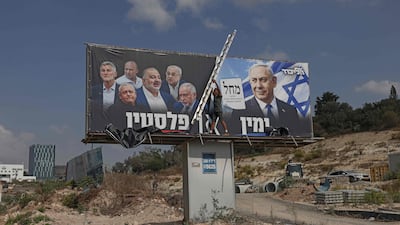

Israelis will head to the polls next week in one of the most important elections in their country's history, with potential implications for the entire region.
As international recognition of Palestinian statehood grows, who are the main figures and what have they said about the issue?
Benjamin Netanyahu
Prime Minister Benjamin Netanyahu has been the most famous, capable and divisive politician in Israel for decades. As with so many recent Israeli elections, Tuesday’s vote is not fundamentally about left versus right. It is about whether Israelis choose to be led by “Bibi” Netanyahu once again.
He is not projected to even come close to a majority in mainstream polls – but no one is writing him off. He survived pressure to stand down after the massive security failure of the October 7, 2023, attacks, even though many predicted that his departure was imminent at the time.
Many analysts say that he could come into his own in complicated coalition negotiations stages, if Tuesday’s elections result in a stalemate.
His supporters, be they fervent or reluctant, say that only he is truly qualified to lead Israel, given his decades-long experience as a statesman, his perfect English and his relationships with world leaders, in particular US President Donald Trump.

His opponents say he has driven Israel into global isolation, undermined its security with aimless and endless wars after the disaster of October 7, and empowered the far-right and the ultra-Orthodox, which could put Israel on a path to becoming a theocracy.
What he says about the two-state solution: Today, Mr Netanyahu is vehemently opposed to a Palestinian state and regularly says that it has been his life’s work to prevent one. His latest government unleashed a massive wave of illegal settlement in the occupied West Bank. Israeli settlements have long been considered one of the main obstacles in achieving the two-state solution. His coalition partners also want to resettle the Gaza Strip.
Gadi Eisenkot
A former military chief of staff, Gadi Eisenkot is trying to bring military efficiency to the hapless campaign to unseat Mr Netanyahu. His straightforward brand has propelled him to the top of the opposition, far ahead of much more experienced candidates, including former prime ministers. His party, Yashar, means “honesty” in Hebrew.
His brand is more about who he is than his policies. His family are Mizrahi Jews from Morocco, not Ashkenazim from Europe, who typically dominate Israel’s political elites. He lost close family members during the Gaza war. He is from Israel’s periphery, not the posh neighbourhoods of Tel Aviv or West Jerusalem.

He says a lot less about his policies and has run a very cautious election campaign. He is not shy when it comes to military force. He pioneered the Dahieh doctrine, the use of disproportionate force in war, including against civilian infrastructure, an approach that shaped Israel’s campaign during the Gaza war. He does not oppose illegal settlement in the occupied West Bank.
Nonetheless, his promise for a state commission of inquiry into the October 7 attacks and an end to draft exemptions for ultra-Orthodox Israelis put him at substantial odds at home with Mr Netanyahu, of whom he is just ahead in most polling.
What he says about the two-state solution: In August, Mr Eisenkot said in a post on X that no Palestinian state would arise if he was in government. In a post earlier in October, he criticised Mr Netanyahu for speaking “in favour of two states dozens of times”.
Itamar Ben-Gvir
National Security Minister Ben-Gvir is a convicted criminal who has been in charge of Israel’s police for four years. He is arguably the second most prominent face of Israel’s coalition, after Mr Netanyahu.
He regularly gloats about the destruction of Gaza, dramatically worsened conditions for Palestinian prisoners in Israeli jails and the huge rise in illegal settlements. He has growing support from Israel’s increasingly populist right wing, much of which is young and full of political energy.

Opponents of Mr Netanyahu often lambast the Prime Minister for giving Mr Ben-Gvir a path to power. They hope that a responsible opposition government can put the Ben-Gvir genie back in the bottle. Even if the Netanyahu bloc that put him in power falls, good polling numbers, a booming brand and a massive social media following mean that he is probably here to stay.
What he says about the two-state solution: Mr Ben-Gvir is deeply opposed to a Palestinian state, calling instead for Israeli annexation of the occupied West Bank and resettlement of the Gaza Strip, alongside the expulsion of its Palestinian residents. Last year he said that Palestinian Authority officials should be assassinated if the UN advanced the recognition of a Palestinian state.
Naftali Bennett-Yair Lapid
Both Naftali Bennett and Yair Lapid were prime ministers in the government before Mr Netanyahu’s current coalition. Their steady decline in the polls over recent months after combining forces in April to form the “Together” party sums up why so many of Mr Netanyahu’s opponents feel depressed by the state of Israel’s opposition.
Despite a great deal of political experience, neither could drum up inspiration and are now overshadowed by Mr Eisenkot, who says very little, giving the impression that Israel’s opposition is neither dynamic nor energised, but instead a cautious exercise in crisis management.

What they say about the two-state solution: Mr Bennett, a former settler leader, is opposed to a Palestinian state. He said in July that if “someone comes along and says that ‘we need to withdraw [from the occupied West Bank]’… they’ll just kill us”.
Over his career, Mr Lapid has been more open to the prospect of the two-state solution than his running partner, often speaking of some form of “separation” between Israelis and Palestinians. He has hardened his rhetoric since the October 7 attacks, however, calling the UK, Canada and Australia's recognition of a Palestinian state in 2025 a “diplomatic disaster, a terrible step and a reward for terrorism”.
Mansour Abbas
He is chairman of the Arab-Israeli Ra’am party and a potential kingmaker. Despite many Jewish-Israeli politicians vowing never to stand with parties that represent Israel’s Palestinian citizens, expectations of higher-than-usual voter turnout in the Arab community could lead to Palestinian politicians commanding an important number of seats in the Knesset.

The community has faced a devastating wave of organised and violent crime since Mr Ben-Gvir took over the police. They are frequently attacked by Israel’s growing right wing as a threat to the country. Motivation to go to the polls after very tough times at home, as well as the trauma of seeing what is happening to fellow Palestinians in the occupied West Bank and Gaza, could make leaders such as Mr Abbas a lot more powerful.
What he says about the two-state solution: Mr Abbas called on Israel to recognise an “independent Palestinian state” in August. “We want [Israel and the US] to recognise it, and we’ll work to achieve peace, rapprochement and an end to the occupation and conflict,” he added.

