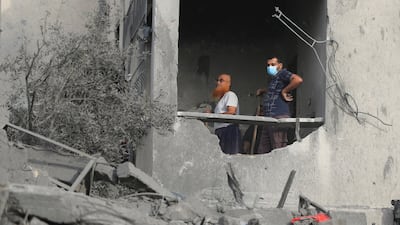

Saber Zaquot awoke early one morning recently to find a foul, sewage-like smell filling the house in Nuseirat camp, central Gaza, where his family lives.
At first, the family checked for the most likely sources.
“We became anxious and thought the smell might be coming from the bathroom, or even from the children while they were asleep,” Mr Zaqout told The National.

“We checked everything several times but could not find the source.”
Later that morning, Mr Zaqout saw on social media that people across Gaza were reporting a similar experience. “Residents across the Gaza Strip complained about the smell, both in the south and the north,” he said.
Civil defence teams have noted the foul smell repeatedly in recent weeks, spokesman Mahmoud Basal said. The odour had caused confusion and anxiety, with people unsure where it was coming from, he said.
“Many residents have complained about these foul odours, particularly children, the elderly and the sick,” Mr Basal told The National.
Israeli hand suspected
He said the civil defence believed Israeli forces were responsible and claimed that aircraft had been used to disperse the odour. He said Israel had in the past used a foul-smelling liquid to disperse Palestinian protesters, including during the Great March of Return demonstrations along the Gaza border in 2018, and during protests in the Sheikh Jarrah neighbourhood of East Jerusalem.
The liquid, developed by an Israeli company, is known as “The Skunk” and its odour has been described as a mixture of sewage and decomposing flesh.
resident of northern Gaza
Moamen Abu Jayyab, 30, who lives in a camp for displaced people in Al Tawam area of northern Gaza, said he first noticed the foul smell about a month to six weeks ago.
“Every now and then, we wake up in the morning to an extremely foul smell, similar to the smell of toilets and sewage,” he told The National.
Mr Abu Jayyab said the first time it happened, his family and other residents suspected the camp’s toilets. They inspected them but found nothing unusual. They then checked the sewerage system but could not identify a problem there either.
An hour or two later, Mr Abu Jayyab left the camp for the market.
“The smell was there too,” he said. “People were talking about how it had spread since dawn across all areas of northern Gaza and was still lingering.”
Rumours soon circulated that the Israeli military had released a foul-smelling substance into the air. Mr Abu Jayyab said he initially did not know whether the claims were true, but later saw social media posts and statements from the Gaza civil defence attributing the odour to the Israelis.
Gazan authorities have not been able to identify the substance causing the odour because they lack the equipment needed to capture and analyse samples, said Ayman Al Ramlawi, director of the Environment Health and Occupational Safety Department at the Ministry of Health.
“We can’t reach a definitive conclusion about the substance without laboratory analysis,” he said.
Mr Al Ramlawi warned that exposure to unidentified gases or airborne substances could affect the environment and public health.
“The use of such substances and gases undoubtedly has an impact on the environment in the Gaza Strip and on the health of residents, particularly those with weakened immune systems and those suffering from respiratory illnesses,” he said.
Mr Abu Jayyab said the smell added another source of distress for families already struggling with displacement and insecurity after two years of war between Israel and Hamas that left Gaza in ruins.
“The smell is extremely distressing and the worst thing is waking up to find it in the air,” he said.

