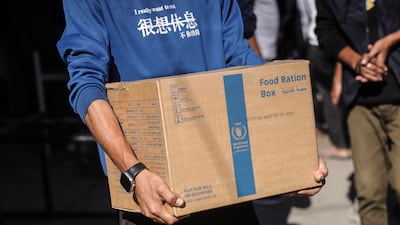

Palestinian families who lost their homes and livelihoods in the Gaza war say the World Food Programme’s decision to cut food and cash assistance to about 500,000 people could deprive them of their only means of survival.
The WFP announced the decision on Monday, saying it was because of a lack of funding. "This is not because the needs are going down, and it's not because we aren't able to bring in the food. This is only because we have less funding,” said Carl Skau, acting head of the UN agency.
For nearly two years, Ahmed Al Haj, 53, has relied on financial assistance from the WFP to feed his family after losing his home and livelihood during the war in Gaza.
Every two or three months, Mr Al Haj receives a payment of 1,250 Israeli shekels (about $380), which has become his family’s main source of support as they struggle to survive in a displacement camp in Al Mawasi, in southern Gaza.
“WFP assistance is extremely important to me, and my family depends on it to survive,” he told The National. “After hearing the news that assistance would be reduced for half a million people in Gaza. I became afraid that my financial support might be cut off.”
Originally from Jabalia refugee camp in northern Gaza, Mr Al Haj has been living in a tent with his family since their home was destroyed during the war.
He and his eldest son, Ahmed, were injured and continue to receive medical treatment, leaving them unable to work even if jobs were available.
“We should be the ones providing for our family but unfortunately, there are no jobs available. Even if there were, our injuries would prevent us from working,” he said.

Mr Al Haj said he contacted the WFP's offices in Gaza to ask whether his assistance would continue, but was told the new list of beneficiaries had not yet been approved.
“I hope the assistance continues because if it stops, my family and I will have nothing left to depend on,” he said. “We will be left completely without any source of income.”
Mr Al Haj's fears are shared by other displaced Palestinians, who depend on humanitarian assistance to meet their most basic needs amid widespread unemployment, the destruction of businesses and growing uncertainty over the sustainability of international aid programmes.
Cut to both recipients and aid quantity
The cuts announced on Monday will reduce the number of Palestinians receiving monthly WFP assistance from 1.6 million to 1.1 million, the agency said.
The reductions go beyond the number of beneficiaries. Families who previously received two food parcels will receive one, along with a smaller bag of wheat flour. The number of hot meals distributed daily will be cut from 250,000 thousand to 150,000, while cash assistance to 75,000 families has also been reduced.
The WFP said it received less than half as much funding for its Palestinian operations in 2026 as in previous years and urgently needs $400 million to maintain essential programmes in Gaza and the occupied West Bank over the next six months.
The announcement comes as an estimated 1.4 million people in Gaza, or 67 per cent of the population, face acute food insecurity at crisis levels or worse. About 200,000 are experiencing emergency levels of hunger, the WFP says.

Although food security has improved modestly since the October 2025 ceasefire, the agency warned that those gains are fragile and could be reversed if humanitarian assistance continues to decline.
A WFP employee in Gaza told The National that reductions in humanitarian assistance had already become evident over the past month to six weeks, with the number of aid lorries arriving falling sharply.
“On days when the [border] crossing was operating, we used to receive more than 25 trucks a day carrying aid for distribution to residents. But for approximately the past month and a half, the number of trucks has not exceeded eight or 10, even on the best days," they said.
“On some days, only five trucks enter. We have been informed internally more than once that these reductions are due to a shortage of funding and donations for Gaza.
“There have also been reductions in the cash assistance programme. More than 100,000 families previously received 1,250 shekels during each payment cycle, but they will now receive only 750 shekels, according to specific criteria.”
Food kitchens no longer an option
For Mohammed Abu Ailwa, 46, the reductions threaten one of the few remaining sources of food for his family of nine, including two people with disabilities, who live in a displacement camp near Gaza city’s port.
Mr Abu Ailwa owned a small grocery shop in Al Shati refugee camp that was destroyed in the war. He now depends on monthly WFP parcels containing lentils, rice, cooking oil, flour and canned goods.
“World Food Programme assistance is a lifeline for us in Gaza,” he said. “It is true that the food items are repetitive and available in local markets, but people like me who have no money depend on the monthly WFP food parcel.”
Mr Abu Ailwa said he was deeply worried about how he would provide for his family, especially as many community kitchens that offered free meals had stopped operating. “The food parcels and assistance should be increased, not reduced,” he said.
Even before the latest reductions, he said, the assistance was not enough to meet his family’s needs but “having a little is better than having nothing at all”.
Threat to Gaza's economy
The loss of humanitarian assistance could have consequences beyond hunger, according to economic analyst Ahmed Abu Qamar, who said it could further weaken the territory’s already devastated economy.
Mr Abu Qamar said the food and cash assistance not only helped families survive but also supported the local economy by enabling households to buy essential goods.
Reducing that support would lower buying power, weaken demand in local markets and place more pressure on traders and the few businesses still operating.
“As a result, local markets risk becoming trapped in a vicious cycle of rising poverty, declining consumption and weakening economic activity,” Mr Abu Qamar said.
He questioned the sustainability of humanitarian programmes in a territory where much of the population has lost their means to earn a living.
Repeated reductions attributed to funding shortages, Mr Abu Qamar said, raise concerns about whether the humanitarian response can continue to meet Gaza’s growing needs.
The crisis is not only about the quantity of food entering Gaza, but also its quality and diversity. Limited varieties of food, including flour and canned goods, cannot compensate for fresh and nutritionally balanced products, he said.
The WFP said only one in five children in Gaza has a sufficiently diverse diet. With more than 80 per cent of the population unemployed, many families cannot afford fresh vegetables and protein-rich foods even when they are available.
Mr Abu Qamar called for sustained humanitarian funding, better management and diversification of food supplies, and the restoration of UNRWA, the UN agency for Palestinian refugees, to its full operational role.
With winter approaching and hundreds of thousands of displaced Palestinians still living in temporary shelters, the aid reduction threatens to place more hardship on families struggling to meet their daily needs.

