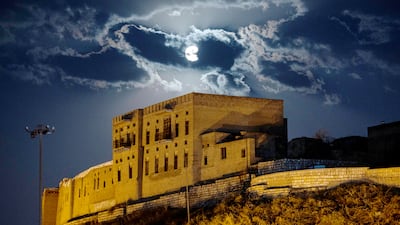

In Erbil’s old quarter, Kurdish history is held in family manuscripts, works of art and memories passed down through generations. Now, four historic houses near the city’s ancient citadel are being brought back to life to give those stories a place to endure.
The Kurdistan Centre for Arts and Culture (KCAC) is working on turning the homes into spaces for safeguarding manuscripts, supporting contemporary artists and documenting Kurdish contributions to the region’s cultural history.
“One of the houses is dedicated to the archive, as a state-of-the-art storage facility … fireproof, waterproof, bulletproof – as you need here: everything-proof,” said Spede Mizuri, director of public impact at KCAC.
The houses were evacuated in 2012 during moves by the regional government to improve the area around the historic landmark, but plans were put on hold when ISIS emerged two years later. The properties have remained vacant ever since.
Most predate the Iraqi monarchy, while one is an Ottoman-era house with British influences, Ms Mizuri said.
The archive building will be home to a partnership with the city's Salahaddin University to make its manuscript collection accessible to researchers and the public. Ms Mizuri said the collection had remained largely inaccessible since being moved to the university in the 1960s, with little cataloguing or academic study.
The second house will become a permanent exhibition space, opening next month with the first solo exhibition in Kurdistan by a Kurdish artist living in exile. The remaining two properties will host workshops and longer-term training programmes in the arts, heritage and cultural sectors.

The restoration builds on the organisation’s work to preserve vulnerable collections across Iraqi Kurdistan. Launched in 2024, its initial mobile archiving project used scanners inside a Toyota van to travel between villages, religious schools and private libraries, digitising material and making it freely accessible online.
The collections range from political documents and religious manuscripts to personal journals, astrological material and modern printed works. Some were hidden underground during periods of conflict to protect them.
“We have a major, major issue in Kurdistan for precious materials and artworks that have been purchased. They've been taken into stewardship, so to say, and nobody really knows what happened to these materials,” Ms Mizuri said.
“Some of them are under really, really bad conditions as well, so digitisation is the first immediate crisis response to something like that.”
Kurds are spread across Iraq, Turkey, Iran and Syria, with a large diaspora beyond those countries. Despite sharing a distinct cultural identity, Kurdish communities have developed under different political systems and national borders, so their language, literature and traditions play an important role in preserving a sense of shared history.
For Ms Mizuri, the work addresses a broader problem: the lack of resources for Kurdish history and its contributions to the region to be documented and studied. “We have left our mark … on the world entirely, but there's very little to showcase that.”
That effort to make Kurdish history more accessible extends beyond Erbil. In Sulaymaniyah, KCAC is working with the British Library and the University of Exeter on a project involving the library of the Ministry of Religious Endowment, which holds some of the oldest manuscripts in Kurdistan.
The initiative, due to be announced next week, aims to make the collection the first Kurdish library represented in the British Library’s cataloguing system, bringing its manuscripts into a wider international research network.
Ms Mizuri said the project was significant given Kurdistan’s history under British imperial rule, and the continued absence of a Kurdish library from the institution’s catalogue.
From preserving manuscripts to promoting contemporary artists, KCAC is also seeking to ensure Kurdish culture has a stronger presence across the region.
For Kurds, whose history has often been preserved through oral traditions and family accounts, making these collections accessible offers a tangible record of their cultural and intellectual contributions. Manuscripts, artworks and personal documents can help establish connections between generations, while giving researchers and communities material evidence to study and share.
Ms Mizuri said the archive could also provide a sense of security by ensuring that Kurdish history was not dependent solely on memories or oral accounts, which can be difficult to substantiate or preserve over time.
It also offers a way to understand Kurdish identity within the wider history of the region, recognising the contributions of Kurdish artists, writers and scholars that have not always been acknowledged as such.
“We are known for being at the midst of war and continuously the spoils of wars that sometimes maybe we were part of, and other times we're really not,” Ms Mizuri said, adding that having tangible history helps to “introduce ourselves beyond conflict”.
'Ambassador for Kurdish artists'
Preserving Kurdish heritage is also a way of bringing it into a wider cultural conversation, ensuring that Kurdish artists and their work are represented even beyond the Kurdistan region.
The centre has been building relationships with cultural institutions in Iraq and across the Middle East, including through its participation in the first edition of Art Basel Qatar. Later this year, it will take part in the Sharjah Art Foundation’s art book fair, where it plans to host a workshop and talk and present its publications. Artist and resident Walid Siti was also recently presented at Jameel Arts Centre in Dubai.
KCAC’s work extends beyond preserving historical material to exploring contemporary social issues through art. Its first exhibition, held in Akre in 2024, transformed the town’s old Qishla, an Ottoman-era fortress, into an exhibition space for digital artist Kaiwan Shaban. The exhibition was extended three times at the request of the local tourism office, Ms Mizuri said.
A subsequent exhibition, Being Lost, was held in a public park in Ranya, a town near the Iranian border, associated with people-smuggling networks and young people attempting to reach Europe. The park, where The National has previously reported from, is known to be a location where those attempting to migrate seek out smugglers.

The exhibition brought together memorabilia connected to families whose relatives had left or disappeared, exploring the uncertainty and pain experienced by those waiting for news. Visitors could record messages on phones attached to a transparent wall, with the recordings intended for broadcast on the radio in the hope of reaching those who had left.
Seminars were held in nearby Raparin University, in the same district as Ranya, which used to be one the highest performing universities in the Kurdish region, which Ms Mizuri described as the “dichotomy” that exists in the city.

“Heritage is collective,” she said of Kurdistan's place in the region. She added that the main priority was to “preserve and then to promote”.
For Ms Mizuri, the work is ultimately about giving Kurdish communities the means to understand and share their own history, while recognising the connections between them and their neighbours.

