
Remains of a Neanderthal found in an Iraqi-Kurdistan cave reveal he died a violent death after more than a year of being cared for in agonising pain, a study has shown.
The killing 75,000 years ago involved a sharpened wooden spear and may be the earliest example of lethal violence using such a weapon, archaeologists believe.
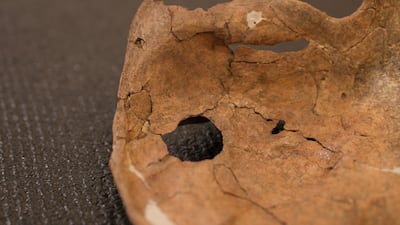
A 15mm circular hole in the shoulder blade suggests a “heart shot”, in which the spear was thrust downwards to pass completely through the body, bringing rapid death.
Tiny shards of displaced bone were pieced together to reveal how the spear would have penetrated the body. A spear tip or flint would have left a different shaped hole, researchers said in the study, published in the journal Scientific Reports.
Other remains, notably damaged teeth, suggest the unfortunate individual – thought to have been around 45 years old when they died – had suffered a brutal facial injury at least a year earlier, and would have needed looking after.
“It is fascinating to have evidence for both compassion and violence amongst Neanderthals, our closest evolutionary cousins, embodied in this one individual,” said Prof Graeme Barker, fellow of St John’s College, Cambridge, who led the excavation.
The Neanderthal has been named Shanidar A by researchers, after the cave on the Bradost Mountain in Erbil where the remains were found.

Preserved bone
The scapula bone, or shoulder blade – broad, flat and so thin in places it is almost translucent – was preserved intact under rock and sediment, along with a mostly complete right hand and two ribs.
“It’s extraordinary to have a perfectly preserved scapula from 75,000 years ago. These bones are so thin that you often don’t get complete scapulae from modern burials,” said Dr Emma Pomeroy, study lead author from Cambridge’s Department of Archaeology. “We were able to lift it out in one piece from under almost eight metres of rock and sediment.”
The earliest known rounded wooden spear, pulled from the sea in Clacton-on-Sea, England, in 1911, is more than 400,000 years old.
But very few wooden objects from prehistory survive due to the inevitable decomposition. Some waterlogged examples of spears dated to around 200,000 years ago – when early Neanderthals roamed Europe – were found in Schoningen, Germany, in the 1990s. They were around two metres long and used for throwing, like modern javelins, to hunt large game.
The researchers believe a similar weapon caused Shanidar A’s death.
“Holes left by recreations of spears from this time are an excellent fit for the one we found in the Neanderthal scapula,” said Dr Pomeroy. “What evidence we have suggests that Neanderthals and their ancestors developed woodworking and weapon-making skills many thousands of years before the death of Shanidar A.”

Violent end
She said it was possible the death might have been in a hunting accident, but the evidence suggests deliberate violence was more likely.
“Animals such as mammoths may have been hunted up close with thrusting spears, so it’s easy to imagine lethal injuries,” she said. “The position of the wound and the force required to push it right through the Neanderthal’s body bear the hallmarks of an intended kill shot directed towards the heart.”
It is possible that the fatal blow was struck by an early human, as they had evolved by that time, but violence between Neanderthals seems a more straightforward explanation.
“All we can ever know about the end of this Neanderthal’s life is that it was violent, and came at the end of a wooden spear,” said Prof Barker.

Blunt force
One of the seven teeth that were found had been split lengthways with only half remaining, with the others twisted inward. The half tooth had significant tartar build-up along the exposed root canal, suggesting it stayed in the mouth for some time after a blow to the face.
Surviving a trauma that splits a tooth in this fashion, then continuing to live and eat for at least a year would have required care and support from other Neanderthals,” said Dr Pomeroy.
Shanidar A may have been fed soft food. Previous research on sediment in Shanidar Cave shows that plants were being soaked before cooking around the same time. “There’s no doubt that Shanidar A would have had difficulty communicating and been in absolute agony for a long period of time,” said Prof Barker.
“The remains of Shanidar A reflect the dual nature of so much of what we recognise as human. On the one hand, we have evidence of a terribly violent end. On the other, this was clearly an individual who was cared for during their lifetime.”
Neanderthal cave
The vast cave in the foothills of Iraqi Kurdistan known as Shanidar is one of the world’s most famous Neanderthal sites. Excavations in the 1950s led by Ralph Solecki found remains from 10 individuals, including a “cluster” of four in the same spot despite dying at different times, suggesting the Neanderthals had returned to inter their dead.
Remains of a Neanderthal from another part of the cave, who lived thousands of years later, showed evidence of a paralysed arm, arthritis, deafness and partial blindness. Yet they had lived a long life, so must have been cared for.
Shanidar A is one of five Neanderthals unearthed in 2020 in a part of a cave just 1.5 metres long and one metre deep, directly behind a large vertical boulder, thought to be a “prominent marker”. The body was positioned on its back, head facing east.
“These Neanderthals returned to the same place to lay their dead to rest,” said Dr Pomeroy. “Some were deposited before the earlier body had fully decomposed, so this was happening within years or decades.”

