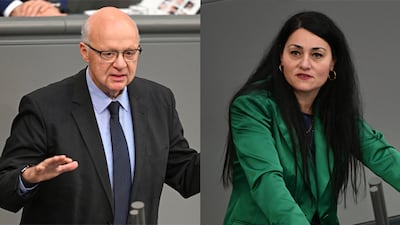

German politicians with close ties to the Middle East have called for a “stronger, deeper partnership” with the Gulf extending beyond economic deals and into culture, education and an appreciation of the Islamic world.
Speaking to The National in the week of President Sheikh Mohamed’s state visit to Berlin, the head of the German parliament’s Arab relations group said Germany has “common interests” with Gulf states as wars rage nearby in Ukraine and Iran.
“We don’t just want to do business, but rather we need a better mutual understanding,” said the MP from Chancellor Friedrich Merz’s conservative bloc, Alexander Radwan, who on Monday met the Saudi Foreign Minister Prince Faisal bin Farhan in Berlin.

His appeal came two days after a radical anti-Islam party won a state election in eastern Germany, potentially giving the far right its first real taste of power since 1945.
Lamya Kaddor, an opposition MP in the Arab affairs group, said Germany should offer a “long-term strategic partnership” to the region instead of “commenting from the sidelines” as major shifts take place in the Middle East.
This should include cultural ties and relationships between start-ups and research institutes, said Ms Kaddor, the Green Party's rapporteur for the Arabian Peninsula.
Germany and the UAE have close economic ties which are expected to be a focus of the state visit. There is interest in Germany in importing natural gas and hydrogen from the Gulf.
Mr Merz's government has also proclaimed a more “strategically aligned” arms sales policy, relaxing what were previously stricter limits based on human rights and disarmament ideals. A German veto on Saudi Arabia buying Eurofighter jets is no longer in place.
Mr Radwan said he would like to see relations develop in education. “My credo is always: Germany can make an important contribution in the region in several areas, in the economy, in technology and research, but especially through deeper co-operation in education,” he said.
“I find it a shame when I'm in the Emirates and I find universities from all over the world, but not from Germany.”
The MP said a deeper relationship should “also mean that we in Europe, in Germany, learn to understand and respect the Middle East and its faith”.

Ukraine and Iran
Mr Radwan said Germany was in the same boat as Gulf states, with fighting taking place near their borders in Ukraine and Iran. The German politician has been briefed on Iran's attacks on the Gulf by Saqr Ghobash, Speaker of the UAE's Federal National Council, among others.
Leaders in Germany and the Gulf have been pushed to rethink a security policy that for years has mainly looked to the US. “We are in a similar situation,” Mr Radwan said. “What the Gulf states are currently experiencing, harder than us, is analogous to what is happening in Ukraine and Russia.
“From this base of common interests, we can talk – firstly about the economy, where things are up and running in any case – but also about deeper political ties, common security architectures and new ways to secure energy supplies. It should now become a stronger, deeper partnership.”
The closure of the strait pushed up energy prices in Germany. Securing sea lanes in the Strait of Hormuz and Bab Al Mandeb is a “vital economic interest both for Germany and the Gulf states”, Ms Kaddor said.
Germany's Middle East policy is heavily influenced by its pro-Israel leanings, a product of atonement for the Holocaust. It did not join 12 countries, including Britain, France and Canada, who announced new sanctions against West Bank settlers this week.
Although Germany has at times been critical of Israel, its stance on the war in Gaza was blamed in part for its failure to win a seat on the UN Security Council in April.
Politicians involved in Germany's Middle East policy nonetheless believe their country has a good standing in the region. But “we must increasingly learn how to translate this trust into political influence”, Ms Kaddor said.

The German parliament was on Wednesday debating modest cuts to the foreign affairs budget that include about $200 million less for the UN. The government proposes to make up the shortfall in 2028.
The funding available includes $11.6 million for the Unifil peacekeeping force in Lebanon, the future of which is uncertain. There is also $2.2 million for peacekeepers in a UN-monitored zone between Syria and Israel.
Ms Kaddor, whose parents migrated from Syria to Germany, said a potential peace accord between Syria and Israel would “in principle be a big win for the stability of the whole region”.
But for this to work the Syrian government must “show it does not tolerate armed non-state actors”, she said, while Israel must accept the integrity of Syrian territory, where the Israeli army has carried out attacks.