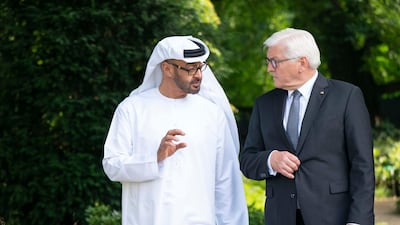

Since President Sheikh Mohamed’s official visit to Germany in June 2019 - in his previous capacity as Crown Prince of Abu Dhabi - the world has endured the Covid-19 pandemic, wars on numerous fronts and increasing climate concerns.
Seven years on, the UAE President's state visit comes at a time when bilateral relations between the nations are arguably stronger than ever and a source of strength in uncertain times across the globe.
The strategic partnership extends beyond the political realm. Trade and investment have become increasingly important in UAE-Germany ties.

The energy partnership between the two countries is now in its 10th year, with the initial focus on renewables expanded in 2021 to involve robust action on climate change.
The UAE has emerged as Germany's most important trading partner in the Gulf. Bilateral trade between the two countries exceeded Dh57 billion ($15.52 billion) last year, with German imports from the UAE increasing by more than 50 per cent.

An estimated 2,000 German businesses have set up office in the UAE, including BMW, Siemens, ThyssenKrupp, and the railway company Deutsche Bahn, which played an important role in establishing Etihad Rail’s first freight services.
The bilateral ties go back to May 1972, six months after the formation of the UAE and the establishment of diplomatic ties with what was then West Germany. Communist East Germany had no formal relationship with the UAE, but when East and West united after the fall of the Berlin Wall in 1989, the embassy in Abu Dhabi transitioned to the Federal Republic of Germany. At the same time, the UAE moved its embassy to the new capital, Berlin.

Informal links between the two countries go back much further. In 1904, a German explorer, Hermann Burchardt, arrived in Abu Dhabi with his camera. Mr Burchardt’s photographs are among the first to capture life in the capital, including Sheikh Zayed the First in his majlis and at Qasr Al Hosn.
These images are now displayed at Zayed National Museum on Saadiyat Island.
Sixty years later, it was a German company, Seibert, that laid a pipeline from Al Ain to Abu Dhabi, bringing the city its first constant supply of drinking water in 1964.

A notable similarity between Germans and Emiratis is their appreciation of powerful cars, particularly the Mercedes-Benz brand. Abdul Jalil Al Fahim imported the first four Mercedes-Benz vehicles in 1962 and Emirates Motor Company (EMC) continues as the official dealership in the UAE today.
The car was a particular favourite of UAE Founding Father, the late Sheikh Zayed bin Sultan Al Nahyan. At one point, demand for the Mercedes-Benz 600 Pullman was so high that the company sent a delegation to the UAE to understand the surge in interest. Fittingly, the country’s first traffic lights, installed in Dubai in 1971, were made by Siemens, another German company.
Another shared passion is football. When the UAE qualified for the 1990 World Cup in Italy, both countries competed in the same group stage. Although Germany won 5-1, the match was significant as it marked the first goal scored by an Emirati, Khalid Mubarak, at a World Cup finals, and it came against the eventual champions.

At the political level, a strategic partnership was established in April 2004 through an accord signed in Berlin by then German chancellor Gerhard Schroder and Sheikh Hamdan bin Zayed, then representing the UAE government as Deputy Prime Minister and Minister of State for Foreign Affairs.
The agreement involved joint commitments to regional security and stability, streamlined bilateral visa and entry procedures, and the development of ties across various industries, including oil, communications, and research and development.
In 2022, the Energy Security and Industry Accelerator Agreement committed the UAE to supply Germany with liquefied natural gas and to expedite joint projects in energy security, decarbonisation and climate action.
Despite today's testing political climate, these ties remain strong and stable. When Mr Schroder announced a visit to Abu Dhabi in 2005, interest from German businesses was three times the number of available spots.
In 2019, concerns that relations were strained due to Berlin’s decision to ban arms sales to Saudi Arabia over the conflict with the Houthis in Yemen were swiftly addressed by a senior German diplomat.
Talking to The National, Philipp Ackermann said: “There is only one Arab country with which we have elevated our relationship to the level of a strategic partnership – and that is the UAE.”

