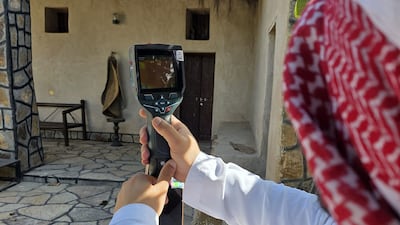

Built for the desert heat using stone, coral and mud brick, the UAE's traditional homes are central to the country's heritage.
Today, old Gulf-style houses are being studied by an academy of German and Arab scientists to help solve the newer problem of climate change.
Researchers involved in the project, which looks at the architecture of the UAE, Oman and Algeria, say the old ways have sometimes been eclipsed by European methods. But in a climate-conscious age, ideas to keep houses cool are in demand in Europe, including in Germany.

The “natural climate control” on display at Al Ain Oasis, where mud brick was used as “some of the oldest technology known to man”, was part of the submission that earned the UAE its first Unesco World Heritage listing in 2010.
Some architects in the Middle East say they “like to work with local materials and local layouts. But eventually the municipality will tell them you can't use that because it's not in our building codes”, Dawud Al Ansari, one of the project's organisers, told The National. “The building codes that the municipalities are working with are mostly copied and pasted from British building codes.”
That was the inspiration for a project funded by the Arab-German Young Academy of Sciences and Humanities, which receives money from the German government. Researchers are asked to analyse the Arab designs and their energy efficiency. Findings are to be presented in Muscat next month to scientists based in Germany, the UAE and beyond.

It is one of several energy and climate issues where Germany and the Gulf are developing ties. There is interest from Germany in importing hydrogen and natural gas from the UAE. To strengthen these ties, President Sheikh Mohamed is heading to Germany this week for a state visit that will focus on economic relations.
Architectural celebration
Dr Al Ansari, the founder of Oman's Shaheen Institute, who is also a professor at Berlin's Technical University, began work on the architecture project with a tour of Gulf homes. It became, he said, a project “celebrating the variety and beauty of the local housing styles”.
One focus is the “passive” means by which homes are kept cool with natural ventilation. Traditional UAE homes often used coral stone, which doesn't absorb heat as much, or wind towers known as barjeels. Designs are drawn from Arabian, Indian and Persian architectural traditions.
In its listing for the Al Ain site, Unesco called it “a symbol of life in the past and the capacity of man to settle and adapt to the harsh desert environment”.

Germany has a similar concept of the “passive house”. Historically, the aim has been to insulate against Europe's cold winters, but the cost of keeping cool in summer is also rising as heatwaves become more extreme. Not many homes have air conditioning, and the German government funds energy-efficient buildings.
Will we see the Gulf styles adopted in Germany? Dr Al Ansari believes the key is applying local knowledge.
“Some form of traditional Omani limestone, for instance, which has been used for building for decades, would offer great properties to save energy in terms of keeping the heat outside and keeping the cool in,” Dr Al Ansari said.
However, a special permit is needed to build a house that way in Oman. In Algeria, he said, researchers will study whether a country with a fiercely anti-colonial streak has also kept European methods in place.
When ideas have been presented, a policy forum will discuss “embedding traditional, climate-adapted architecture” into building codes.
German climate ventures abroad are sometimes “not culturally reflected, nor geographically reflected in the target region”, Dr Al Ansari said.
The UAE and Germany have for years positioned themselves as front-runners in climate action. In 2022 Germany received a first shipment of hydrogen-based ammonia from the UAE, a “fuel of the future” that could one day be vital to German industry. Germany has also set 2045 as its net-zero target, earlier than most European countries.

