
Live updates: Follow the latest news on Iran war
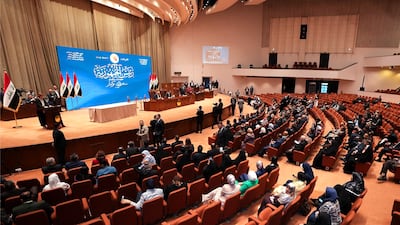
The nomination of the next Iraqi prime minister has been postponed for a third time until Friday, due to a political crisis among the ruling parties.
The largest bloc of Shiite parties, the Co-ordination Framework, holds 185 of 329 seats in parliament and has the right to select a prime minister, but has delayed an announcement to hold further consultations. There are signs that the bloc has "deep divisions among member parties and a lack of consensus on a single nominee," one Iraqi politician told The National.
The Framework had been expected to convene a meeting on Wednesday, but it has been postponed until Friday, leaving just two days of a 15-day constitutional window in which a prime minister must be nominated.
“It was decided to postpone the meeting of the Co-ordination Framework until Friday to leave more space for dialogue and reach a result within the constitutional period,” the bloc said in a statement late on Wednesday.
Iraq's power-sharing system stipulates that a Shiite holds the powerful post of prime minister, the parliament speaker is a Sunni, and the largely ceremonial role of president goes to a Kurd. The allocation was drawn up to help avoid sectarian conflict in the country.
The Iraqi parliament this month chose Nizar Amedi as president after months of political deadlock following elections in November. Mr Amedi on Wednesday urged the Framework to declare its nominee, saying the alliance must not miss the constitutional deadline and cause further delays in forming a new government.
The Framework must "work on forming a government capable of meeting the aspirations of the Iraqi people", said the President in a statement.
Several names are circulating within the bloc. The State of Law Coalition has put forward the head of the Federal Commission of Integrity, Bassem Al Badri, while the Reconstruction and Development Coalition favours Ihsan Al Awadi, chief of staff to incumbent Prime Minister Mohammed Shia Al Sudani.
"There has been a push by the parties to nominate Bassem Al Badri, but it still remains unclear who will take the position," the Iraqi politician said. "Al Badri was not officially announced as the nominee due to internal objections and protests."
The Framework previously nominated the former prime minster Nouri Al Maliki to take the post, but US President Donald Trump said his administration would halt its support for Iraq if Mr Al Maliki was appointed. It was previously reported that the Framework is spilt between Mr Al Maliki and Mr Al Sudani.
Among other names on the shortlist were Basra governor Asaad Al Eidani and Intelligence Service chief Hamid Al Shatri.
Renad Mansour, director of the Iraq Initiative at London's Chatham House, told The National that the split is an internal Shia issue rather than the result of pressure from the US.
"They are stuck – and interestingly it's an intra-Shia problem, I don't think the US (other than the Al Maliki veto) or Iran are making it that difficult," Mr Mansour said.
"It's just whether Mr Al Sudani wants to give it up, or Mr Al Maliki wants to keep his candidacy, and others who want either Bassem Al Badri or Hamid Al Shatri," he said.