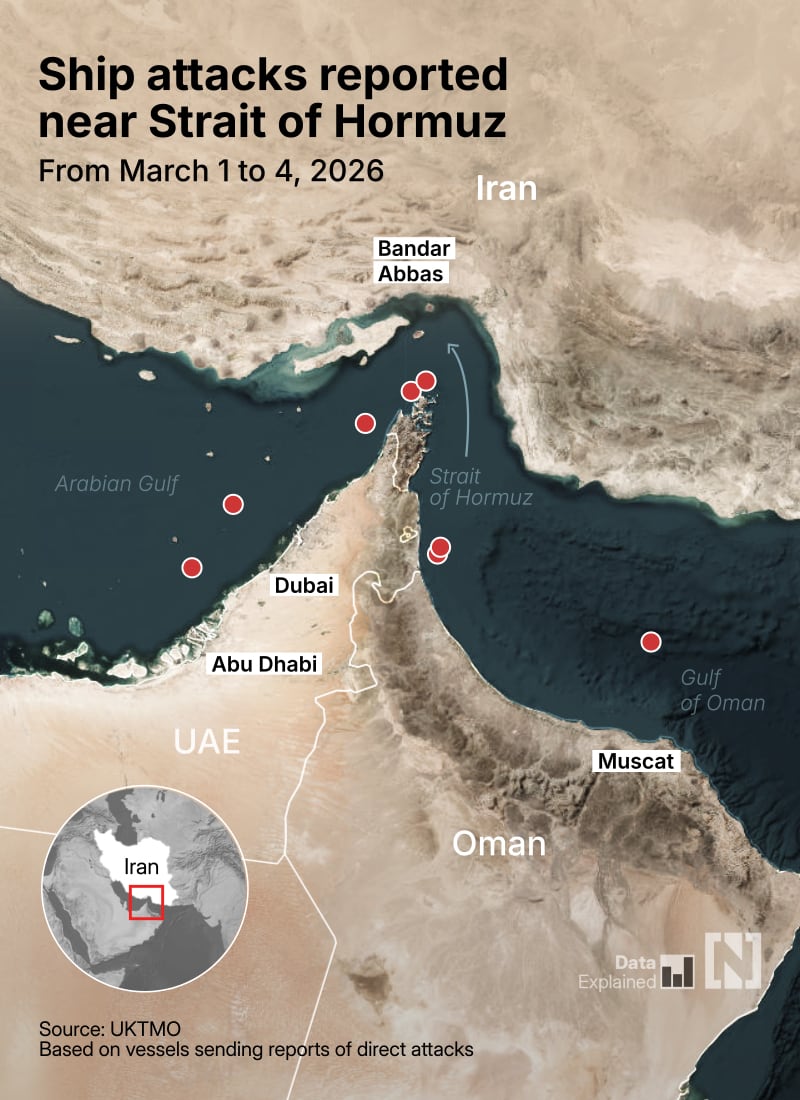
The US is deploying high-tech aircraft to the Middle East that will provide enhanced precision firepower for its fighters to help open up the Strait of Hormuz, a senior RAF officer has told The National.
It will provide American targeting planners with instantaneous intelligence using highly specialised eavesdropping and signals intercepts, according to retired Air Marshal Martin "Sammy" Sampson.
With the US now repositioning its satellites to provide intense surveillance alongside aircraft that can relay live video footage to ground and air forces while gathering signals intelligence, the next phase of the campaign will provide more dynamic interception, said Air Marshall Sampson, speaking from Bahrain.

Positioning "very exquisite platforms" on the battlespace means that they can "operate at high value for the campaign”, said the officer, one of the RAF’s most operationally experienced fighter pilots who has flown more than 500 combat missions in Iraq, Afghanistan, Kosovo and Bosnia.
The aircraft will allow commanders to “accurately move fighter and bomber assets around the battlefield”, putting them “where mobile forces or targets emerge…to efficiently to bring your air power to bear”.
The disrupter
The EA-37 Compass Call is a next generation electronic attack aircraft that uses a modified Gulfstream jet equipped with highly advanced technology for long-range jamming, disrupting enemy command and control.
Similarly, the Rivet Joint aircraft provides high-end radar and communications intercepts, geolocating enemy positions and allowing commanders to rapidly strike missile batteries or warships.
Operating at high altitudes, the Battlefield Airborne Communications Node (BACN) is ideal for conditions in Iran with its mountainous areas, having the ability to provide critical information via video links to both ground and air commanders simultaneously. This and all the other assets, plus the P8 Poseidon maritime surveillance and E2 Hawkeye, will all give US commanders exceptional situational awareness.
“These new capabilities will help observe and direct attacks to degrade Iran’s naval capabilities,” said Air Marshal Sampson, who was formerly the UK's Defence Senior Adviser to the Middle East. Furthermore, they will be able to rapidly allocate additional aircraft “to maintain maritime freedom of manoeuvre in the Strait of Hormuz”.

Bombing the Basij
The new surveillance armada will allow the US to conduct “a steady stream of drumbeat activity", he said.
This new phase of the air war could be critical in allowing the Iranian people to revolt against the regime with the intense surveillance giving the US the ability to, for example, attack a convoy of Basij militia heading to put down a protest.
“There may be a phase where you wish to go after forces in the field which are much more mobile, much less predictable, much less static,” said the officer, one of the RAF’s most decorated pilots.
“You will now be able to strike at all offensive forces, whether they're offensive against the GCC, Israel, the US, or against the Iranian people and that option needs to be on the table.”

GCC defence
This new stage would further help Gulf countries because it wold likely cause greater damage to Iranian forces, and "Iran maybe has to think very carefully about how and when they expose the forces that are attacking the Arabian Peninsula”.
The enhanced surveillance means that the Iranian missile batteries would be “one shot only” before they are discovered and destroyed.
“These forces allow different opportunities for the US to drive up the cost to the people who are conducting this campaign, not just the tactical fielded forces but those who are controlling them.
“I foresee this phase where you downgrade missile and missile production, launchers, command and control and naval forces,” he said.

Beware the cruise
However, he also warned that Iran still retains a formidable arsenal of cruise missiles that could still disrupt Gulf states unless tackled in the new bombing phase.
Iran’s stockpile of several hundred cruise missiles had yet to be fully deployed and could be used to target civilian infrastructure “as cruise is much harder to detect than drone or ballistic, are faster than drones and carry heavier payload".
“The enemy always has a vote and thus far we have seen very little of Iran’s cruise missiles,” he added. It was therefore a question of whether they had been destroyed in the early attacks or were being held in reserve for a “different phase” of an Iranian response that “has yet to play out”.
But if they do resort to them, then both civilian and military infrastructure would be under threat as the cruise missiles fly very low, are accurate and have a strong warhead, he said.

Power to bear
The burden on front line fighters, such as F-16s or F-15s, will now be lifted with Britain allowing the US to use its bases with B-52s and B-1 Lancers deployed forward. The bomber’s range allows them to “hang over the target for infinitely longer” with less drain on air-to-air refuelling.
Commanders would also be helped by the experience gathered from the enduring air campaign against ISIS over Syria and Iraq.

“There is a learnt experience of operating in an area where you don't necessarily have your own forces on the ground,” said the officer. “So the ability to discriminate between Basij and civilians will be a challenge, but that's where you bring these other strategic assets alongside the exquisite assets giving you wide area surveillance to understand movement and trends.”
This was critical in a country the size of Iran which has 1.65 million square kilometres. It also allowed the campaign to shift from “pre-planned, fixed targeting into more dynamic development of targets, and that was learnt very effectively in Iraq and in Syria against Daesh”.