After US President Donald Trump said he was on the cusp of getting “very tough” with Iran unless it concedes to his demands on abandoning its nuclear programmes, the region – and the world – has been anticipating his next move.
Experts have also told The National that with both American defensive and offensive weaponry now “locked and loaded” an attack could commence imminently.
While Mr Trump insists he wants diplomacy to work – and his team were in Geneva on Tuesday for talks with Iran – his forces have been readying for military action, something he had promised last month when the Iran protests were at their peak before the regime killed more than 7,000 people.

Military analysts have detailed the nature of the air, sea and land onslaught that Iran could face with its navy and oil refineries high on the list, alongside its air defences and special forces raids against senior regime members.
With a range of defensive missiles now posted around the region to fend off any Tehran retaliation, it is now a question of will Mr Trump decide to pull the trigger.
Why the delay?
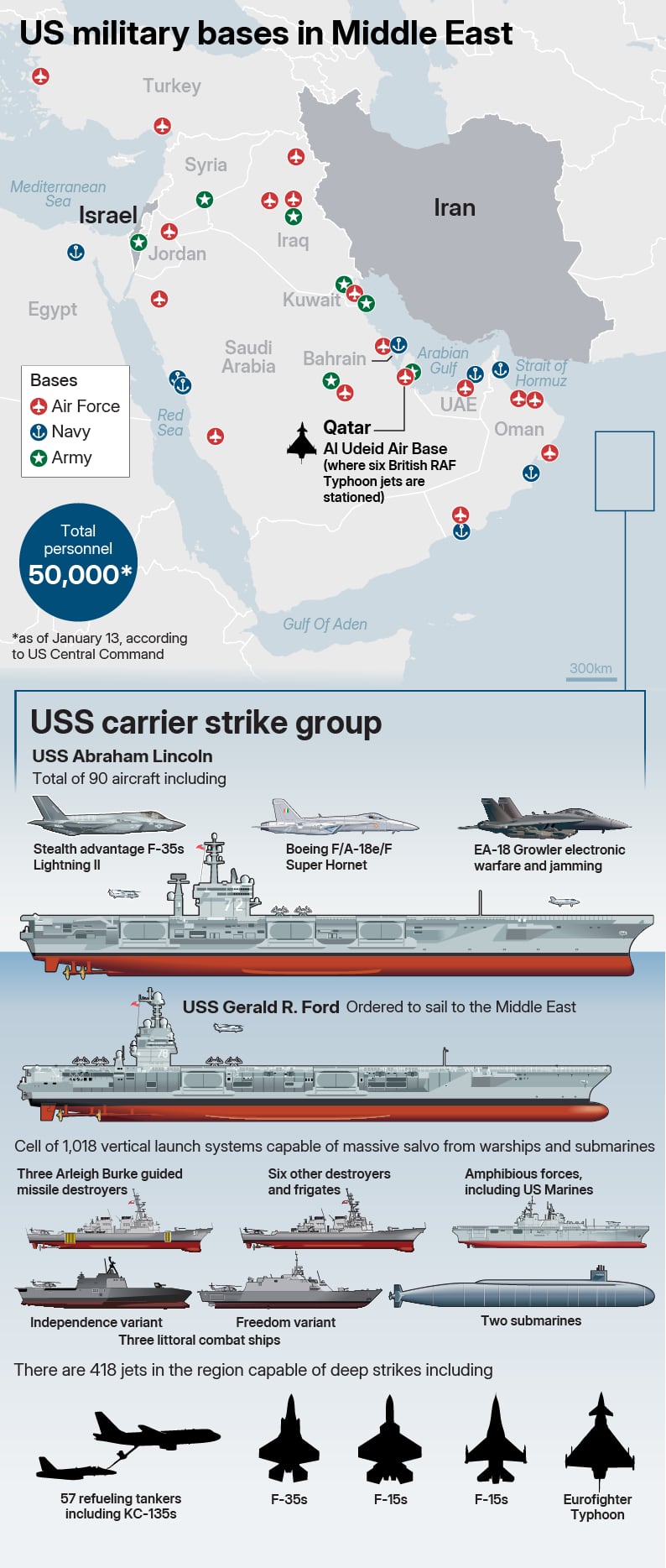
Batteries of air defence missiles and squadrons of fighter jets have flown into the Gulf region since late last month, as the Americans have stiffened defences against Iranian retaliation.
Patriot and Thaad (Terminal High Altitude Air Defence) systems have been spotted being unloaded at regional airbases.
F-15s and F-16s jets, that have proven effective against cruise missiles and Iran’s Shahed-136 drones have also been sent to airbases in Jordan and Kuwait.
There is now a squadron of Arleigh Burke guided missile destroyers in place as part of the Abraham Lincoln carrier fleet. It has the highly capable Aegis missile defence system that in two weeks will be joined by the Gerald Ford carrier strike group.
All these systems make an Iranian retaliation less threatening and was probably the reason for a delay.
“The US has the capability to strike Iran right now and has done so since the crisis started, all the military build-up is purely to protect the region,” said Sascha Bruchmann of the IISS think tank. “The question has been, how do they defend the region?”
This, he added, was especially important for those countries closer to Iran, with many targets and little warning time.
Former military intelligence officer Dr Lynette Nusbacher argued that “the overhanging truth” on the build-up was that it was there for “power projection and coercion” on Tehran.

Sink the navy
The extra time would have been used to the full by American tactical planners selecting the first targets to be struck.
“I would sink the IRGC Navy first,” said Dr Nusbacher. Her reasoning was that Tehran could attempt to lay mines to close the Strait of Hormuz to strangle the international oil economy. Iran state media on Tuesday announced parts of the strategic strait would close temporarily due to “security precautions” while the IRGC conducted military drills.
“The Americans do need to be fast enough so that the Iranians don't have a chance to deliver mines,” added Mr Bruchmann.

Iran has 12 warships, 20 fast attack boats as well as 19 submarines. But its satellite reconnaissance capabilities means the US will know precisely where each vessel is, including those in protected shelters. With the huge firepower on hand “it would not be a terribly demanding task for the US to just send the IRGC Navy to the bottom”, added Dr Nusbacher.
The US also has “form” for this after it sank a large chunk of the Iranian fleet in 1988, taking out three warships and several armed boats in Operation Praying Mantis in retaliation for Tehran attacking a US frigate.
To further weaken Iran’s economy, the US could also destroy Iran’s oil refining capabilities in Abadan, Bandar Abbas, Isfahan, and Tehran.

Suppressing defences
If the 12-day war in June last year saw the Israeli air force destroy selected Iranian air defences, then an America attack could see them utterly wiped out.
The US Air Force is the master of what is called Suppression of Enemy Air Defences and it goes to great lengths to minimise threats to its aviators.
In what would be a massive first strike – potentially close to the scale of the first day of the 1991 Operation Desert Storm against Iraq – the full might of its bomber force would likely be used.
Experts point to the current low profile of the B-1 Lancer and stealthy B-2 Spirit bombers, that were used to drop massive bunker busters on Iran’s nuclear programme in June last year.
It would aim to smother Iran's air defences using ballistic submarines alongside the guided missiles destroyers equipped with Tomahawk cruise missiles and the armada of F-35 and FA-18 fighter bombers.
“The US has been far quieter about positioning, air force strike aircraft,” said Dr Nusbacher.
“And I'm absolutely certain there’s a big fat binder on every US targeteer's desk detailing what to destroy with respect to the Iranian regime’s stability and capability.”
However, she ruled as “unlikely” a “decapitation strike” against Iranian supreme leader Ayatollah Ali Khamenei, adding that he would also have a “robust succession plan in place”.
Special forces options
The Sead’s objective “would be to provide some level of liberty for the next wave”, said Mr Ledwidge, whose “main target set would be the IRGC military assets”.
Dr Burcu Ozcelik, Middle East security expert at the Rusi think tank, suggested that the subsequent tempo of strikes, given the US assets in the region, would amount to 80 to 120 a day.
“The issue is how long US combat operations can be sustained without creating fatigue in the forward forces and depleting weapons fuel,” she added.
Given their success in snatching Venezuela’s president Nicholas Maduro from his heavily defended compound, US special forces could mount a “grab” operation against a senior IRGC or government figure.

US Navy seals are also likely to conduct close target reconnaissance or sabotage of Iran’s hidden warships. “SOF operations will absolutely be one of the items on the menu,” said Dr Nusbacher.
But US thinking will also be tempered by the long memory of the failed Operation Eagle Claw mission in 1980 where Delta Force attempted to rescue the 53 hostages held in the US embassy in Tehran. The issue that handicapped that mission, the long distances from the coast to Tehran by helicopter, would also hamper special forces missions into Iran.
Tehran retaliation
The biggest concern is how the regime might retaliate to any attack. Iran's ballistic missile strikes on Israel in June's 12-day war caused more damage than was reported.
Former intelligence officer Frank Ledwidge warned that Tehran is not toothless as “an interesting development has been the degree to which Iran’s air defence system has been reinforced”.
He pointed to the regime allegedly acquiring advanced Russian S-400 surface to air missile (SAM) batteries last year that have proved highly effective in shooting down US-made HIMARS missiles fired by Ukraine. It also still has a stockpile of the older but still useful S-300 SAMs.
Mr Bruchmann warned too that Tehran could use the Popular Mobilisation Forces, the Iran-back paramilitary groups that have about 200,000 fighters, to target American bases or assets in Iraq.
However, the analyst, who is based in IISS’s Bahrain office, was more concerned about Iran’s considerable shorter range missile stockpile being used against Gulf countries.

“The Gulf is only 250km wide and whereas Israel was about 13 minutes flight time away with the best missile defence system in the world, we might have only between four and seven minutes warning time.”
He added that if Iran fired them from behind the Zagros Mountains they would not be picked up on radar immediately “so you're completely relying on satellites, which only the Americans have”.
Dr Ozcelik added that Iran would want to “impose a cost” on Israel posing a “huge risk” against urban centres. “But if they strike one of their Gulf neighbours that will really damage relations at a time when Iran is facing isolation and needs to maintain ties with the Gulf.”
Ultimately, what Washington would “love to see is spontaneous regime change”, said Dr Nusbacher, but failing that, like Venezuela, it wants compliance rather than creating “ungoverned space in a country with the size and population of France,” she added.