As severe weather caused by Storm Byron swept across the Gaza Strip this week, pounding the territory with heavy rain, strong winds and flooding, thousands of displaced families were plunged deeper into crisis.
What had already been a humanitarian emergency became, in the words of local officials, a catastrophe unfolding in real time.
Ismail Al Thawabta, a spokesman for the government in Gaza, said the storm’s impact more than lived up to earlier warnings.

“We are facing serious developments,” he told The National, adding that at least 12 people had been killed, 13 homes had collapsed, and 27,000 tents had been flooded or uprooted. “This has significantly worsened the humanitarian catastrophe in the Gaza Strip.”
More than 1.5 million displaced people, many living in worn and makeshift tents, were suddenly exposed to the risk of drowning, injury, and total loss of shelter. Civil defence teams were responding to hundreds of distress calls, while officials estimated that more than a quarter of a million displaced people had been directly affected by the storm.
-
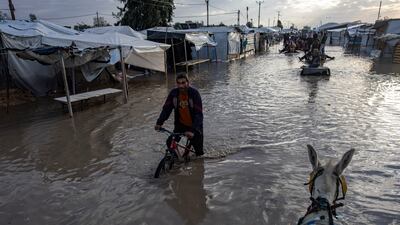
Flooding after heavy rain in Khan Younis, southern Gaza. In addition, an eight-month-old baby girl died on December 11 due to extreme cold in the city. EPA -
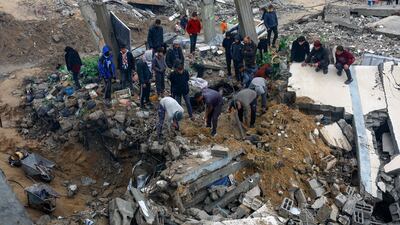
Palestinians sift through what's left of a house that collapsed in heavy rain, in Beit Lahia, northern Gaza. Reuters -
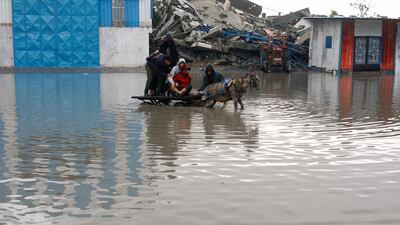
Displaced Palestinians ride a donkey-drawn cart through the floodwater in Gaza city. Reuters -

The weather, brought by Storm Byron, has compounded matters for Gaza's estimated 1.5 million displaced residents. EPA -
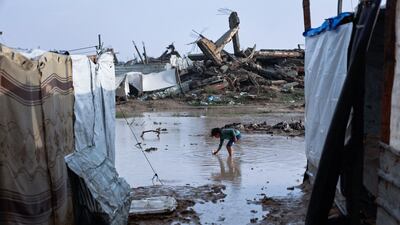
A huge puddle at a makeshift camp in Zeitoun, Gaza city. AFP -
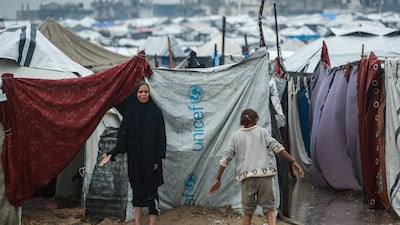
More wading needs to be done, in Deir Al Balah. AFP -

People mourn the loss of baby Rahaf Abu Jazar, who died in cold weather in Khan Younis, Gaza. Anadolu


Mr Al Thawabta said the natural disaster could not be separated from the broader context of suffering in the enclave. “The catastrophe comes amid an ongoing siege and a war of extermination,” he said, citing the continued closure of border crossings and Israel's blockade of urgently needed shelter supplies.
“More than 300,000 tents, mobile homes, caravans and shelter materials are being blocked from entering Gaza,” he said.
Winter has magnified an already dire situation. For the past two days alone, flooding has destroyed thousands of tents, sending dozens of people, many of them children, to hospitals suffering from extreme cold, exposure and the lack of blankets, clothing and adequate shelter.
“Organisations have tried to bring in caravans to shelter people, but these attempts are repeatedly rejected,” Mr Al Thawabta said.
Jonathan Crickx, spokesman of the UN agency for children, Unicef, told The National from Gaza that the 48 hours since Thursday had been catastrophic.

Waterborne diseases
Tents that he visited were flooded, clothes were soaking wet, mattresses damp and mud was “everywhere”.
“There is an immediate risk for children of hypothermia, with two babies killed from the disease,” he said. Tents are not protecting people from the weather, particularly children whose immunity has been compromised due to a lack of nutrition.
The UN in August declared famine in Gaza city, saying there was a high risk of it spreading further if not immediately tackled. Israel continues to block aid, allowing only a trickle of assistance into the enclave, which amounts to a fraction of the 600 or so lorries that are required daily to sustain 2.2 million people in dire need.
Another concern, Mr Crickx said, is the emergence of waterborne diseases, particularly with sewage overflowing due to the heavy rain and damaged infrastructure, and Israel blocking the collection of solid waste.
The low temperatures and poor hygiene conditions are “the perfect recipe” for the spread of preventable diseases, Mr Crickx warned.
“We have seen a spike in acute watery diarrhoea, especially in children above the age of five, and we are concerned about the emergence of illnesses like cholera,” he said.

Officials have called on mediators and guarantors of the ceasefire to intervene, saying caravans or weatherproof shelters must be brought in.
International charity officials have told The National that challenges over caravans are centred on them possibly becoming a permanent rather than a temporary solution, and potentially impeding the reconstruction process.
Al Badri Hassouna, 42, described watching his tent collapse due to rising water. His four-month-old baby became sick with a cold. His tent is pitched on the ruins of his destroyed home.
“We need immediate help. We need a caravan so we can live with dignity,” he said. “I feel paralysed. I cannot bring stability to my family,” he added, his voice faltering.
As winter storms continue and shelter remains scarce, Gaza’s displaced face a stark reality: survival against the elements with little protection and dwindling hope that help will arrive in time.

