


Hundreds of people have died across Indonesia, Malaysia, Sri Lanka and Thailand as the Asian nations suffer the worst floods in years, authorities said on Saturday.
Heavy monsoon rains overwhelmed areas of the Asian countries this week, killing more than 500 people and leaving thousands stranded, many on rooftops awaiting rescue.
At least 123 people died in Sri Lanka in floods and torrential rain triggered by Cyclone Ditwah, with another 130 still missing, the Disaster Management Centre announced.

The centre's director general, Sampath Kotuwegoda, said on Saturday that relief operations were under way, with 43,995 people moved to state-run welfare centres after their homes were destroyed in the week-long heavy rains.
-
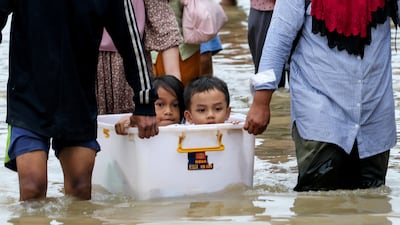
Indonesian residents leave a flooded area in Deli Serdang in the country's North Sumatra province. Reuters -

Military personnel deliver relief supplies to flood survivors in Hat Yai, Songkhla province, Thailand. EPA -

Submerged cars and homes in Hat Yai, southern Thailand. EPA -

An umpire's seat and tennis courts are covered in mud in Hat Yai, Thailand. Reuters -

Flood-displaced people take shelter in a gymnasium in Hat Yai, Thailand. Getty Images -
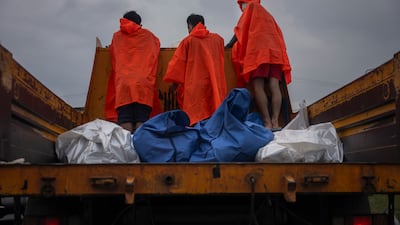
Corpses in body bags are taken away on a lorry after being retrieved by emergency workers Hat Yai, Thailand. Getty Images -

A damaged car in Hat Yai , Thailand. Reuters -

A home surrounded by floodwater in Kangar, in Malaysia's Perlis state. AFP -

A flooded mosque in Kangar, Malaysia. AFP -

Malaysian civil defence officers evacuate an elderly woman on a boat, in Kangar. EPA -

Buildings submerged in floodwater, in Hat Yai, Thailand. AFP -

Rescuers search for survivors in Kangar, Malaysia. AFP -

People displaced by flooding shelter at an evacuation centre in Kangar, Malaysia. Reuters -
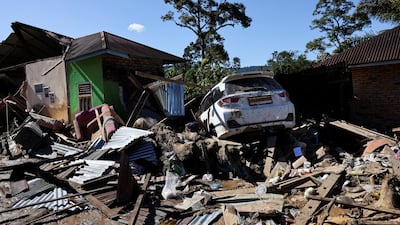
This car ended up stuck among rubble in Palembayan in the West Sumatra province of Indonesia. Reuters -
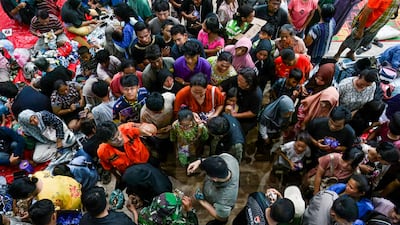
North Sumatra Governor Bobby Nasution distributes meals to displaced residents at a shelter. AFP -

A truck stranded precariously in Padang, West Sumatra. Reuters -

Police officers carry a resident across a wooden bridge in West Sumatra. Reuters -
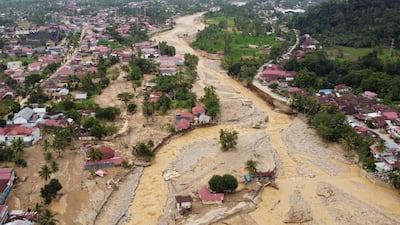
A drone view shows the extent of the damage in Padang, West Sumatra province. Reuters -
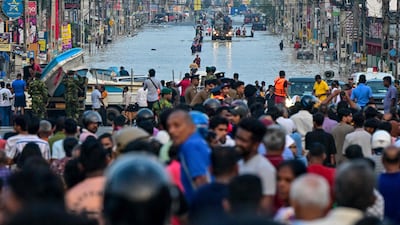
Army personnel ride a truck carrying boats to rescue stranded people in Colombo, Sri Lanka. AFP -

Evacuees are transported on a Sri Lankan army boat on a flooded street in Colombo. AFP -
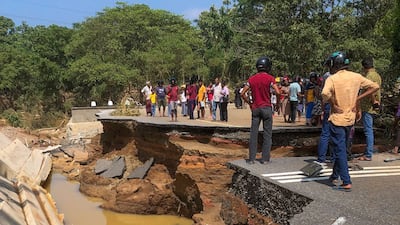
This bridge collapsed after floods in the Sri Lankan city of Kurunegala. AFP -
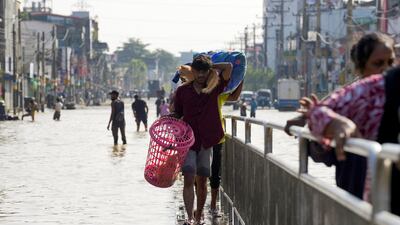
A man carries cats to safety across a flooded street in Wellampitiya, Sri Lanka. Reuters -

This statue of Buddha in Kelaniya. Sri Lanka, was partially submerged. Reuters


The flooding in low-lying areas worsened on Saturday, prompting authorities to issue evacuation orders for those living along the banks of the Kelani River, which flows into the Indian Ocean from the capital, Colombo.
The Kelani burst its banks on Friday evening, forcing hundreds of people to move to temporary shelters, the Disaster Management Centre said.
Rain had subsided in most parts of the country, including the capital, but parts of the island's north were experiencing showers due to the residual effects of Cyclone Ditwah.
Officials said India had sent a planeload of supplies for the victims. Indian Prime Minister Narendra Modi expressed his condolences over the loss of life in Sri Lanka and said New Delhi was ready to send more aid.
In Indonesia, rescuers are struggling to reach the worst-affected areas of Sumatra as the death toll from floods and landslides on the island rose to 248, with more than 100 people missing.
The National Disaster Management Agency said rescuers in West Sumatra’s Agam district have recovered more bodies, and nearly 3,000 displaced families have fled to government shelters.
The areas were largely cut off by damaged roads and downed communications lines. Relief aircraft are delivering aid and supplies to the hard-hit district of Central Tapanuli in North Sumatra province and others in the region.

In Thailand, at least 145 people were killed, according to authorities, as the water level reached three metres (9.8 feet) in the southern Songkhla province.
Prime Minister Anutin Charnvirakul apologised to the public late on Friday for the widespread devastation caused by the worst flooding in years. His comments came as he visited a shelter for evacuees in the hard-hit Hat Yai district.
“I really have to apologise to them for letting this happen during the time I am in government,” he told reporters in footage broadcast on AmarinTV. “The next step is to prevent the situation from deteriorating,” he added, announcing a two-week time frame for the district's clean-up.
The Thai government rolled out relief measures for those affected by the flooding, including compensation of up to two million baht ($62,000) for households that lost family members.
Two other people were killed in Malaysia by flooding caused by heavy rain that left stretches of northern Perlis state underwater.
The annual monsoon season, typically between June and September, often brings heavy rain, triggering landslides and flash floods. But climate change has exacerbated the conditions.

