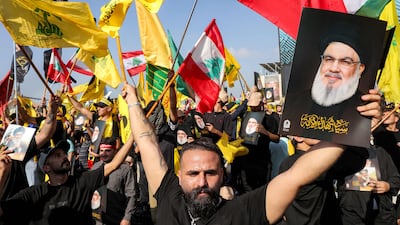

Lebanon says it has dismantled an Israel-supported spy network that planned to carry out bombings in the country, including at events to commemorate assassinated leaders of the Hezbollah militant group.
Four people were arrested on suspicion of taking part in the plot – one dual citizen of Brazil and Lebanon, two Lebanese nationals, and a Palestinian – the General Security Directorate said on Friday.
It said it was able to “dismantle a network working for the Israeli enemy that was preparing for terrorist acts of bombings and assassinations inside Lebanon”.
It added that raids were carried out in conjunction with the Lebanese Army in various areas of Lebanon without specifying where.
A Lebanese security source confirmed to The National that the arrests were related to plots to bomb the continuing commemorations of Hezbollah leaders killed by Israel last year.
Hezbollah's longtime leader Hassan Nasrallah and his successor Hashem Safieddine were killed within days of each other a little more than a year ago, as Israel intensified its war on Lebanon after nearly a year of cross-border exchanges of fire with the Iran-backed group.

Although the arrests were only announced on Friday, there have been reports in Lebanese media in recent days that a spy cell plotting attacks on Hezbollah memorials had been stopped.
A Hezbollah official told The National that “the most clear target” would be anything “related to the commemorations of the sayyids”, referring to Mr Nasrallah and Mr Safieddine.
The General Security said one of the arrested cell members had admitted to carrying out assassinations of members of the Islamic Group, a Lebanese political party that is an offshoot of the Muslim Brotherhood. The party has a small armed wing that has occasionally engaged in fighting with Israel.
“The most probable cause is recreating tension in the particular moment, keeping everyone busy fighting their own people instead of focusing on what's going on outside,” the Hezbollah official said.
Hezbollah, weakened by its war with Israel but still operating, is currently marking 70 days of commemorations for Mr Nasrallah and Mr Safieddine, as well as a slew of senior commanders and fighters who were killed in the war.
Those deaths were in part blamed on Israel infiltrating Hezbollah, including most infamously when thousands of explosives-rigged pagers carried by Hezbollah members across Lebanon blew up in an operation by Mossad, maiming thousands of the militant group's operatives, as well as civilians.
The group, once the most dominant force in Lebanon, is under intense pressure from many in Lebanon and much of the international community to disarm, but is rebuffing any conversation over its weapons while Israel continues to occupy parts of south Lebanon and to bomb the country.