

As the last Israeli tanks rumbled out of Gaza city at midday on Friday, a wave of displaced residents began entering from the south – slowly, hesitantly, as if afraid of what they might find.
They walked through streets that no longer existed, past intersections where no buildings stood, and into neighbourhoods that had become fields of ash and twisted iron.
It was the first time that residents who were forced to leave by the weeks-long Israeli assault on the city were able to return, thanks to a US-backed ceasefire intended to end more than two years of war between Israel and the militant group Hamas.

People wandered through their former neighbourhoods like mourners at a funeral, whispering to each other, calling out names, digging through the dust for fragments of their lives.
Some found nothing. Others found a door, a pot, a photograph.
Children pointed at the rubble and asked their parents, “Was this our house?”
Fuad Al Masri, 54, a father of seven, who moved his family out of their home but refused to leave the city, had been waiting impatiently for the Israelis to leave so that he could return.
“From the moment they announced the truce, I was burning inside,” Mr Al Masri told The National. “I just wanted to see my home, to see what was left.”

His family's four-storey house on Al Jalaa Street had been built brick by brick over two decades of saving and dreaming. What he found was a pile of rubble.
“Twenty years of hard work, all gone,” he said, tears streaming down his face as he stood in front of what was once his living room. “Thirty-five of us – my sons, their wives, my grandchildren – we have nowhere to go.”
Rami Samour, 33, a father of two, said he spent two days in the Al Nuwairi area near Gaza city, waiting to enter, as reports from truce talks in Egypt suggested a ceasefire was imminent. When the roads finally opened, he ran to the Al Nasr neighbourhood to see if his home was still standing.
“Thank God, my house is still there,” he told The National, wiping dust from his hands. “But it’s badly damaged. The walls cracked, windows gone, roof half-collapsed. The work of my life, almost gone.”
Then his voice faltered. “But when you see what’s around you, you realise you were lucky. There isn’t a single street without massive destruction. The army didn’t leave until it had turned Gaza into rubble; it wiped out every sign of life.”
Still, Mr Samour refuses to lose hope.
“You can see how much people love Gaza,” he said. “Thousands gathered near Al Nuwairi area, waiting to be allowed in, even knowing they’d find nothing but ruins. That love, that’s what will rebuild this city.”
Palestinians make their way back to Gaza city - in pictures
-
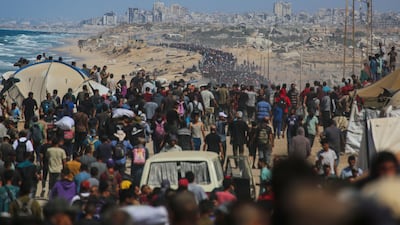
Thousands of displaced Palestinians return to Gaza city from Nuseirat, using Al Rashid road, after the ceasefire between Israel and Hamas was announced. AFP -
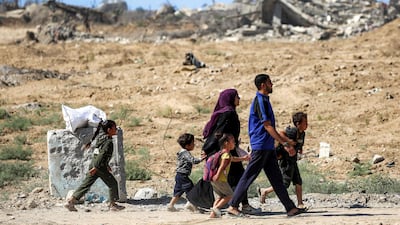
A family on the move to Gaza city. The enclave's civil defence agency said Israeli troops began withdrawing from parts of the territory, particularly in Gaza city and Khan Younis. AFP -

Palestinians make their way along Al Rashid road towards Gaza city. AFP -
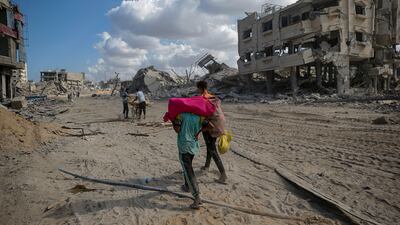
Many were returning to find their homes destroyed in Gaza city. EPA -
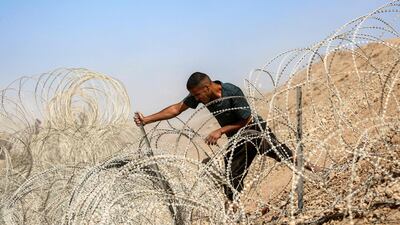
A man attempts to remove parts of the barbed-wire fence of the so-called 'Netzarim corridor' near Nuseirat, as people make their way back to Gaza city. AFP -

A car towing a cart with passengers moves along a dirt road to Gaza city. AFP -
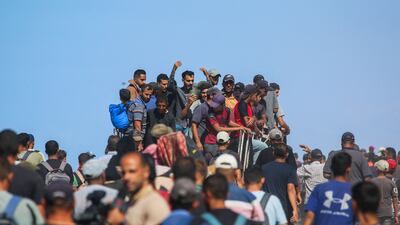
Palestinians make their way along Al Rashid road toward Gaza city. AFP -

A man carries firewood on his shoulders past people making their way to Gaza city. AFP


In the Zeitoun neighbourhood, Mo’men Azzam, 28, walked through what used to be his family’s street, or where he thought it was. He recognised nothing.
“It’s true, we’ve returned,” he told The National. “But our return is full of pain, grief, and loss.”
Mr Azzam fled south after an Israeli air strike on the city killed his brother and all of his brother’s children, but he promised himself that he would come back to see what was left.
“I found nothing,” he said. “Nothing of what we built over a lifetime.
“We lost our homes, our work, our family. Gaza is destroyed, completely. The streets, the restaurants, the landmarks, the very soul of the city, all gone.”
Despite the devastation, the city will rebuild, he said, turning in the direction of the sea, no longer visible behind blocks of flattened concrete.
“God willing, the [ceasefire] agreement will hold. Peace will return, and we’ll rebuild everything. Gaza will come back, and so will we,” he said.
“Israel destroyed Gaza because it knows how much we love it. But no matter how much they destroy, they can’t kill that love.”

