Lebanon's army began removing weapons from a Palestinian refugee camp on Thursday in what officials described as the first step in disarming the makeshift settlements.
The weapons were taken out of the Burj Al Barajneh camp on a pickup truck under the guard of Lebanese troops on Thursday, with sources saying they had been collected from a splinter group of the Palestinian faction Fatah.
Ramez Dimechkie, chairman of the committee which co-ordinated the effort between Lebanese and Palestinian authorities, said: “The first phase of the process of handing over weapons from within the Palestinian camps will begin today, starting with the Burj Al Barajneh camp in Beirut. A first batch of weapons will be handed over and placed in the custody of the Lebanese Army.”
But the handover may be less sweeping than Lebanese officials suggest. A Hamas source told The National that the move does not amount to a broader disarmament of Palestinian factions.
The source said the weapons to be given to the Lebanese state today amount to “a few rockets”.
“It’s not a disarmament of Palestinian weapons,” the source said, explaining that the Lebanese army was confiscating weapons from a warehouse where a splinter group of the Fatah party had been storing them.
“They [Fatah] are handing them to the state. They’re disarming themselves; it has nothing to do with us or the camps.
“They’re not able to take our weapons, so they’re trying to sell this as a camp-wide disarmament.”

A security source in Beirut had earlier said the operation in Burj Al Barajneh would be followed by disarmament in El Buss camp in the south, and would involve the handover of heavy weaponry.
The disarmament of Lebanon’s 12 Palestinian refugee camps was previously scheduled to begin in mid-June. The issue of disarming the 12 Palestinian refugee camps, which are not under Lebanese state control, has long been contentious. Groups such as Hamas and Palestinian Islamic Jihad (PIJ), dedicated to armed resistance against Israel and allied with Hezbollah, have frequently used Lebanon as a base to launch rockets at Israel.
Nadine Marouk, director of the Lebanese-Palestinian Dialogue Committee, confirmed that “Fatah are the ones to hand over today”, but added that other factions, including Hamas and the PIJ, “are co-ordinating closely with us and the government”.
The US special envoy Tom Barrack, who has been heading Washington's push for the disarmament of Hezbollah, congratulated the Lebanese government and Fatah on "a great accomplishment as a result of the bold action recently taken by the Lebanese Council of Ministers".
-
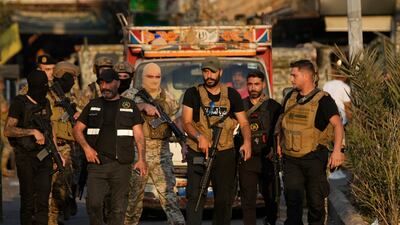
Lebanese soldiers from the intelligence units escort a lorry carrying weapons handed over by Palestinian factions at the Burj Al Barajneh Palestinian refugee camp in Beirut, Lebanon. AP -
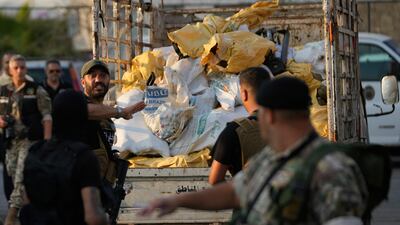
A lorry loaded with weapons makes its way through Beirut. AP -
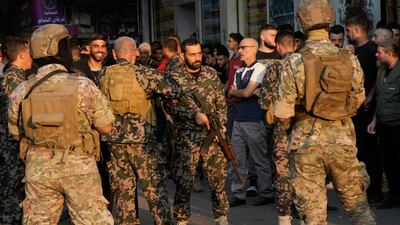
A Palestinian from the National Security Forces, centre, stands in front of Lebanese soldiers, at the entrance of Burj Al Barajneh Palestinian refugee camp. AP -
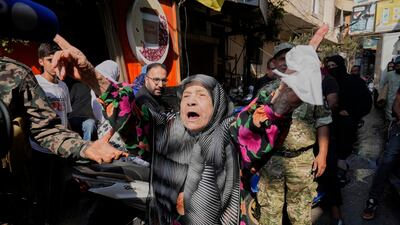
A Palestinian woman protests the handing over of weapons by Palestinian factions to the Lebanese army. AP -
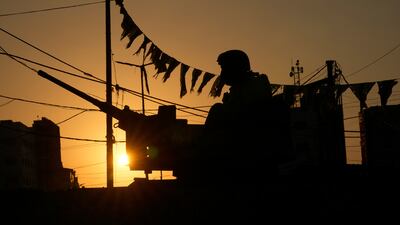
A silhouetted Lebanese soldier sits on his armoured personnel carrier at the entrance of Burj Al Barajneh Palestinian refugee camp. AP -
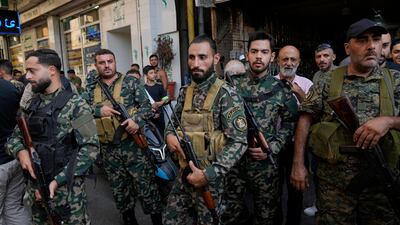
Palestinians from the National Security Forces stand at the entrance of Burj Al Barajneh Palestinian refugee camp. AP -
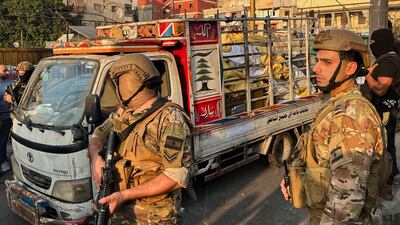
A lorry carrying weapons handed over by Palestinian factions. AP


In a post on X, he described it as "a historic step toward unity and stability, showing true commitment to peace and co-operation".
Disarming the camps comes under a broader initiative by Lebanese leaders to limit and disarm non-state forces. But the memory of Lebanon's 1975–1990 civil war – in which Palestinian militias were among the main participants alongside a series of Lebanese factions and international proxies – still lingers for many Palestinians, who view weapons as essential for self-defence.
Weaponry also holds deep symbolic value for Palestinians in Lebanon, many of whom were expelled from their land in 1948 during the Nakba, which marked the creation of what is now Israel. For them, arms represent not only protection but a continuing struggle to return to their homeland.
Hamas, Fatah’s primary opposition, is the governing authority in the Israeli-besieged Gaza Strip and enjoys significant popularity in many of Lebanon’s refugee camps. Both it and PIJ have publicly rejected the idea of disarmament.
The Hamas official tied the fate of Hezbollah's disarmament to that of their own. “The weapons aren’t ours, they belong to the resistance,” he said, alluding to Hezbollah and its backer, Iran – both Hamas allies.
“If we ever decide to disarm, we will return them to the resistance. And so far, Hezbollah is saying it won’t disarm.”
Ms Marouk acknowledged the challenges of dealing with Hamas, PIJ and other armed groups that form a coalition opposed to Fatah. “We cannot separate the two,” she said, referring to Hezbollah and the coalition. “But we have assurances from them that they fully co-operate with the Lebanese state.”
Lebanon hosts about 222,000 Palestinian refugees, many of whom live in the 12 overcrowded camps, according to the UN agency UNRWA. Most are direct refugees or descendants of Palestinians who were expelled from their land during a violent mass removal that led to the creation of the state of Israel in 1948. They face a variety of legal restrictions in Lebanon, including on employment.

