
Iraqi Prime Minister Mohammad Shia Al Sudani at a 2022 meeting with the Emir of Kuwait Sheikh Meshal, when he was Kuwaiti crown prince. Photo: Kuwait News Agency

The Khor Abdullah waterway: Navigation deal or border surrender?


Sinan Mahmoud
  • English
  • Arabic

A 2012 agreement between Iraq and Kuwait regulating navigation in the shared Khor Abdullah waterway has triggered intense debate inside Iraq ever since, with critics warning it blurs maritime boundaries and threatens national sovereignty.

Some opponents are calling to annul the deal, while others support renegotiation to safeguard Iraq's rights.

Meanwhile, Kuwait maintains that its maritime boundary with Iraq, including navigation rights in Khor Abdullah, is firmly grounded in international law. Kuwaiti officials have repeatedly stressed that any attempt to revoke this agreement unilaterally is invalid and unacceptable.

The Kuwaiti Ministry of Foreign Affairs has lodged formal protests and called on Iraq to honour its commitments under binding international treaties, reaffirming Kuwait’s sovereignty over its territorial waters and its right to shared navigation in Khor Abdullah.

The issue of land and maritime borders between Iraq and Kuwait is highly sensitive among Iraqis with many viewing the border demarcation unfairly imposed by the US Security Council after driving Saddam Hussein’s army out of its neighbour in 1991 and say the country’s weakened state at the time was exploited. It is equally sensitive from the Kuwaiti point of view due to the 1990 invasion, with concerns about Iraqi over-reach.

The controversy has pitted Iraqi Prime Minister Mohammed Shia Al Sudani against the public, with critics accusing him of compromising the country’s rights to Kuwait to secure regional support as he eyes a second term in office in November's national election. Some have gone as far as accusing Iraqi officials involved in the border negotiations of receiving bribes from Kuwait, without providing substantial evidence.

Both Iraq and Kuwait claim exclusive ownership of the narrow canal, which curves around Kuwait's Bubiyan and Warba islands on one side and Iraq's Al Faw Peninsula on the other. Iraqis say it is named after a famous Basra fisherman, Abdullah Al Timimi, while Kuwaitis say its name derives from the second ruler of Kuwait, Abdullah bin Sabah, who ruled from 1762 to 1814.

In early 2022, Iraq closed off the chapter of Kuwait compensation, paying its final war reparations, settling the $52.4 billion of claims made for damage inflicted during the 1990 invasion.
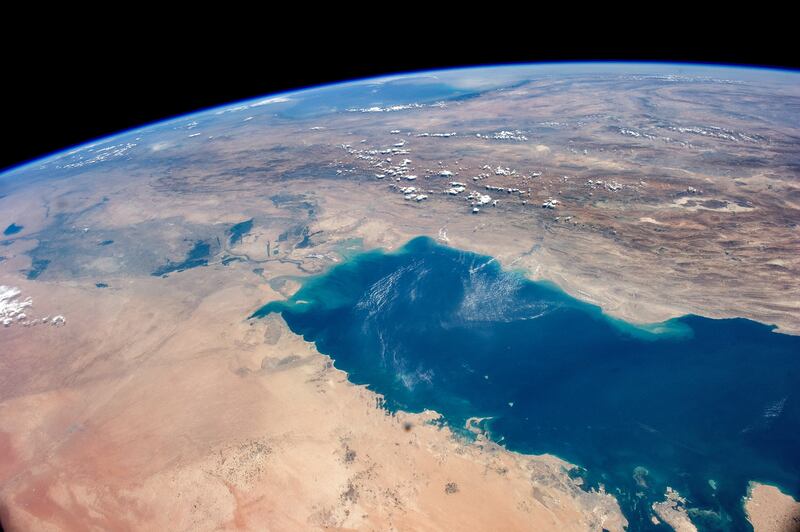
A 2014 image taken from the International Space Station shows the Tigris and Euphrates valleys leading into the Arabian Gulf. Nasa / AFP

What is the agreement and its purpose?

Three years after Iraq's invasion of Kuwait in 1990, the UN Security Council passed Resolution 833, which determined the land border between the two. However, the delineation of the maritime border was left to the countries themselves.

In 2012, Baghdad and Kuwait signed the agreement and it was ratified in 2013 by the parliament in Baghdad. It aimed to regulate maritime traffic, environmental protection and safety within the estuary that forms Iraq’s only gateway to the Arabian Gulf.

The deal gives each country the right to control navigation and safety enforcement. It stipulates that the agreement “shall remain in effect indefinitely” but can be mutually terminated with six months' notice. This also applies to amending it.

Critics’ arguments

Critics – mainly legislators, independent politician and experts – argue that the terms of the accord implicitly draw a boundary, warning it could prejudice future maritime border negotiations and impose access controls on Iraqi ships, requiring Kuwaiti approval and fees.

Amir Abdul Jabar, who served as transport minister from 2008 to 2010 and is one of the strongest opponents of the agreement, argues it is meant to delineate a maritime border rather than regulate navigation.

Although the accord states that the agreement “shall have no effect upon the boundary” between Iraq and Kuwait as demarcated pursuant to the UN Security Council Resolution 833 in 1993 at the creek, it gives Kuwait more control beyond that deep in the Gulf, Mr Abdul Jabar said.

Article 2 of the agreement explains the term “waterway” as the area from the point where the maritime channel at Khor Abdullah meets the international boundary between the points 156 and 157 heading south to the point 162 set by the Resolution 833 “thence to the beginning of the maritime channel at the entrance to Khor Abdullah”.

“So, the definition of the waterway in the agreement didn’t stop at the 162 point – the one set by the UN Security General resolution,” Mr Abdul Jabar said.

Article 4 stipulates that “each party shall exercise its sovereignty over that part of the waterway which lies within its territorial water”.

The essence of the objection, Mr Abdul Jabar said, is that it must not be applied on the area beyond the point 162 as Article 2 stipulates. “How is it possible to divide the area beyond the point 162?” Mr Abdul Jabar said.

“We are not objecting to the [833] resolution even though it’s unfair, but the government and parliament of 2012-2013 brought a new disaster [in signing this deal],” he added, warning that Iraq could lose future maritime entitlement to deeper Gulf waters and its natural resources known as the Exclusive Economic Zone.

Mr Abdul Jabar had filed a lawsuit against Mr Al Sudani for “blocking the court’s ruling”, by refusing to have copies of it deposited to the UN and the International Maritime Organisation.

US warplanes fly over Kuwaiti oil fires, started by the retreating Iraqi army in 1991. Getty Images

Ruling and controversy

In September 2023, Iraq’s Federal Supreme Court invalidated the law ratifying the agreement, ruling that it violated the Iraqi Constitution by lacking the required two thirds parliamentary majority for international treaties. Parliament had passed it by simple majority only.

Shortly after the ruling, the GCC and US issued a joint statement in which they called on the Iraqi government to “ensure that the agreement remains in force”.

The Iraqi government has assured Kuwait that Iraq is committed to all its international agreements. Afterwards, Mr Al Sudani and President Abdul Latif Rashid have independently sought to reverse the ruling. These requests were withdrawn early this month and the agreement was sent back to parliament to approve in a two-thirds majority.

It was a sigh of relief for the opponents. Many of them are now asking to annul the agreement by rejecting it inside parliament, while others are seeking to renegotiate it with an Iraqi team including experts, not only politicians.

Protests across Iraq have continued, to reject the agreement in its current form. A public campaign is also set to be launched to collect signatures for a petition for the UN Security Council.

Fadi Al Shammari, a political adviser to Mr Al Sudani, confirmed the Khor Abdullah agreement aims to regulate navigation and has nothing to do with border demarcation.

“Iraqi land is sacred, and there will be no leniency or compromise over any inch of it under any pretext,” Mr Al Shammari said, claiming that campaigns opposing the agreement are “driven by political and electoral agendas”.

Iraqis are divided about the agreement, although many of the Iran-backed political parties and armed groups are echoing the government stance.

In an interview with a local satellite channel in May, the leader of the Asaib Ahl Al Haq group, Qais Al Khazali, blamed Saddam Hussein’s banned Baath party for seeking to discredit the agreement by portraying it as “giving up Iraq's borders with Kuwait”.

“Saddam was the one who sold it [the border] when he recognised resolution 833", a UN motion which set the land and maritime borders, he said.

It is still unclear if the parliament will ratify the agreement or whether it will be left to the next parliament after national elections in November national elections.

Kuwait is also in dispute with Iran over their maritime border and Al Durra offshore gasfield in the Arabian Gulf. Kuwait and Saudi Arabia say they have “exclusive rights” to Al Durra and called on Iran to validate its claim by demarcating its maritime borders.

Iran previously claimed a stake in the field and said a Kuwaiti-Saudi agreement signed last year to develop the field was illegal.


Mercer, the investment consulting arm of US services company Marsh & McLennan, expects its wealth division to at least double its assets under management (AUM) in the Middle East as wealth in the region continues to grow despite economic headwinds, a company official said.

Mercer Wealth, which globally has $160 billion in AUM, plans to boost its AUM in the region to $2-$3bn in the next 2-3 years from the present $1bn, said Yasir AbuShaban, a Dubai-based principal with Mercer Wealth.

Within the next two to three years, we are looking at reaching $2 to $3 billion as a conservative estimate and we do see an opportunity to do so,” said Mr AbuShaban.

Mercer does not directly make investments, but allocates clients’ money they have discretion to, to professional asset managers. They also provide advice to clients.

“We have buying power. We can negotiate on their (client’s) behalf with asset managers to provide them lower fees than they otherwise would have to get on their own,” he added.

Mercer Wealth’s clients include sovereign wealth funds, family offices, and insurance companies among others.

From its office in Dubai, Mercer also looks after Africa, India and Turkey, where they also see opportunity for growth.

Wealth creation in Middle East and Africa (MEA) grew 8.5 per cent to $8.1 trillion last year from $7.5tn in 2015, higher than last year’s global average of 6 per cent and the second-highest growth in a region after Asia-Pacific which grew 9.9 per cent, according to consultancy Boston Consulting Group (BCG). In the region, where wealth grew just 1.9 per cent in 2015 compared with 2014, a pickup in oil prices has helped in wealth generation.

BCG is forecasting MEA wealth will rise to $12tn by 2021, growing at an annual average of 8 per cent.

Drivers of wealth generation in the region will be split evenly between new wealth creation and growth of performance of existing assets, according to BCG.

Another general trend in the region is clients’ looking for a comprehensive approach to investing, according to Mr AbuShaban.

“Institutional investors or some of the families are seeing a slowdown in the available capital they have to invest and in that sense they are looking at optimizing the way they manage their portfolios and making sure they are not investing haphazardly and different parts of their investment are working together,” said Mr AbuShaban.

Some clients also have a higher appetite for risk, given the low interest-rate environment that does not provide enough yield for some institutional investors. These clients are keen to invest in illiquid assets, such as private equity and infrastructure.

“What we have seen is a desire for higher returns in what has been a low-return environment specifically in various fixed income or bonds,” he said.

“In this environment, we have seen a de facto increase in the risk that clients are taking in things like illiquid investments, private equity investments, infrastructure and private debt, those kind of investments were higher illiquidity results in incrementally higher returns.”

The Abu Dhabi Investment Authority, one of the largest sovereign wealth funds, said in its 2016 report that has gradually increased its exposure in direct private equity and private credit transactions, mainly in Asian markets and especially in China and India. The authority’s private equity department focused on structured equities owing to “their defensive characteristics.”

Bio

Born in Dibba, Sharjah in 1972.
He is the eldest among 11 brothers and sisters.
He was educated in Sharjah schools and is a graduate of UAE University in Al Ain.
He has written poetry for 30 years and has had work published in local newspapers.
He likes all kinds of adventure movies that relate to his work.
His dream is a safe and preserved environment for all humankind. 
His favourite book is The Quran, and 'Maze of Innovation and Creativity', written by his brother.

Blackpink World Tour [Born Pink] In Cinemas

Starring: Rose, Jisoo, Jennie, Lisa

Directors: Min Geun, Oh Yoon-Dong

Rating: 3/5

The specs

Engine: 3.8-litre, twin-turbo V8

Transmission: eight-speed automatic

Power: 582bhp

Torque: 730Nm

Price: Dh649,000

On sale: now  

The specs
  • Engine: 3.9-litre twin-turbo V8
  • Power: 640hp
  • Torque: 760nm
  • On sale: 2026
  • Price: Not announced yet
Specs

Engine: Dual-motor all-wheel-drive electric

Range: Up to 610km

Power: 905hp

Torque: 985Nm

Price: From Dh439,000

Available: Now

F1 The Movie

Starring: Brad Pitt, Damson Idris, Kerry Condon, Javier Bardem

Director: Joseph Kosinski

Rating: 4/5

Brief scores

Barcelona 2

Pique 36', Alena 87'

Villarreal 0

Army of the Dead

Director: Zack Snyder

Stars: Dave Bautista, Ella Purnell, Omari Hardwick, Ana de la Reguera

Three stars

AGL AWARDS

Golden Ball - best Emirati player: Khalfan Mubarak (Al Jazira)
Golden Ball - best foreign player: Igor Coronado (Sharjah)
Golden Glove - best goalkeeper: Adel Al Hosani (Sharjah)
Best Coach - the leader: Abdulaziz Al Anbari (Sharjah)
Fans' Player of the Year: Driss Fetouhi (Dibba)
Golden Boy - best young player: Ali Saleh (Al Wasl)
Best Fans of the Year: Sharjah
Goal of the Year: Michael Ortega (Baniyas)

The National in Davos

We are bringing you the inside story from the World Economic Forum's Annual Meeting in Davos, a gathering of hundreds of world leaders, top executives and billionaires.

The six points:

1. Ministers should be in the field, instead of always at conferences

2. Foreign diplomacy must be left to the Ministry of Foreign Affairs and International Co-operation

3. Emiratisation is a top priority that will have a renewed push behind it

4. The UAE's economy must continue to thrive and grow

5. Complaints from the public must be addressed, not avoided

6. Have hope for the future, what is yet to come is bigger and better than before

The%20specs
%3Cp%3E%3Cstrong%3EPowertrain%3A%20%3C%2Fstrong%3ESingle%20electric%20motor%0D%3Cbr%3E%3Cstrong%3EPower%3A%20%3C%2Fstrong%3E201hp%0D%3Cbr%3E%3Cstrong%3ETorque%3A%20%3C%2Fstrong%3E310Nm%0D%3Cbr%3E%3Cstrong%3ETransmission%3A%20%3C%2Fstrong%3ESingle-speed%20auto%0D%3Cbr%3E%3Cstrong%3EBattery%3A%20%3C%2Fstrong%3E53kWh%20lithium-ion%20battery%20pack%20(GS%20base%20model)%3B%2070kWh%20battery%20pack%20(GF)%0D%3Cbr%3E%3Cstrong%3ETouring%20range%3A%20%3C%2Fstrong%3E350km%20(GS)%3B%20480km%20(GF)%0D%3Cbr%3E%3Cstrong%3EPrice%3A%20%3C%2Fstrong%3EFrom%20Dh129%2C900%20(GS)%3B%20Dh149%2C000%20(GF)%0D%3Cbr%3E%3Cstrong%3EOn%20sale%3A%3C%2Fstrong%3E%20Now%3C%2Fp%3E%0A
Sarfira

Director: Sudha Kongara Prasad

Starring: Akshay Kumar, Radhika Madan, Paresh Rawal 

Rating: 2/5

Specs

Engine: 51.5kW electric motor

Range: 400km

Power: 134bhp

Torque: 175Nm

Price: From Dh98,800

Available: Now

Key findings of Jenkins report
  • Founder of the Muslim Brotherhood, Hassan al Banna, "accepted the political utility of violence"
  • Views of key Muslim Brotherhood ideologue, Sayyid Qutb, have “consistently been understood” as permitting “the use of extreme violence in the pursuit of the perfect Islamic society” and “never been institutionally disowned” by the movement.
  • Muslim Brotherhood at all levels has repeatedly defended Hamas attacks against Israel, including the use of suicide bombers and the killing of civilians.
  • Laying out the report in the House of Commons, David Cameron told MPs: "The main findings of the review support the conclusion that membership of, association with, or influence by the Muslim Brotherhood should be considered as a possible indicator of extremism."

Thor: Ragnarok

Dir: Taika Waititi

Starring: Chris Hemsworth, Tom Hiddleston, Cate Blanchett, Jeff Goldblum, Mark Ruffalo, Tessa Thompson

Four stars

Muslim Council of Elders condemns terrorism on religious sites

The Muslim Council of Elders has strongly condemned the criminal attacks on religious sites in Britain.

It firmly rejected “acts of terrorism, which constitute a flagrant violation of the sanctity of houses of worship”.

“Attacking places of worship is a form of terrorism and extremism that threatens peace and stability within societies,” it said.

The council also warned against the rise of hate speech, racism, extremism and Islamophobia. It urged the international community to join efforts to promote tolerance and peaceful coexistence.

The 100 Best Novels in Translation
Boyd Tonkin, Galileo Press

Islamophobia definition

A widely accepted definition was made by the All Party Parliamentary Group on British Muslims in 2019: “Islamophobia is rooted in racism and is a type of racism that targets expressions of Muslimness or perceived Muslimness.” It further defines it as “inciting hatred or violence against Muslims”.

Updated: August 02, 2025, 3:50 AM