


Saddam Hussein’s invasion of Kuwait, 30 years ago on Sunday, and its aftermath left a legacy of economic and social devastation from which Iraq has yet to emerge.
The invasion was a disaster of epic proportions, even to Iraqis used to the harshness and missteps of Saddam’s rule.
Only two years earlier, Iraq's war with Iran ended with one million killed on both sides over eight years.
This time, Saddam’s miscalculation destroyed their livelihoods. The monthly salary of a university professor became barely enough to buy a carton of eggs.
Official Iraqi data, shown only to Saddam by central bank officials, revealed that the economy contracted by 56 per cent in 1991.
Some of the decline was reversed in 2001 as illicit trade with Syria and Iraqi Kurdistan, which was under US and British air protection, went into full swing.
The Iraqi currency was one of the strongest in the Middle East before the invasion of Kuwait, with one Iraqi dinar buying US$3.
By the eve of the American advance towards Baghdad in March 2003, $1 bought 3,500 dinars.
The exchange rate recovered somewhat to 1,400 dinars by the end of 2003.
The dinar is trading at 1,200 to the dollar today, still immensely weaker in value than before the invasion and the UN sanctions it provoked.
Saddam invaded after Kuwait resisted his demands to write off $14 billion it lent to Iraq, mostly during the Iraq-Iran war, and to lower oil production.
Within days, the UN voted for the sanctions to punish the Iraqi government for the invasion and to stop it importing technology to make weapons.
It then authorised the Gulf War that removed Saddam’s forces from Kuwait and dealt the Iraqi army one of the heaviest defeats in modern history.
Bombardment by the US-led coalition inflicted massive devastation on Iraq’s infrastructure.
-

Picture taken on August 14, 1990 at Ruwaished showing Arab refugees from different countries waiting for the permission to return to their homelands at the Iraq-Jordan border checkpoint as thousands of foreigners flee the war in Iraq and Kuwait. AFP -
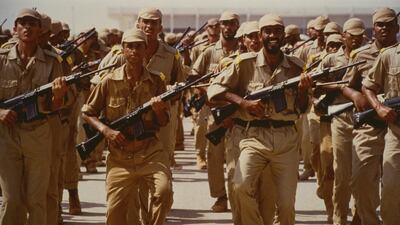
August 1990: A training camp for new recruits in the United Arab Emirates, following the country's appeal for servicemen on the 11th August 1990, during the Gulf Crisis. Getty -
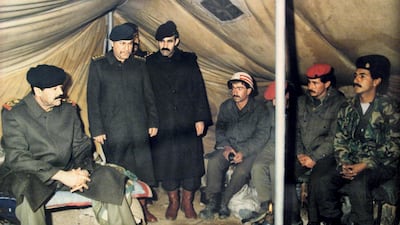
A reproduction of a picture displayed at the Nasr or Victory Museum in Baghdad shows Iraqi President Saddam Hussein (L) visiting Iraqi troops at a military camp in occupied territory in Kuwait after the August 2, 1990 invasion of the Gulf emirate. Getty -

The Emir of Kuwait Jaber Al Sabah (R) walks with Egyptian President Hosni Mubarak 9 August 1990 upon his arrival for the emergency Arab Summit to discuss Iraq's invasion of Kuwait and the worsening situation. AFP -
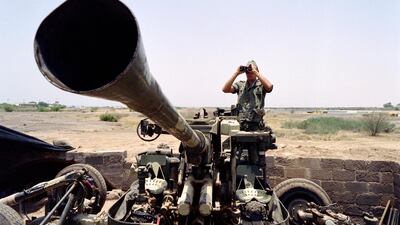
A French soldier looks through binoculars as he mans an anti-craft gun near Djibouti airport, on August 20, 1990, as French army was deployed in the Persian Gulf since Iraq's invasion of Kuwait on August 02, 1990, leading to a conflict between Iraq and Kuwait and an international military intervention. AFP -
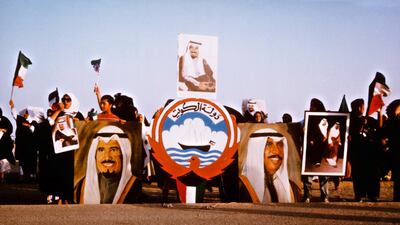
A demonstration in Kuwait, following the country's invasion by Iraq at the start of the Gulf War, 4th-6th August 1990. In the centre is the Emblem of Kuwait, adopted in 1962. Getty -
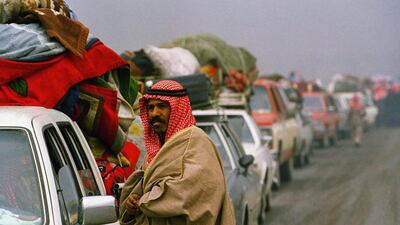
A Kuwaiti refugee stands beside his car outside Kuwait City after Iraq invaded 30 years ago. Scott Applewhite / AP


Since the war, Iraq has paid at least $48bn of the $52bn the UN Compensation Commission ordered.
The commission set the amount for the destruction by Saddam’s troops of Kuwaiti oilfields and other state-owned and private assets during their seven-month occupation of the country.
Iraq's current Finance Minister, Ali Allawi, said that by the end of the war in 1991, Iraq “was faced with catastrophic economic, social and administrative collapse”.
Mr Allawi, a former banker and academic, was speaking at a confidential meeting in Berlin in March, two months before he joined the new government.
The National obtained a copy of his presentation on "institutional decay" in Iraq.
As examples of the massive corruption, Mr Allawi told of teachers receiving bribes to give students pass marks and doctors refusing to treat patients unless they were paid extra.
The sanctions produced “a widespread network of smugglers and fixers who dealt routinely in bribes and corruption”, he said.
As the sanctions took a huge toll on Iraqi civilians, the UN reached an agreement with Saddam’s government in 1996, allowing it to sell "oil for food" and other humanitarian goods.
After Saddam fell, details emerged of the extent of corruption in the programme, forcing the UN to start an investigation led by Paul Volcker, the former US Federal Reserve chairman and one of the world’s most respected financial figures.
The 2005 Volcker Report documented how Saddam and his associates used the oil-for-food programme to obtain illicit income, with multinational and smaller companies paying bribes or kickbacks to the regime for contracts.
He also used oil sales to reward officials and politicians in the Middle East, Russia, France and Britain for supporting the regime.
The sales generated $1.8bn in illicit income from 2,200 companies in 66 countries.
On top of the cashflow from the programme, Saddam’s son Uday opened major oil smuggling channels through Syria and Iraqi Kurdistan.
For the sake of business, Syrian President Hafez Al Assad buried a decades-long rivalry with Saddam and reactivated the Kirkuk-Baniyas pipeline, through which up to 200,000 barrels a day of Iraqi oil was smuggled.
Uday also did business with Kurdish politicians, a few years after the gassing of the city of Halabja by Saddam’s air force, to smuggle oil and fuel through Iraqi Kurdistan to Turkey.
A new class of smugglers emerged in Saddam’s territory.
They preferred to dine at Lanterns, an old restaurant in Baghdad favoured by Uday until an assassination attempt that almost killed him in 1996 and curtailed sharply his public appearances.
Uday occasionally had cigars after dinner and tipped generously.

Lanterns was also favoured by the smugglers because they had booths where alcohol was served away from prying eyes.
Although Saddam imposed restrictions on the sale of alcohol and its consumption in public, he never banned it outright.
By this time he had initiated a huge mosque-building programme and even female members of the purportedly secular Baath Party were being encouraged to wear the headscarf.
A more hard-line form of Islam was tolerated, especially in Fallujah and other Sunni areas in eastern Iraq, which later became the main recruiting ground for extremist groups.
Saddam also promoted Shiites he saw as a counterweight to perceived “Persian” influence in the hawza, the Shiite religious schools in the city of Najaf.
One was Ayatollah Mohammad Sadiq Al Sadr, father of the cleric Moqtada Al Sadr, who is today the kingmaker of Iraqi politics. Mohammad Sadiq fell out with the regime and was killed in 1999.
Iraqi political analyst Sajad Jiyad said the religious campaign set the scene for Al Qaeda and other extremist groups to find “an incubator” in Iraq after Saddam fell.
The health and education sectors were ruined. Links between Iraqi universities and hospitals and the outside world were severed.
Most of the population had no access to the internet, mobile phones and international television, Mr Jiyad told The National.
“There was no transfer of knowledge," he said. "Society was dismembered and its informed layers had escaped. The embargo benefited the state and weakened the people.”
Mr Jiyad said the brain drain and “lack of awareness” in society, combined with the terror under Saddam, affected at least two generations since 1990.
Many Iraqis went on looting rampages after Saddam fell. In Baghdad, they were mostly disenfranchised Shiites in Saddam’s City, later renamed Sadr City.
They regarded the things they stole “as not belonging to the state but to Saddam”, Mr Jiyad said.
Hours after a US tank pulled down Saddam’s statue from a major square in Baghdad, looters, some of them armed, ransacked government buildings and the large villas belonging to Saddam’s associates.
They drove tractors, trucks, and a bus to the villa of Tariq Aziz, who was also Saddam's deputy prime minister.
Aziz had met with US Secretary of State James Baker in Geneva in January 1991 in a last-ditch effort to avoid war between Iraq and the US.
He repeated Saddam’s position that Iraq would not pull out from Kuwait unless Israel withdrew from the Palestinian territories.
Seven weeks later, Saddam’s generals accepted a de facto surrender in the Gulf War.
One man from Sadr City had brought his wife and children and his extended family to Aziz’s villa. They did not touch anything.
“I just wanted to show my family how they lived and how we live,” he said.
The looters stole everything, even electrical wire they stripped from the walls.
But they left Aziz's books. One was The Godfather by Mario Puzo.
Iraq was ruled by a mafia that in many ways thrived as the people suffered.
A major reason behind a civil uprising that broke out in October, and was later crushed, was a popular belief that the old oligarchy was replaced by a new one.
The country’s new Prime Minister, Mustafa Al Kadhimi, promised a break with the past and an end to militia rule.
But state coffers are empty. With the decline in oil prices, officials say government revenue is about $2bn (Dh7.34bn) a month, compared with the $5bn monthly cost just for salaries.
Three per cent of that oil revenue this year is supposed to pay for the remaining reparations to Kuwait, which is looking more unlikely by the day.
Kuwait City was one of the first foreign stops for Mr Allawi as soon as he took the job in May.
He is seeking Arab investment to prop up the economy and wants to establish a sovereign fund to protect the oil wealth from corruption.
Many of the same militia-linked power centres Mr Al Kadhimi and Mr Allawi detest have cheered their plans because they do not want Iraq to sink financially.
Like The Godfather showed, the mafia-like militias can adapt.

