
Lebanon is reaching a critical point in its efforts to disarm Hezbollah, with the cabinet due to formally discuss the issue on August 5 and President Joseph Aoun expected to address it in a speech on Friday.
Prime Minister Nawaf Salam called for a cabinet session next Tuesday to conclude discussions over “the extension of state sovereignty over all its territories” and weapons exclusivity − which in essence means disarming Hezbollah and other non-state groups.
“The session was brought forward due to external pressure on Lebanon regarding Hezbollah disarmament,” Lebanese sources familiar with the matter told The National. “Important decisions are expected to be made soon.”
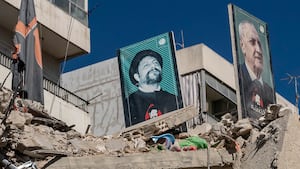
The US has tied any postwar reconstruction aid and a potential halt to Israeli military operations to the full disarmament of Hezbollah across Lebanon. The country is still reeling from the aftermath of Hezbollah's year-long war with Israel and the economic collapse that began in 2019.
Whether the ministers will vote to issue a formal cabinet decision committing to disarm the Iran-backed group remains unclear. Although the cabinet does not consist of any political parties, it includes members who back Hezbollah or its allies.
“The Council of Ministers will focus on how to implement arms exclusivity,” said a source close to Mr Salam, but added that the road map to achieve that remains undecided.
They said it remained unclear “if there will be a vote or if there will be a decision by agreement. We will wait and see”.
The US continues to exert significant pressure on Lebanon to push forward and disarm Hezbollah. Mr Aoun and his government have repeatedly said this is their objective. But they warn that unless achieved in the right way, it risks fuelling tensions in a country already on edge.
Disarming Hezbollah became a possible outcome after its war with Israel left it weakened by significant losses.
The group's new reality has made it open to discussions on a national defence strategy but it has rejected talk of disarming while Israel continues to bomb Lebanon daily and occupies five points on Lebanese soil.
Hezbollah secretary general Naim Qassem spoke on Wednesday night to mark the first anniversary of the assassination of the group's top military commander, Fouad Shukr. A series of assassinations followed, targeting senior leaders of the group including long-serving secretary general Hassan Nasrallah.
Mr Qassem reiterated that Hezbollah's weapons arsenal was a “domestic issue," and insisted that Israel's continued occupation of Lebanese territory was a prelude to further expansion.
He added that the Lebanese state should focus on ending Israeli attacks on Lebanon and commencing with reconstruction projects before there is any talk of disarmament.
As he has repeatedly said previously, Mr Qassem insisted Hezbollah would never hand over their weapons to Israel.
US special envoy Tom Barrack has made regular visits to Lebanon, including last week, to push the disarmament plan.
He has warned that Lebanon risks being left behind in a rapidly changing region if it does not proceed with the reforms and disarm Hezbollah. Key international donors have also made clear that any desperately needed economic assistance hinges on progress on both fronts.
In March, the World Bank said reconstruction and recovery needs in Lebanon were estimated at US$11 billion after Israel's war with Hezbollah. Some US$4.6 billion of the damage costs were to the housing sector alone – with around 100,000 housing units partially or fully damaged, the World Bank said.

RESULTS
Bantamweight:
Zia Mashwani (PAK) bt Chris Corton (PHI)
Super lightweight:
Flavio Serafin (BRA) bt Mohammad Al Khatib (JOR)
Super lightweight:
Dwight Brooks (USA) bt Alex Nacfur (BRA)
Bantamweight:
Tariq Ismail (CAN) bt Jalal Al Daaja (JOR)
Featherweight:
Abdullatip Magomedov (RUS) bt Sulaiman Al Modhyan (KUW)
Middleweight:
Mohammad Fakhreddine (LEB) bt Christofer Silva (BRA)
Middleweight:
Rustam Chsiev (RUS) bt Tarek Suleiman (SYR)
Welterweight:
Khamzat Chimaev (SWE) bt Mzwandile Hlongwa (RSA)
Lightweight:
Alex Martinez (CAN) bt Anas Siraj Mounir (MAR)
Welterweight:
Jarrah Al Selawi (JOR) bt Abdoul Abdouraguimov (FRA)
%3Cp%3E%3Cstrong%3EDirector%3A%3C%2Fstrong%3E%20Nag%20Ashwin%3C%2Fp%3E%0A%3Cp%3E%3Cstrong%3EStarring%3A%20%3C%2Fstrong%3EPrabhas%2C%20Saswata%20Chatterjee%2C%20Deepika%20Padukone%2C%20Amitabh%20Bachchan%2C%20Shobhana%3C%2Fp%3E%0A%3Cp%3E%3Cstrong%3ERating%3A%20%3C%2Fstrong%3E%E2%98%85%E2%98%85%E2%98%85%E2%98%85%3C%2Fp%3E%0A
Your rights as an employee
The government has taken an increasingly tough line against companies that fail to pay employees on time. Three years ago, the Cabinet passed a decree allowing the government to halt the granting of work permits to companies with wage backlogs.
The new measures passed by the Cabinet in 2016 were an update to the Wage Protection System, which is in place to track whether a company pays its employees on time or not.
If wages are 10 days late, the new measures kick in and the company is alerted it is in breach of labour rules. If wages remain unpaid for a total of 16 days, the authorities can cancel work permits, effectively shutting off operations. Fines of up to Dh5,000 per unpaid employee follow after 60 days.
Despite those measures, late payments remain an issue, particularly in the construction sector. Smaller contractors, such as electrical, plumbing and fit-out businesses, often blame the bigger companies that hire them for wages being late.
The authorities have urged employees to report their companies at the labour ministry or Tawafuq service centres — there are 15 in Abu Dhabi.
TOUCH RULES
Touch is derived from rugby league. Teams consist of up to 14 players with a maximum of six on the field at any time.
Teams can make as many substitutions as they want during the 40 minute matches.
Similar to rugby league, the attacking team has six attempts - or touches - before possession changes over.
A touch is any contact between the player with the ball and a defender, and must be with minimum force.
After a touch the player performs a “roll-ball” - similar to the play-the-ball in league - stepping over or rolling the ball between the feet.
At the roll-ball, the defenders have to retreat a minimum of five metres.
A touchdown is scored when an attacking player places the ball on or over the score-line.
MATCH INFO
Uefa Champions League, last-16, second leg (first-leg scores in brackets):
PSG (2) v Manchester United (0)
Midnight (Thursday), BeIN Sports
Mercer, the investment consulting arm of US services company Marsh & McLennan, expects its wealth division to at least double its assets under management (AUM) in the Middle East as wealth in the region continues to grow despite economic headwinds, a company official said.
Mercer Wealth, which globally has $160 billion in AUM, plans to boost its AUM in the region to $2-$3bn in the next 2-3 years from the present $1bn, said Yasir AbuShaban, a Dubai-based principal with Mercer Wealth.
“Within the next two to three years, we are looking at reaching $2 to $3 billion as a conservative estimate and we do see an opportunity to do so,” said Mr AbuShaban.
Mercer does not directly make investments, but allocates clients’ money they have discretion to, to professional asset managers. They also provide advice to clients.
“We have buying power. We can negotiate on their (client’s) behalf with asset managers to provide them lower fees than they otherwise would have to get on their own,” he added.
Mercer Wealth’s clients include sovereign wealth funds, family offices, and insurance companies among others.
From its office in Dubai, Mercer also looks after Africa, India and Turkey, where they also see opportunity for growth.
Wealth creation in Middle East and Africa (MEA) grew 8.5 per cent to $8.1 trillion last year from $7.5tn in 2015, higher than last year’s global average of 6 per cent and the second-highest growth in a region after Asia-Pacific which grew 9.9 per cent, according to consultancy Boston Consulting Group (BCG). In the region, where wealth grew just 1.9 per cent in 2015 compared with 2014, a pickup in oil prices has helped in wealth generation.
BCG is forecasting MEA wealth will rise to $12tn by 2021, growing at an annual average of 8 per cent.
Drivers of wealth generation in the region will be split evenly between new wealth creation and growth of performance of existing assets, according to BCG.
Another general trend in the region is clients’ looking for a comprehensive approach to investing, according to Mr AbuShaban.
“Institutional investors or some of the families are seeing a slowdown in the available capital they have to invest and in that sense they are looking at optimizing the way they manage their portfolios and making sure they are not investing haphazardly and different parts of their investment are working together,” said Mr AbuShaban.
Some clients also have a higher appetite for risk, given the low interest-rate environment that does not provide enough yield for some institutional investors. These clients are keen to invest in illiquid assets, such as private equity and infrastructure.
“What we have seen is a desire for higher returns in what has been a low-return environment specifically in various fixed income or bonds,” he said.
“In this environment, we have seen a de facto increase in the risk that clients are taking in things like illiquid investments, private equity investments, infrastructure and private debt, those kind of investments were higher illiquidity results in incrementally higher returns.”
The Abu Dhabi Investment Authority, one of the largest sovereign wealth funds, said in its 2016 report that has gradually increased its exposure in direct private equity and private credit transactions, mainly in Asian markets and especially in China and India. The authority’s private equity department focused on structured equities owing to “their defensive characteristics.”
DUNE%3A%20PART%20TWO
%3Cp%3E%3Cstrong%3EDirector%3A%3C%2Fstrong%3E%20Denis%20Villeneuve%3C%2Fp%3E%0A%3Cp%3E%3Cstrong%3EStarring%3A%3C%2Fstrong%3E%20Timothee%20Chamalet%2C%20Zendaya%2C%20Austin%20Butler%3C%2Fp%3E%0A%3Cp%3E%3Cstrong%3ERating%3A%3C%2Fstrong%3E%205%2F5%3C%2Fp%3E%0A
Infiniti QX80 specs
Engine: twin-turbocharged 3.5-liter V6
Power: 450hp
Torque: 700Nm
Price: From Dh450,000, Autograph model from Dh510,000
Available: Now
Gulf Under 19s final
Dubai College A 50-12 Dubai College B
