
Mourners at the funeral of Palestinians killed on the previous day by Israeli air strikes at Nasser Medical Complex in Khan Younis in the southern Gaza Strip on July 20, 2025. AFP

Hamas considering quitting Gaza ceasefire talks unless deal reached by end of week, sources say


Hamza Hendawi
  • English
  • Arabic

Hamas is considering giving Israel and Gaza ceasefire mediators until the end of the week to reach a deal that would end the war or it will withdraw from the current talks in Doha and only return if proposals for a comprehensive deal are on the table, sources told The National on Sunday.

The latest round of Gaza talks mediated by the US, Qatar and Egypt began on July 6. Significant progress has since been made on some issues but Israel and Hamas remain at odds over several key questions.

If the ultimatum is handed, Hamas will only return to the negotiating table to discuss the terms and details of a comprehensive agreement that ends the war in Gaza and ensures an Israeli withdrawal from the coastal enclave, the sources said.
“The ultimatum, if given, will be a message to the United States and the families of the hostages held by Hamas to exert pressure on Israel to accept a deal,” said one of the sources.

“The idea comes from commanders of Hamas's military wing who are bearing witness to the humanitarian tragedy and Israel's moves on the ground while frustrated at the slow pace of progress in Doha.”

Such an agreement will also provide for the exit of wounded Palestinians to receive medical treatment abroad and the return to the enclave of those whose treatment has been completed.

It also envisages the unfettered flow of humanitarian aid into Gaza and the running of the territory's affairs by a panel of independent Palestinian experts once a ceasefire goes into effect.

Palestinians gather to receive food from a charity kitchen at Nuseirat in central Gaza on July 20, 2025. Reuters

The Doha talks are taking place amid a worsening humanitarian crisis in Gaza, with hundreds of thousands now facing hunger and acute shortages of essential life items.

The sticking points include the Israeli army's withdrawal from Gaza, the distribution of humanitarian aid and the inclusion of some high-profile Palestinians among the hundreds to be freed from Israeli prisons in return for the release of hostages held by Hamas.

The Israeli army is also suspected of killing hundreds of Palestinians while collecting aid from the Gaza Humanitarian Foundation, a US and Israeli-backed group that bypassed the UN's distribution network. Israel alleges the UN system has allowed Hamas-led militants loot aid shipments intended for civilians. Hamas denies the charge.

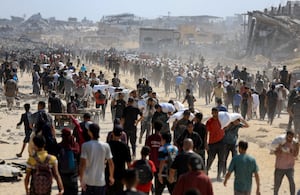
Palestinians carry aid supplies that entered Gaza through Israel in Beit Lahia in the northern Gaza Strip on July 20, 2025. Reuters

There was no immediate confirmation from Hamas on the plan reported by the sources, but both the militant group and Israel have accused each other of preventing a deal from being reached by not compromising on their conditions.

The latest Hamas position would not mark the first time a temporary truce and a limited hostages-for-prisoners swap is put aside, with the group instead focusing on negotiating a wider and enduring settlement.

The move is rooted in its fear that the Israeli army will resume military operations when the proposed 60-day truce expires or when all the hostages are freed.

Hamas is believed to be holding 50 hostages, of whom 20 are still alive.

Israel, for its part, has been generally reluctant to publicly discuss what comes after the proposed truce ends, insisting the war will only end when Hamas's governing and military capabilities are completely dismantled and its leaders leave Gaza to live in exile.

Mourners during the funeral of Palestinians killed the previous day by Israeli bombardment at Nasser Medical Complex in Khan Yunis in the southern Gaza Strip on July 20, 2025. AFP

The sources said the decision to give Israel and the mediators an ultimatum also reflected what Hamas saw as time-wasting tactics by Israel in the Doha talks while it proceeds with plans to keep its military indefinitely in Gaza, carving out security zones inside the tiny enclave and pushing hundreds of thousands into designated areas for food distribution from which they cannot leave.

In its latest move, the Israeli army published new eviction warnings for areas of central Gaza on Sunday, for the first time.

When implemented, the evacuation will cut access between the city of Deir Al Balah and the southern cities of Rafah and Khan Younis. Moreover, the area under the order is also home to many international organisations attempting to distribute aid.

The Gaza war began when Hamas-led militants attacked southern Israel on October 7, 2023, killing about 1,200 people, mostly civilians, and taking another 250 hostages back to Gaza.

Israel's response to the attack has since killed more than 58,000 Palestinians, most of them civilians, according to health officials, displaced almost the entire 2.3 million population, plunged the enclave into a humanitarian crisis and left much of the territory in ruins.


Mercer, the investment consulting arm of US services company Marsh & McLennan, expects its wealth division to at least double its assets under management (AUM) in the Middle East as wealth in the region continues to grow despite economic headwinds, a company official said.

Mercer Wealth, which globally has $160 billion in AUM, plans to boost its AUM in the region to $2-$3bn in the next 2-3 years from the present $1bn, said Yasir AbuShaban, a Dubai-based principal with Mercer Wealth.

Within the next two to three years, we are looking at reaching $2 to $3 billion as a conservative estimate and we do see an opportunity to do so,” said Mr AbuShaban.

Mercer does not directly make investments, but allocates clients’ money they have discretion to, to professional asset managers. They also provide advice to clients.

“We have buying power. We can negotiate on their (client’s) behalf with asset managers to provide them lower fees than they otherwise would have to get on their own,” he added.

Mercer Wealth’s clients include sovereign wealth funds, family offices, and insurance companies among others.

From its office in Dubai, Mercer also looks after Africa, India and Turkey, where they also see opportunity for growth.

Wealth creation in Middle East and Africa (MEA) grew 8.5 per cent to $8.1 trillion last year from $7.5tn in 2015, higher than last year’s global average of 6 per cent and the second-highest growth in a region after Asia-Pacific which grew 9.9 per cent, according to consultancy Boston Consulting Group (BCG). In the region, where wealth grew just 1.9 per cent in 2015 compared with 2014, a pickup in oil prices has helped in wealth generation.

BCG is forecasting MEA wealth will rise to $12tn by 2021, growing at an annual average of 8 per cent.

Drivers of wealth generation in the region will be split evenly between new wealth creation and growth of performance of existing assets, according to BCG.

Another general trend in the region is clients’ looking for a comprehensive approach to investing, according to Mr AbuShaban.

“Institutional investors or some of the families are seeing a slowdown in the available capital they have to invest and in that sense they are looking at optimizing the way they manage their portfolios and making sure they are not investing haphazardly and different parts of their investment are working together,” said Mr AbuShaban.

Some clients also have a higher appetite for risk, given the low interest-rate environment that does not provide enough yield for some institutional investors. These clients are keen to invest in illiquid assets, such as private equity and infrastructure.

“What we have seen is a desire for higher returns in what has been a low-return environment specifically in various fixed income or bonds,” he said.

“In this environment, we have seen a de facto increase in the risk that clients are taking in things like illiquid investments, private equity investments, infrastructure and private debt, those kind of investments were higher illiquidity results in incrementally higher returns.”

The Abu Dhabi Investment Authority, one of the largest sovereign wealth funds, said in its 2016 report that has gradually increased its exposure in direct private equity and private credit transactions, mainly in Asian markets and especially in China and India. The authority’s private equity department focused on structured equities owing to “their defensive characteristics.”

Dubai Rugby Sevens

November 30-December 2, at The Sevens, Dubai

Gulf Under 19

Pool A – Abu Dhabi Harlequins, Jumeirah College Tigers, Dubai English Speaking School 1, Gems World Academy

Pool B – British School Al Khubairat, Bahrain Colts, Jumeirah College Lions, Dubai English Speaking School 2

Pool C - Dubai College A, Dubai Sharks, Jumeirah English Speaking School, Al Yasmina

Pool D – Dubai Exiles, Dubai Hurricanes, Al Ain Amblers, Deira International School

UAE currency: the story behind the money in your pockets
The five pillars of Islam

1. Fasting

2. Prayer

3. Hajj

4. Shahada

5. Zakat 

Gulf Under 19s final

Dubai College A 50-12 Dubai College B

PROFILE OF INVYGO

Started: 2018

Founders: Eslam Hussein and Pulkit Ganjoo

Based: Dubai

Sector: Transport

Size: 9 employees

Investment: $1,275,000

Investors: Class 5 Global, Equitrust, Gulf Islamic Investments, Kairos K50 and William Zeqiri

THE SPECS


Engine: 1.5-litre


Transmission: 6-speed automatic


Power: 110 horsepower 


Torque: 147Nm 


Price: From Dh59,700 


On sale: now  


Red Sparrow

Dir: Francis Lawrence

Starring: Jennifer Lawrence, Joel Egerton, Charlotte Rampling, Jeremy Irons

Three stars

Desert Warrior

Starring: Anthony Mackie, Aiysha Hart, Ben Kingsley

Director: Rupert Wyatt

Rating: 3/5

ADCC AFC Women’s Champions League Group A fixtures

October 3: v Wuhan Jiangda Women’s FC
October 6: v Hyundai Steel Red Angels Women’s FC
October 9: v Sabah FA

Company Profile

Name: Thndr
Started: 2019
Co-founders: Ahmad Hammouda and Seif Amr
Sector: FinTech
Headquarters: Egypt
UAE base: Hub71, Abu Dhabi
Current number of staff: More than 150
Funds raised: $22 million

Founders: Abdulmajeed Alsukhan, Turki Bin Zarah and Abdulmohsen Albabtain.

Based: Riyadh

Offices: UAE, Vietnam and Germany

Founded: September, 2020

Number of employees: 70

Sector: FinTech, online payment solutions

Funding to date: $116m in two funding rounds  

Investors: Checkout.com, Impact46, Vision Ventures, Wealth Well, Seedra, Khwarizmi, Hala Ventures, Nama Ventures and family offices

The Perfect Couple

Starring: Nicole Kidman, Liev Schreiber, Jack Reynor

Creator: Jenna Lamia

Rating: 3/5

The%20Mother%20
%3Cp%3E%3Cstrong%3EDirector%3A%3C%2Fstrong%3E%20Niki%20Caro%26nbsp%3B%3C%2Fp%3E%0A%3Cp%3E%3Cstrong%3EStars%3A%3C%2Fstrong%3E%20Jennifer%20Lopez%2C%20Joseph%20Fiennes%2C%20Gael%20Garcia%20Bernal%2C%20Omari%20Hardwick%20and%20Lucy%20Paez%3C%2Fp%3E%0A%3Cp%3E%3Cstrong%3ERating%3A%3C%2Fstrong%3E%203%2F5%3C%2Fp%3E%0A
Updated: July 20, 2025, 1:31 PM