
US contractors guarding Gaza aid sites admit to firing live ammunition at hungry Palestinians


  • English
  • Arabic

US contractors guarding aid distribution sites in Gaza are firing live ammunition and stun grenades at Palestinians rushing to get food near the deadly distribution centres, AP has revealed, based on accounts and videos.

Two American contractors said their colleagues regularly use stun grenades, pepper spray and bullets against aid-seekers. “There are innocent people being hurt. Badly. Needlessly,” one of them said.

Thousands of starving Palestinians typically gather near the sites. The scenes have been chaotic, turning deadly as people rush when gunfire is heard.
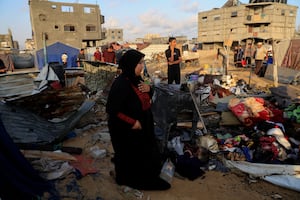
The American staff work with the US and Israel-backed Gaza Humanitarian Foundation (GHF), guarding its aid distribution centres that have been the site of several deadly incidents and controversy. The AP said it spoke to contractors for UG Solutions, subcontracted to hire security personnel for the sites.

A man after being teargassed at a distribution site run by the GHF in Gaza. AP

A spokesman for UG Solutions, Drew O’Brien, said UG has an extensive recruiting and training process. Meanwhile, a representative for the GHF said there are people with a “vested interest” in seeing it fail and are willing to do or say almost anything to make that happen, AP reported.

The GHF opened sites around the enclave in May, secured by a private security force and Israeli troops, to prevent the alleged Hamas looting. The deadly incidents near the site have raised further questions about whether the militarised aid initiative can deliver food supplies safely. AP's report is the latest in a series of accounts revealing harrowing details.

A report published by Israeli newspaper Haaretz on Friday said Israeli commanders ordered troops to fire at crowds to drive them away or disperse them, even though it was clear the people posed no threat. The Israeli military admitted civilians had been “harmed” near GHF distribution points, saying there were “lessons learnt”.

Israeli authorities have previously denied soldiers fired directly at desperate civilians seeking aid at GHF sites.

At least 549 Palestinians have been killed while waiting for food aid near the GHF distribution centres since they began operating late in May, according to the Gaza Health Ministry.

The AP said videos taken at the site, obtained from the contractors, showed hundreds of Palestinians “crowded between metal gates, jostling for aid amid the sound of bullets, stun grenades and the sting of pepper spray”. Other videos were said to include men speaking in English about how to disperse the crowds “and encouraging each other after bursts of gunfire”.

Palestinians behind gates before entering a food distribution site operated by the GHF, shortly after the start of the organisation's distribution sites. AP

In an email from May shared with the AP by a third party, one high-ranking contractor wrote to the head of UG Solutions and called the operation “amateur hour”. He wrote that the sites did not have enough staff or resources making them “not sustainable” and “not safe”, according to the email, seen by the AP.

The outlet said it geolocated the videos received and analysed them with two forensic experts who identified live ammunition, including machine-gun fire, coming from the sites.

“According to the contractor who took the videos, the Israeli army is leveraging the distribution system to access information,” the report said. “Both contractors said that cameras monitor distributions at each site and that American analysts and Israeli soldiers sit in a control room where the footage is screened in real time.”

The GHF has said the Israeli army is not posted at the distribution sites.

The UN and international NGOs have refused to work with the GHF. Last week, in an apparent reference to the GHF, UN Secretary General Antonio Guterres said any operation that funnels desperate civilians seeking aid into militarised zones in Gaza is “inherently unsafe”, and “is killing people”.

More than 160 charities and NGOs have issued a joint call for the GHF to close.

The Swiss Federal Supervisory Authority for Foundations said in a notice published in the Swiss Official Gazette of Commerce on Wednesday that it could order the dissolution of the GHF unless creditors come forward in 30 days.


MATCH INFO

Europa League semi-final, second leg
Atletico Madrid (1) v Arsenal (1)

Where: Wanda Metropolitano
When: Thursday, May 3
Live: On BeIN Sports HD

Company profile

Name: Back to Games and Boardgame Space

Started: Back to Games (2015); Boardgame Space (Mark Azzam became co-founder in 2017)

Founder: Back to Games (Mr Azzam); Boardgame Space (Mr Azzam and Feras Al Bastaki)

Based: Dubai and Abu Dhabi 

Industry: Back to Games (retail); Boardgame Space (wholesale and distribution) 

Funding: Back to Games: self-funded by Mr Azzam with Dh1.3 million; Mr Azzam invested Dh250,000 in Boardgame Space  

Growth: Back to Games: from 300 products in 2015 to 7,000 in 2019; Boardgame Space: from 34 games in 2017 to 3,500 in 2019

THE DEALS

Hamilton $60m x 2 = $120m

Vettel $45m x 2 = $90m

Ricciardo $35m x 2 = $70m

Verstappen $55m x 3 = $165m

Leclerc $20m x 2 = $40m

TOTAL $485m

Torbal Rayeh Wa Jayeh
Starring: Ali El Ghoureir, Khalil El Roumeithy, Mostafa Abo Seria
Stars: 3

Fight card

Preliminaries:

Nouredine Samir (UAE) v Sheroz Kholmirzav (UZB); Lucas Porst (SWE) v Ellis Barboza (GBR); Mouhmad Amine Alharar (MAR) v Mohammed Mardi (UAE); Ibrahim Bilal (UAE) v Spyro Besiri (GRE); Aslamjan Ortikov (UZB) v Joshua Ridgwell (GBR)

Main card:

Carlos Prates (BRA) v Dmitry Valent (BLR); Bobirjon Tagiev (UZB) v Valentin Thibaut (FRA); Arthur Meyer (FRA) v Hicham Moujtahid (BEL); Ines Es Salehy (BEL) v Myriame Djedidi (FRA); Craig Coakley (IRE) v Deniz Demirkapu (TUR); Artem Avanesov (ARM) v Badreddine Attif (MAR); Abdulvosid Buranov (RUS) v Akram Hamidi (FRA)

Title card:

Intercontinental Lightweight: Ilyass Habibali (UAE) v Angel Marquez (ESP)

Intercontinental Middleweight: Amine El Moatassime (UAE) v Francesco Iadanza (ITA)

Asian Featherweight: Zakaria El Jamari (UAE) v Phillip Delarmino (PHI)

Royal wedding inspired menu

Ginger, citrus and orange blossom iced tea

Avocado ranch dip with crudites

Cucumber, smoked salmon and cream cheese mini club sandwiches

Elderflower and lemon syllabub meringue

How to help

Call the hotline on 0502955999 or send "thenational" to the following numbers:

2289 - Dh10

2252 - Dh50

6025 - Dh20

6027 - Dh100

6026 - Dh200

Gender pay parity on track in the UAE

The UAE has a good record on gender pay parity, according to Mercer's Total Remuneration Study.

"In some of the lower levels of jobs women tend to be paid more than men, primarily because men are employed in blue collar jobs and women tend to be employed in white collar jobs which pay better," said Ted Raffoul, career products leader, Mena at Mercer. "I am yet to see a company in the UAE – particularly when you are looking at a blue chip multinationals or some of the bigger local companies – that actively discriminates when it comes to gender on pay."

Mr Raffoul said most gender issues are actually due to the cultural class, as the population is dominated by Asian and Arab cultures where men are generally expected to work and earn whereas women are meant to start a family.

"For that reason, we see a different gender gap. There are less women in senior roles because women tend to focus less on this but that’s not due to any companies having a policy penalising women for any reasons – it’s a cultural thing," he said.

As a result, Mr Raffoul said many companies in the UAE are coming up with benefit package programmes to help working mothers and the career development of women in general. 

Updated: July 03, 2025, 11:34 AM