Lorry drivers across Egypt are bracing themselves for a wave of new regulations and drug tests following the deaths of 18 women and girls in a crash last week, an incident that has put the spotlight on the high rate of road accidents in the country.
While officials often point to narcotics use among drivers as a major factor, the drivers argue that they are being unfairly blamed for a crisis caused by poor road conditions, economic pressures and systemic neglect.
“We’re the ones who get the backlash every time something happens,” said Islam Awad, 39, a lorry driver who has been navigating Egypt’s highways for more than a decade. “But accidents will continue until the roads are fixed, no matter how many drug tests they run.”
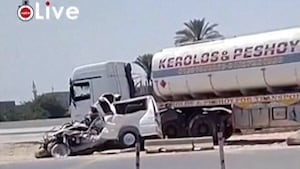
The accident, which occurred near Ashmoun in Menoufia province on Friday, has sparked a national conversation about road safety and accountability. A lorry coming from the opposite direction crossed the central divider and slammed into a microbus carrying 21 female workers home from grape farms, a daily commute for the group. Eighteen of the passengers and the driver were killed.
The lorry driver, who turned himself in to authorities out of fear of reprisals from the victims’ families, said he lost control of his vehicle while attempting to avoid a rock in the middle of the road. The driver explained during questioning that the rock was impossible to see in time due to the narrow lanes and poor road conditions.
“I wasn’t speeding, and I wasn’t reckless,” he told investigators. “I was only driving 50kph, but the steering slipped out of my control. I didn’t mean for this to happen. My heart aches for the victims – I have daughters their age.”
Officials said tests showed he was under the influence of illegal drugs. The tragedy took place on the Regional Ring Road, a 365km motorway connecting Cairo to five provinces – Giza, Fayoum, Menoufia, Sharqia, and Qalyubia.
A 110km stretch of the road has been under repair since 2020, with one lane closed entirely, forcing two-way traffic into a single, poorly divided lane shared by lorries, buses, cars and microbuses. This is where the accident happened.
The Ministry of Transport has defended the repairs, saying that the asphalt road is being replaced with concrete to better withstand heavy traffic and Egypt's high temperatures. However, the project has faced criticism for its slow pace and dangerous detours. Drivers like Mr Awad, who navigate the road daily, describe it as a “death trap”.
If you hit a broken part of the road or even something as small as a rock, you need several metres to recover, which you don’t have. That’s why this road is so deadly
Islam Awad,
lorry driver
“Lorry drivers are forced to drive these narrow lanes, and there is very little room to manoeuvre,” he said. “Lorries are huge, and you’re often carrying loads of up to 10 tonnes. If you hit a broken part of the road or even something as small as a rock, you need several metres to recover, which you don’t have. That’s why this road is so deadly.”
The accident has reignited public anger over the quality of roads in Egypt after the government under President Abdel Fattah El Sisi spent billions of dollars on the national network. Social media users flooded platforms with demands for accountability, questioning why the ring road, completed in 2018 after a decade of construction, required such intense repairs just two years later.
This anger is particularly palpable in Menoufia, where several residents told The National that their warnings about the road’s dangers had been ignored for years. They said they had filed repeated complaints to the government about the number of accidents taking place on the road as a result of the repairs, to no avail.
“The only reason the government is causing such an uproar about the accident is because it is particularly tragic. Eighteen young girls and all from the same town, that is terrible. But many accidents, such as one that took place just last night near Mansoura, go ignored by the government,” said a Menoufia resident who asked to remain anonymous.
Families of the victims refused to allow the governor of Menoufia to attend the joint funeral for the 18 girls held in the city of Menouf. Videos of the families turning their backs to the governor and shouting at him to leave were widely circulated.
The Minister of Transport, Kamel El Wazir, visited the accident site on Sunday and promised that the ring road would be fully repaired in a project costing 50 billion Egyptian pounds ($1 billion). However, Mr El Wazir did not address the question of why such extensive repairs were needed so soon after the road’s completion, a question that has fuelled public frustration and scepticism.
Lorry drivers say they are being targeted unfairly by the government's decision to introduce random drug tests, among of measures to improve road safety. Both drivers interviewed for this article agreed that narcotics use is common among drivers, but they insisted that it is often a necessity rather than a choice.
“Everyone driving on roads all over the country is high – lorry drivers and sons of pashas alike,” said Abdo Ibrahim, 48. “But the focus of this accident shouldn’t be drugs. The focus should be the Regional Ring Road and how unsafe it is. Accidents happen all over the country, but I have never seen a road this deadly in my life.”
Mr Ibrahim said the physical demands of driving long distances with little rest often push drivers to rely on narcotics like tramadol to stay awake and cope with the pain. “It’s not just about getting high,” he said. “It’s about surviving the trip.”
Drug testing and another new measure, background checks of lorry drivers, will disproportionately harm them without addressing the root causes of road accidents, they say.
“Life has gotten so expensive lately, and for many of us, this is the only job we can do,” Mr Ibrahim said. “Now they’re going to make it even harder for us to survive.”
Lorry drivers are typically on the top rung of their career ladder, having obtained first-degree licences after years of experience. The process requires six years of professional driving, with drivers working their way up from smaller vehicles.
“The job isn’t easy, and most of us are experienced,” Mr Awad explained. “But no one listens to drivers when we say the roads are unsafe. This accident happened because of the road repairs, not the driver. The whole stretch from Cairo to Menoufia is under repair – it’s irrational.” He said it might have been more efficient to repair the road stretch by stretch to minimise the parts of it that are unsafe.
The Regional Ring Road has earned its grim nickname – “The Road of Death” – for good reason. According to state statistics, there have been 304 recorded accidents on the Regional Ring Road since mid-2022, resulting in 239 deaths.
The number of accidents has been increasing steadily, with 114 reported in 2024, compared to 76 accidents in 2023. There have already been 67 accidents this year.

Left Bank: Art, Passion and Rebirth of Paris 1940-1950
Agnes Poirer, Bloomsbury
Benefits of first-time home buyers' scheme
- Priority access to new homes from participating developers
- Discounts on sales price of off-plan units
- Flexible payment plans from developers
- Mortgages with better interest rates, faster approval times and reduced fees
- DLD registration fee can be paid through banks or credit cards at zero interest rates
UAE currency: the story behind the money in your pockets
The burning issue
The internal combustion engine is facing a watershed moment – major manufacturer Volvo is to stop producing petroleum-powered vehicles by 2021 and countries in Europe, including the UK, have vowed to ban their sale before 2040. The National takes a look at the story of one of the most successful technologies of the last 100 years and how it has impacted life in the UAE.
Read part four: an affection for classic cars lives on
Read part three: the age of the electric vehicle begins
Read part one: how cars came to the UAE
The bio
Favourite book: Peter Rabbit. I used to read it to my three children and still read it myself. If I am feeling down it brings back good memories.
Best thing about your job: Getting to help people. My mum always told me never to pass up an opportunity to do a good deed.
Best part of life in the UAE: The weather. The constant sunshine is amazing and there is always something to do, you have so many options when it comes to how to spend your day.
Favourite holiday destination: Malaysia. I went there for my honeymoon and ended up volunteering to teach local children for a few hours each day. It is such a special place and I plan to retire there one day.
Ten tax points to be aware of in 2026
1. Domestic VAT refund amendments: request your refund within five years
If a business does not apply for the refund on time, they lose their credit.
2. E-invoicing in the UAE
Businesses should continue preparing for the implementation of e-invoicing in the UAE, with 2026 a preparation and transition period ahead of phased mandatory adoption.
3. More tax audits
Tax authorities are increasingly using data already available across multiple filings to identify audit risks.
4. More beneficial VAT and excise tax penalty regime
Tax disputes are expected to become more frequent and more structured, with clearer administrative objection and appeal processes. The UAE has adopted a new penalty regime for VAT and excise disputes, which now mirrors the penalty regime for corporate tax.
5. Greater emphasis on statutory audit
There is a greater need for the accuracy of financial statements. The International Financial Reporting Standards standards need to be strictly adhered to and, as a result, the quality of the audits will need to increase.
6. Further transfer pricing enforcement
Transfer pricing enforcement, which refers to the practice of establishing prices for internal transactions between related entities, is expected to broaden in scope. The UAE will shortly open the possibility to negotiate advance pricing agreements, or essentially rulings for transfer pricing purposes.
7. Limited time periods for audits
Recent amendments also introduce a default five-year limitation period for tax audits and assessments, subject to specific statutory exceptions. While the standard audit and assessment period is five years, this may be extended to up to 15 years in cases involving fraud or tax evasion.
8. Pillar 2 implementation
Many multinational groups will begin to feel the practical effect of the Domestic Minimum Top-Up Tax (DMTT), the UAE's implementation of the OECD’s global minimum tax under Pillar 2. While the rules apply for financial years starting on or after January 1, 2025, it is 2026 that marks the transition to an operational phase.
9. Reduced compliance obligations for imported goods and services
Businesses that apply the reverse-charge mechanism for VAT purposes in the UAE may benefit from reduced compliance obligations.
10. Substance and CbC reporting focus
Tax authorities are expected to continue strengthening the enforcement of economic substance and Country-by-Country (CbC) reporting frameworks. In the UAE, these regimes are increasingly being used as risk-assessment tools, providing tax authorities with a comprehensive view of multinational groups’ global footprints and enabling them to assess whether profits are aligned with real economic activity.
Contributed by Thomas Vanhee and Hend Rashwan, Aurifer
COMPANY%20PROFILE%20
%3Cp%3E%3Cstrong%3EName%3A%3C%2Fstrong%3E%20Haltia.ai%0D%3Cbr%3E%3Cstrong%3EStarted%3A%3C%2Fstrong%3E%202023%0D%3Cbr%3E%3Cstrong%3ECo-founders%3A%3C%2Fstrong%3E%20Arto%20Bendiken%20and%20Talal%20Thabet%0D%3Cbr%3E%3Cstrong%3EBased%3A%3C%2Fstrong%3E%20Dubai%2C%20UAE%0D%3Cbr%3E%3Cstrong%3EIndustry%3A%3C%2Fstrong%3E%20AI%0D%3Cbr%3E%3Cstrong%3ENumber%20of%20employees%3A%3C%2Fstrong%3E%2041%0D%3Cbr%3E%3Cstrong%3EFunding%3A%3C%2Fstrong%3E%20About%20%241.7%20million%0D%3Cbr%3E%3Cstrong%3EInvestors%3A%3C%2Fstrong%3E%20Self%2C%20family%20and%20friends%26nbsp%3B%3C%2Fp%3E%0A
Who's who in Yemen conflict
Houthis: Iran-backed rebels who occupy Sanaa and run unrecognised government
Yemeni government: Exiled government in Aden led by eight-member Presidential Leadership Council
Southern Transitional Council: Faction in Yemeni government that seeks autonomy for the south
Habrish 'rebels': Tribal-backed forces feuding with STC over control of oil in government territory
The specs
Engine: 2.0-litre 4cyl turbo
Power: 261hp at 5,500rpm
Torque: 405Nm at 1,750-3,500rpm
Transmission: 9-speed auto
Fuel consumption: 6.9L/100km
On sale: Now
Price: From Dh117,059
Teaching your child to save
Pre-school (three - five years)
You can’t yet talk about investing or borrowing, but introduce a “classic” money bank and start putting gifts and allowances away. When the child wants a specific toy, have them save for it and help them track their progress.
Early childhood (six - eight years)
Replace the money bank with three jars labelled ‘saving’, ‘spending’ and ‘sharing’. Have the child divide their allowance into the three jars each week and explain their choices in splitting their pocket money. A guide could be 25 per cent saving, 50 per cent spending, 25 per cent for charity and gift-giving.
Middle childhood (nine - 11 years)
Open a bank savings account and help your child establish a budget and set a savings goal. Introduce the notion of ‘paying yourself first’ by putting away savings as soon as your allowance is paid.
Young teens (12 - 14 years)
Change your child’s allowance from weekly to monthly and help them pinpoint long-range goals such as a trip, so they can start longer-term saving and find new ways to increase their saving.
Teenage (15 - 18 years)
Discuss mutual expectations about university costs and identify what they can help fund and set goals. Don’t pay for everything, so they can experience the pride of contributing.
Young adulthood (19 - 22 years)
Discuss post-graduation plans and future life goals, quantify expenses such as first apartment, work wardrobe, holidays and help them continue to save towards these goals.
* JP Morgan Private Bank
The specs
Engine: 3.5-litre twin-turbo V6
Power: 380hp at 5,800rpm
Torque: 530Nm at 1,300-4,500rpm
Transmission: Eight-speed auto
Price: From Dh299,000 ($81,415)
On sale: Now
Key facilities
- Olympic-size swimming pool with a split bulkhead for multi-use configurations, including water polo and 50m/25m training lanes
- Premier League-standard football pitch
- 400m Olympic running track
- NBA-spec basketball court with auditorium
- 600-seat auditorium
- Spaces for historical and cultural exploration
- An elevated football field that doubles as a helipad
- Specialist robotics and science laboratories
- AR and VR-enabled learning centres
- Disruption Lab and Research Centre for developing entrepreneurial skills
Company%20profile
%3Cp%3E%3Cstrong%3ECompany%20name%3A%3C%2Fstrong%3E%20Fasset%0D%3Cbr%3E%3Cstrong%3EStarted%3A%20%3C%2Fstrong%3E2019%0D%3Cbr%3E%3Cstrong%3EFounders%3A%3C%2Fstrong%3E%20Mohammad%20Raafi%20Hossain%2C%20Daniel%20Ahmed%0D%3Cbr%3E%3Cstrong%3EBased%3A%3C%2Fstrong%3E%20Dubai%0D%3Cbr%3E%3Cstrong%3ESector%3A%20%3C%2Fstrong%3EFinTech%0D%3Cbr%3E%3Cstrong%3EInitial%20investment%3A%3C%2Fstrong%3E%20%242.45%20million%0D%3Cbr%3E%3Cstrong%3ECurrent%20number%20of%20staff%3A%3C%2Fstrong%3E%2086%0D%3Cbr%3E%3Cstrong%3EInvestment%20stage%3A%3C%2Fstrong%3E%20Pre-series%20B%0D%3Cbr%3E%3Cstrong%3EInvestors%3A%3C%2Fstrong%3E%20Investcorp%2C%20Liberty%20City%20Ventures%2C%20Fatima%20Gobi%20Ventures%2C%20Primal%20Capital%2C%20Wealthwell%20Ventures%2C%20FHS%20Capital%2C%20VN2%20Capital%2C%20local%20family%20offices%3C%2Fp%3E%0A
