Syria's economy is opening up to foreign investors after 14 years as a no-go zone in wartime. Getty Images

'Vote of confidence': Trump’s lifting of Syria sanctions raises hopes for investment


Nada Maucourant Atallah
  • English
  • Arabic

US President Donald Trump’s executive order to permanently lift most sanctions on Syria is a “vote of confidence” in the country’s new leaders, removing some of the final barriers for foreign investors, Syrian officials and experts told The National.

The move implements a promise Mr Trump made in May to lift crippling sanctions on Syria’s new government, in a major policy shift aimed at giving the country a chance at “greatness”. The signing of the executive order “will definitely encourage more investors to take the step and enter the Syrian market,” Ayman Hamawiye, head of Syria’s Investment Authority, told The National.

In late May, Mr Hamawiye told The National that the authority had received hundreds of letters expressing interest, including letters from dozens of Western companies, following Mr Trump’s pledge to end sanctions. Now, Mr Trump's order terminating those sanctions will “definitely” help turn those expressions of interest into concrete investments, though expectations around the time frame should be managed, Mr Hamawiye said.
The regime of Bashar Al Assad was under a dense web of sanctions, which intensified after 2011 following a brutal crackdown on peaceful protests, which led to a 14-year civil war. Since the regime was toppled in December by Sunni rebel groups, Syria has had a surge of investment pledges, particularly from Gulf countries. The latest, announced this week, was a $1.5 billion deal backed by a Qatari company to develop an artistic and media production hub in Damascus.

“Of course, we’ll keep in mind that even executive orders need some time before they’re implemented on the ground, but in any case, this is a positive and encouraging development,” Mr Hamawiye added.

“There’s strong interest in investment, and it’s constantly growing. The more the security and international concerns diminish, the more investment interest increases, especially from major international investors,” a source at Syria's Ministry of Economy told The National.

The sanctions relief does not apply to Mr Al Assad or his associates. It also excludes people accused of human rights abuses, drug trafficking, chemical weapons activities, or linked to ISIS or Iranian proxies, White House press secretary Karoline Leavitt said on Monday.

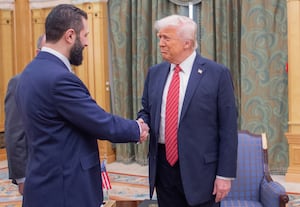
US President Donald Trump announced in May he would lift sanctions on Syria, a day before meeting its President, Ahmad Al Shara. AP

A 'vote of confidence'

Benjamin Feve, a senior researcher at Karam Shaar Advisory, told The National the move was significant for investor confidence and Syria’s international reputation, and demonstrated Washington’s seriousness in supporting the country.

“This is really a vote of confidence from the US government towards the Syrian government. It also shows that the American administration – even its most senior figures, including those most opposed to [Syrian President Ahmad] Al Shara – were unable to convince Trump to reverse his decision on lifting the sanctions,” Mr Feve said. “This reflects a real, radical shift within the US administration itself,” he added.

During a brief, historic meeting with Mr Al Shara – a formerly Al Qaeda-linked fighter described by Mr Trump as a “handsome man” with a “tough past” – the US President urged him to meet specific conditions, including establishing ties with Israel.

Back-channel talks have taken place between Syria and Israel are continuing but have yet to yield tangible results, with the issues highly sensitive. Syria has a long history of war with Israel, which has occupied the Golan Heights, a rocky plateau bordering the two countries, since 1967.

“It's also kind of a test for the Syrian authorities, will they manage this post-Assad transitional phase well?” Mr Feve added.

Syria's new regime is seeking international investment to repair the economy from the civil war. AFP

Outbreaks of sectarian violence have also raised questions about the interim government’s ability to stabilise Syria, despite its pledges of inclusivity.

Some sanctions will remain on Syria, including those mandated by the US Congress, as well as the US designation of Syria as a state sponsor of terrorism. Sanctions on Hayat Tahrir al-Sham (HTS), the now-disbanded group that led the December offensive and whose former members lead the government, also remain in place.

“Obviously, none of these sanctions explicitly prevent investments, but they do damage Syria’s reputation,” Mr Feve said.

Challenges ahead

Experts and officials told The National that while the lifting of sanctions is a milestone, the path to recovery remains long. For Mr Feve, the reintegration of Syrian banks into the global financial system, a necessary step to manage the expected flow of billions in reconstruction funds, is a top priority.

“What still blocks things today are the interbank links between Syrian banks and international banks,” Mr Feve said. He said the end of sanctions does not mean foreign banks will automatically resume long-cut ties.

“International banks still don’t know whether Syrian banks are really compliant with all the measures meant to prevent money laundering and terrorism financing. So it's taking time, but those connections will gradually be re-established.”

Syria's central bank governor told The National last week that Syria's banks are expected to resume ties with international lenders within weeks. According to the source at the Ministry of Economy, challenges also lie in the urgent need for administrative reforms and the state's capacity to manage massive investments.

“The legal complications and the old chaos within government institutions will take time to dismantle. We are in the process of building a new government system – not from zero, but from a point below that, due to the presence of the old system,” the source said.


Ten tax points to be aware of in 2026

1. Domestic VAT refund amendments: request your refund within five years

If a business does not apply for the refund on time, they lose their credit.

2. E-invoicing in the UAE

Businesses should continue preparing for the implementation of e-invoicing in the UAE, with 2026 a preparation and transition period ahead of phased mandatory adoption. 

3. More tax audits

Tax authorities are increasingly using data already available across multiple filings to identify audit risks. 

4. More beneficial VAT and excise tax penalty regime

Tax disputes are expected to become more frequent and more structured, with clearer administrative objection and appeal processes. The UAE has adopted a new penalty regime for VAT and excise disputes, which now mirrors the penalty regime for corporate tax.

5. Greater emphasis on statutory audit

There is a greater need for the accuracy of financial statements. The International Financial Reporting Standards standards need to be strictly adhered to and, as a result, the quality of the audits will need to increase.

6. Further transfer pricing enforcement

Transfer pricing enforcement, which refers to the practice of establishing prices for internal transactions between related entities, is expected to broaden in scope. The UAE will shortly open the possibility to negotiate advance pricing agreements, or essentially rulings for transfer pricing purposes. 

7. Limited time periods for audits

Recent amendments also introduce a default five-year limitation period for tax audits and assessments, subject to specific statutory exceptions. While the standard audit and assessment period is five years, this may be extended to up to 15 years in cases involving fraud or tax evasion. 

8. Pillar 2 implementation 

Many multinational groups will begin to feel the practical effect of the Domestic Minimum Top-Up Tax (DMTT), the UAE's implementation of the OECD’s global minimum tax under Pillar 2. While the rules apply for financial years starting on or after January 1, 2025, it is 2026 that marks the transition to an operational phase.

9. Reduced compliance obligations for imported goods and services

Businesses that apply the reverse-charge mechanism for VAT purposes in the UAE may benefit from reduced compliance obligations. 

10. Substance and CbC reporting focus

Tax authorities are expected to continue strengthening the enforcement of economic substance and Country-by-Country (CbC) reporting frameworks. In the UAE, these regimes are increasingly being used as risk-assessment tools, providing tax authorities with a comprehensive view of multinational groups’ global footprints and enabling them to assess whether profits are aligned with real economic activity. 

Contributed by Thomas Vanhee and Hend Rashwan, Aurifer

'Operation Mincemeat' 

Director: John Madden 


Cast: Colin Firth, Matthew Macfayden, Kelly Macdonald and Penelope Wilton


Rating: 4/5

 
Key products and UAE prices

iPhone XS
With a 5.8-inch screen, it will be an advance version of the iPhone X. It will be dual sim and comes with better battery life, a faster processor and better camera. A new gold colour will be available.
Price: Dh4,229

iPhone XS Max
It is expected to be a grander version of the iPhone X with a 6.5-inch screen; an inch bigger than the screen of the iPhone 8 Plus.
Price: Dh4,649

iPhone XR
A low-cost version of the iPhone X with a 6.1-inch screen, it is expected to attract mass attention. According to industry experts, it is likely to have aluminium edges instead of stainless steel.
Price: Dh3,179

Apple Watch Series 4
More comprehensive health device with edge-to-edge displays that are more than 30 per cent bigger than displays on current models.

The National Archives, Abu Dhabi

Founded over 50 years ago, the National Archives collects valuable historical material relating to the UAE, and is the oldest and richest archive relating to the Arabian Gulf.

Much of the material can be viewed on line at the Arabian Gulf Digital Archive - https://www.agda.ae/en

Quick pearls of wisdom

Focus on gratitude: And do so deeply, he says. “Think of one to three things a day that you’re grateful for. It needs to be specific, too, don’t just say ‘air.’ Really think about it. If you’re grateful for, say, what your parents have done for you, that will motivate you to do more for the world.”

Know how to fight: Shetty married his wife, Radhi, three years ago (he met her in a meditation class before he went off and became a monk). He says they’ve had to learn to respect each other’s “fighting styles” – he’s a talk it-out-immediately person, while she needs space to think. “When you’re having an argument, remember, it’s not you against each other. It’s both of you against the problem. When you win, they lose. If you’re on a team you have to win together.” 

THE SPECS

Engine: 3.5-litre V6
Transmission: six-speed manual
Power: 325bhp
Torque: 370Nm
Speed: 0-100km/h 3.9 seconds
Price: Dh230,000
On sale: now

How to watch Ireland v Pakistan in UAE

When: The one-off Test starts on Friday, May 11
What time: Each day’s play is scheduled to start at 2pm UAE time.
TV: The match will be broadcast on OSN Sports Cricket HD. Subscribers to the channel can also stream the action live on OSN Play.

Updated: July 04, 2025, 10:09 AM