
The US will re-enter talks with Iran next week after a ceasefire with Israel that also raises the prospects of peace in Gaza, President Donald Trump has said.
Speaking at a Nato summit, Mr Trump said Iran is “not going to be building bombs for a long time” after US attacks, as mystery surrounded the fate of Iran's nuclear materials. He compared the US strikes to the atomic bombings of Hiroshima and Nagasaki that ended the Second World War.
A truce continued to hold after Israel and Iran halted a 12-day air war, their worst ever direct conflict. If Israel “does not take any aggressive actions, Iran will not react either”, an Iranian government official told The National.
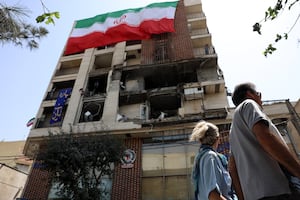
Hamas said Gaza ceasefire talks had “intensified in recent hours” with the participation of mediators from Egypt and Qatar. Mr Trump said “great progress” was being made to end the Israel-Hamas war, and added that his special envoy Steve Witkoff had told him: “Gaza is very close.”
He linked his optimism about imminent “very good news” for Gaza to the ceasefire agreed on Tuesday between Israel and Iran. “It helped a little, and sowed a lot of power,” he said. “I think this helped.”
Mr Trump said the “war is done” after the US dropped “bunker-buster” bombs on three Iranian nuclear sites early on Sunday. Iran responded by launching missiles at an American airbase in Qatar, in an attack widely condemned in the Arab world.
“We're going to talk to them next week with Iran. We may sign an agreement, I don't know,” said Mr Trump. “The way I look at it, they fought, the war is done.
“I don’t want to use an example of Hiroshima. I don’t want to use an example of Nagasaki, but that was essentially the same thing – that ended a war.”
The bombing raid ordered by Mr Trump hit the Fordow, Natanz and Isfahan nuclear sites in Iran, which is suspected by the US and Israel of secretly developing a nuclear weapon. Iran denies this, insisting it is enriching uranium for peaceful purposes.
Tehran will re-enter nuclear talks only if the US offers clear aims and takes steps to rebuild trust, current and former Iranian officials said. Five rounds of meetings failed to produce a deal on curbing Iran's activities, before Israel attacked Iran almost a fortnight ago.
“We need to see whether the opposing sides will enter in good faith or not,” an analyst in Tehran who is close to the Iranian government told The National.
“The opposing side must prove that it is reliable this time with confidence-building measures,” the analyst said. “We will wait until there is good faith and a new initiative.”
Iran was believed to have a stockpile of near-weapons grade uranium before the air war broke out. The whereabouts of its nuclear materials are now unclear, amid speculation it could have moved them before the US bombing.
Mr Trump maintained on Wednesday that “there was obliteration” but conceded that early US intelligence findings were inconclusive. “It could've been very severe. That's what the intelligence suggests,” he said.
Iran said only that its nuclear sites were “badly damaged” in the bombing raids. Israeli strikes also killed nuclear scientists and several senior military commanders in Iran, as well as hitting symbols of government power in Tehran.
Rafael Grossi, the head of the International Atomic Energy Agency, said Iran informed him it had taken “precautionary measures” regarding its uranium stockpile. He said: “There is rubble, there could be unexploded ordnance, there are not normal inspections.”
A statement from Israeli Prime Minister Benjamin Netanyahu's office said the strike on Fordow “destroyed the site's critical infrastructure and rendered the enrichment facility inoperable”.
Israel said it assessed that the strikes had set back Iran's nuclear programme “by many years”. Mr Netanyahu is now coming under pressure from some quarters in Israeli politics to follow the Iran truce with a ceasefire deal in Gaza.
Sources reported that top Hamas officials, including Khalil Al Hayah, Zaher Jabareen, and Nazar Awadallah, have been holding talks with Egyptian officials since they arrived in Cairo on Monday.
A lone mid-level Israeli negotiator was also in Cairo, while a senior team from Israel's Mossad spy agency was expected later in the week, but only if the chances of making progress in the talks improve, according to the sources.
They told The National that the proposals on the table to pause the war and secure the release of the remaining hostages held in Gaza were not different from those discussed in previous rounds, and which mediators from Egypt, Qatar and the US could not get Hamas and Israel to agree to.
Life was returning to normal after the war. Israel has mostly lifted restrictions on schools and public gatherings put in place by a home front command. Iranian authorities announced the gradual easing of internet restrictions.
“The communication network is gradually returning to its previous state,” said the Islamic Revolutionary Guard Corps' cyber security command in a statement carried by state media.
Hezbollah meanwhile lauded what it described as Iran’s “divine victory” over Israel in the 12-day war. The Lebanese armed group and political party said Iran’s attacks “shattered the aura of [Israel’s] defence systems” and marked a “new historical stage” in the region.
Egyptian President Abdel Fattah El Sisi spoke by phone with Iranian President Masoud Pezeshkian, condemning Iran’s attack on a US airbase in Qatar and reaffirming Cairo's support for “the sovereignty of Arab and Islamic states”.
According to a statement from Egypt's presidency, Mr El Sisi welcomed the ceasefire agreement between Iran and Israel, emphasising the need to “stabilise and uphold the agreement” to prevent escalation in the region.

LIVERPOOL SQUAD
Alisson Becker, Virgil van Dijk, Georginio Wijnaldum, James Milner, Naby Keita, Roberto Firmino, Sadio Mane, Mohamed Salah, Joe Gomez, Adrian, Jordan Henderson, Alex Oxlade-Chamberlain, Adam Lallana, Andy Lonergan, Xherdan Shaqiri, Andy Robertson, Divock Origi, Curtis Jones, Trent Alexander-Arnold, Neco Williams
'My Son'
Director: Christian Carion
Starring: James McAvoy, Claire Foy, Tom Cullen, Gary Lewis
Rating: 2/5
RESULTS
6.30pm UAE 1000 Guineas Trial Conditions (TB) US$100,000 (Dirt) 1,400m
Winner Final Song, Christophe Soumillon (jockey), Saeed bin Suroor (trainer).
7.05pm Handicap (TB) $135,000 (Turf) 1,000m
Winner Almanaara, Dane O’Neill, Doug Watson.
7.40pm Handicap (TB) $175,000 (D) 1,900m
Winner Grand Argentier, Brett Doyle, Doug Watson.
8.15pm Meydan Challenge Listed Handicap (TB) $175,000 (T) 1,400m
Winner Major Partnership, Patrick Cosgrave, Saeed bin Suroor.
8.50pm Dubai Stakes Group 3 (TB) $200,000 (D) 1,200m
Winner Gladiator King, Mickael Barzalona, Satish Seemar.
9.25pm Dubai Racing Club Classic Listed Handicap (TB) $175,000 (T) 2,410m
Winner Universal Order, Richard Mullen, David Simcock.
Mercer, the investment consulting arm of US services company Marsh & McLennan, expects its wealth division to at least double its assets under management (AUM) in the Middle East as wealth in the region continues to grow despite economic headwinds, a company official said.
Mercer Wealth, which globally has $160 billion in AUM, plans to boost its AUM in the region to $2-$3bn in the next 2-3 years from the present $1bn, said Yasir AbuShaban, a Dubai-based principal with Mercer Wealth.
“Within the next two to three years, we are looking at reaching $2 to $3 billion as a conservative estimate and we do see an opportunity to do so,” said Mr AbuShaban.
Mercer does not directly make investments, but allocates clients’ money they have discretion to, to professional asset managers. They also provide advice to clients.
“We have buying power. We can negotiate on their (client’s) behalf with asset managers to provide them lower fees than they otherwise would have to get on their own,” he added.
Mercer Wealth’s clients include sovereign wealth funds, family offices, and insurance companies among others.
From its office in Dubai, Mercer also looks after Africa, India and Turkey, where they also see opportunity for growth.
Wealth creation in Middle East and Africa (MEA) grew 8.5 per cent to $8.1 trillion last year from $7.5tn in 2015, higher than last year’s global average of 6 per cent and the second-highest growth in a region after Asia-Pacific which grew 9.9 per cent, according to consultancy Boston Consulting Group (BCG). In the region, where wealth grew just 1.9 per cent in 2015 compared with 2014, a pickup in oil prices has helped in wealth generation.
BCG is forecasting MEA wealth will rise to $12tn by 2021, growing at an annual average of 8 per cent.
Drivers of wealth generation in the region will be split evenly between new wealth creation and growth of performance of existing assets, according to BCG.
Another general trend in the region is clients’ looking for a comprehensive approach to investing, according to Mr AbuShaban.
“Institutional investors or some of the families are seeing a slowdown in the available capital they have to invest and in that sense they are looking at optimizing the way they manage their portfolios and making sure they are not investing haphazardly and different parts of their investment are working together,” said Mr AbuShaban.
Some clients also have a higher appetite for risk, given the low interest-rate environment that does not provide enough yield for some institutional investors. These clients are keen to invest in illiquid assets, such as private equity and infrastructure.
“What we have seen is a desire for higher returns in what has been a low-return environment specifically in various fixed income or bonds,” he said.
“In this environment, we have seen a de facto increase in the risk that clients are taking in things like illiquid investments, private equity investments, infrastructure and private debt, those kind of investments were higher illiquidity results in incrementally higher returns.”
The Abu Dhabi Investment Authority, one of the largest sovereign wealth funds, said in its 2016 report that has gradually increased its exposure in direct private equity and private credit transactions, mainly in Asian markets and especially in China and India. The authority’s private equity department focused on structured equities owing to “their defensive characteristics.”
SERIE A FIXTURES
Saturday (All UAE kick-off times)
Cagliari v AC Milan (6pm)
Lazio v Napoli (9pm)
Inter Milan v Atalanta (11.45pm)
Sunday
Udinese v Sassuolo (3.30pm)
Sampdoria v Brescia (6pm)
Fiorentina v SPAL (6pm)
Torino v Bologna (6pm)
Verona v Genoa (9pm)
Roma V Juventus (11.45pm)
Parma v Lecce (11.45pm)
Dubai Rugby Sevens
November 30, December 1-2
International Vets
Christina Noble Children’s Foundation fixtures
Thursday, November 30:
10.20am, Pitch 3, v 100 World Legends Project
1.20pm, Pitch 4, v Malta Marauders
Friday, December 1:
9am, Pitch 4, v SBA Pirates
War 2
Director: Ayan Mukerji
Stars: Hrithik Roshan, NTR, Kiara Advani, Ashutosh Rana
Rating: 2/5
Gender pay parity on track in the UAE
The UAE has a good record on gender pay parity, according to Mercer's Total Remuneration Study.
"In some of the lower levels of jobs women tend to be paid more than men, primarily because men are employed in blue collar jobs and women tend to be employed in white collar jobs which pay better," said Ted Raffoul, career products leader, Mena at Mercer. "I am yet to see a company in the UAE – particularly when you are looking at a blue chip multinationals or some of the bigger local companies – that actively discriminates when it comes to gender on pay."
Mr Raffoul said most gender issues are actually due to the cultural class, as the population is dominated by Asian and Arab cultures where men are generally expected to work and earn whereas women are meant to start a family.
"For that reason, we see a different gender gap. There are less women in senior roles because women tend to focus less on this but that’s not due to any companies having a policy penalising women for any reasons – it’s a cultural thing," he said.
As a result, Mr Raffoul said many companies in the UAE are coming up with benefit package programmes to help working mothers and the career development of women in general.
Need to know
The flights: Flydubai flies from Dubai to Kilimanjaro airport via Dar es Salaam from Dh1,619 return including taxes. The trip takes 8 hours.
The trek: Make sure that whatever tour company you select to climb Kilimanjaro, that it is a reputable one. The way to climb successfully would be with experienced guides and porters, from a company committed to quality, safety and an ethical approach to the mountain and its staff. Sonia Nazareth booked a VIP package through Safari Africa. The tour works out to $4,775 (Dh17,538) per person, based on a 4-person booking scheme, for 9 nights on the mountain (including one night before and after the trek at Arusha). The price includes all meals, a head guide, an assistant guide for every 2 trekkers, porters to carry the luggage, a cook and kitchen staff, a dining and mess tent, a sleeping tent set up for 2 persons, a chemical toilet and park entrance fees. The tiny ration of heated water provided for our bath in our makeshift private bathroom stall was the greatest luxury. A standard package, also based on a 4-person booking, works out to $3,050 (Dh11,202) per person.
When to go: You can climb Kili at any time of year, but the best months to ascend are January-February and September-October. Also good are July and August, if you’re tolerant of the colder weather that winter brings.
Do not underestimate the importance of kit. Even if you’re travelling at a relatively pleasant time, be geared up for the cold and the rain.
