
Key figures in the current Middle East hostilities, from left, Israeli Prime Minister Benjamin Netanyahu, Ayatollah Ali Khamenei, Iranian supreme leader, and US President Donald Trump. AFP

Have US strikes on Iran brought Netanyahu closer to declaring ceasefire?


Thomas Helm
  • English
  • Arabic

As the region appeared to be heading for uncontrolled escalation after the US joined Israel in attacking Iran, Israeli Prime Minister Benjamin Netanyahu discussed the possibility of an end to hostilities, albeit with major caveats and no timeline.

In a statement delivered on Sunday evening, the Prime Minister said Israel was close to achieving its goals in Iran and promised his country would not be dragged into a “war of attrition”.

“We won’t pursue our actions beyond what is needed to achieve [objectives] but we also won’t finish too soon. When the objectives are achieved, then the operation is complete and the fighting will stop,” Mr Netanyahu said.
“We embarked on this operation to eliminate the two concrete threats to our existence: the nuclear threat and the ballistic missile threat. We are moving step by step towards achieving these goals. We are very, very close to completing them.”

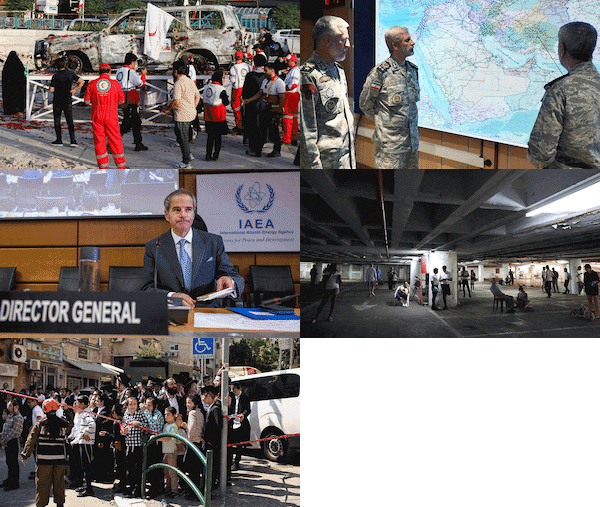
Iran's army commander-in-chief Amir Hatami, centre, attends a meeting in the army's war command room. Iranian Army Media Office / AFP

The confident assessment came after the US carried out overnight strikes on three key Iranian nuclear sites, including dropping "bunker bombs" on underground uranium enrichment facilities at Fordow and Natanz. US Defence Secretary Pete Hegseth said those sites had been “obliterated”. Mr Netanyahu said the US attack had inflicted "very serious damage" at Fordow.

With Iran escalating its rhetoric after the attack and continuing major strikes on Israel, the urgent question now is whether the US and Israel are truly willing to work towards a diplomatic solution.

Israel responded on Monday by attacking "regime targets and government repression bodies in the heart of Tehran with unprecedented force”, including the internal security base of the Islamic Revolutionary Guard Corps, the headquarters of the affiliated Basij volunteer militia, and Evin jail, where political prisoners are held, Defence Minister Israel Katz said.

"Israel's endgame isn't straightforward," a senior regional security official told The National. "The security assessment in some Arab capitals is that Netanyahu's government of extremists feels emboldened by the US strikes and will continue the war with the help of the US and European countries until a dramatic change happens in Iran.

"It's very hard to see him stopping the war now. This isn't about nuclear sites any more. It's about Netanyahu's legacy."

Despite Mr Netanyahu long being accused by his many opponents in Israel of being willing to place the country in dangerous situations to ensure his political survival, there has been little such criticism over the attack on Iran, indicating widespread belief among Jewish Israelis that Iran is an existential threat.

All but the most left-wing opposition politicians have had nothing but praise for the way the campaign against Iran has proceeded, especially the US decision to become involved.

Yair Lapid, leader of the opposition and one of Mr Netanyahu’s highest-profile critics, said only: “Thank you President Trump for your historic decision. Israel, the Middle East and the world are now safer.” Democrat leader Yair Golan, who heads arguably the most dynamic party on Israel’s beleaguered and dwindling left, described the US strikes as “impressive, important and justified”.

People shelter from Iranian strikes in an underground car park in Tel Aviv, Israel, on Monday. Reuters

Israeli pollster Dahlia Scheindlin told The National that Israel’s plans for the war with Iran seem far clearer than its war against Hamas in Gaza, now in its 21st month. “There was clearly not only a bank of [Iranian] targets but also a bank of achievable aims that Israel will have decided once they are achieved, the war can be over in Iran”.

Ms Scheindlin said she was “watching very closely to see if [Mr Netanyahu’s] language changes in that regard”.

“If I piece together what he has said and done, the plan was to define a clear set of achievable aims, with measures of how those are to be assessed. This is consistent with the longer-term history of him wanting to destroy these two [nuclear and missile] programmes and preferring short, definitive wars over ones that are dragged out, of the kind he got dragged into on October 7.”

She added that, for now, Mr Netanyahu’s campaign has vast support among Jewish Israelis: “There's nothing clouding the sense of moral purity around the need to counter Iran. There's no occupation to spoil it and it doesn't tie into deep internal ideological divisions among the Israeli public, like Gaza does.”


The specs

Engine: 4.0-litre V8 twin-turbocharged and three electric motors

Power: Combined output 920hp

Torque: 730Nm at 4,000-7,000rpm

Transmission: 8-speed dual-clutch automatic

Fuel consumption: 11.2L/100km

On sale: Now, deliveries expected later in 2025

Price: expected to start at Dh1,432,000

25%20Days%20to%20Aden
%3Cp%3EAuthor%3A%20Michael%20Knights%3C%2Fp%3E%0A%3Cp%3EPages%3A%20256%3C%2Fp%3E%0A%3Cp%3EAvailable%3A%20January%2026%3C%2Fp%3E%0A
Company%20Profile
%3Cp%3E%3Cstrong%3EName%3A%3C%2Fstrong%3E%20HyveGeo%3Cbr%3E%3Cstrong%3EStarted%3A%3C%2Fstrong%3E%202023%3Cbr%3E%3Cstrong%3EFounders%3A%3C%2Fstrong%3E%20Abdulaziz%20bin%20Redha%2C%20Dr%20Samsurin%20Welch%2C%20Eva%20Morales%20and%20Dr%20Harjit%20Singh%3Cbr%3E%3Cstrong%3EBased%3A%20%3C%2Fstrong%3ECambridge%20and%20Dubai%3Cbr%3E%3Cstrong%3ENumber%20of%20employees%3A%3C%2Fstrong%3E%208%3Cbr%3E%3Cstrong%3EIndustry%3A%20%3C%2Fstrong%3ESustainability%20%26amp%3B%20Environment%3Cbr%3E%3Cstrong%3EFunding%3A%20%3C%2Fstrong%3E%24200%2C000%20plus%20undisclosed%20grant%3Cbr%3E%3Cstrong%3EInvestors%3A%20%3C%2Fstrong%3EVenture%20capital%20and%20government%3C%2Fp%3E%0A
Who's who in Yemen conflict

Houthis: Iran-backed rebels who occupy Sanaa and run unrecognised government

Yemeni government: Exiled government in Aden led by eight-member Presidential Leadership Council

Southern Transitional Council: Faction in Yemeni government that seeks autonomy for the south

Habrish 'rebels': Tribal-backed forces feuding with STC over control of oil in government territory

PROFILE OF CURE.FIT

Started: July 2016

Founders: Mukesh Bansal and Ankit Nagori

Based: Bangalore, India

Sector: Health & wellness

Size: 500 employees

Investment: $250 million

Investors: Accel, Oaktree Capital (US); Chiratae Ventures, Epiq Capital, Innoven Capital, Kalaari Capital, Kotak Mahindra Bank, Piramal Group’s Anand Piramal, Pratithi Investment Trust, Ratan Tata (India); and Unilever Ventures (Unilever’s global venture capital arm)

Who has lived at The Bishops Avenue?
  • George Sainsbury of the supermarket dynasty, sugar magnate William Park Lyle and actress Dame Gracie Fields were residents in the 1930s when the street was only known as ‘Millionaires’ Row’.
  • Then came the international super rich, including the last king of Greece, Constantine II, the Sultan of Brunei and Indian steel magnate Lakshmi Mittal who was at one point ranked the third richest person in the world.
  • Turkish tycoon Halis Torprak sold his mansion for £50m in 2008 after spending just two days there. The House of Saud sold 10 properties on the road in 2013 for almost £80m.
  • Other residents have included Iraqi businessman Nemir Kirdar, singer Ariana Grande, holiday camp impresario Sir Billy Butlin, businessman Asil Nadir, Paul McCartney’s former wife Heather Mills. 
Hunting park to luxury living
  • Land was originally the Bishop of London's hunting park, hence the name
  • The road was laid out in the mid 19th Century, meandering through woodland and farmland
  • Its earliest houses at the turn of the 20th Century were substantial detached properties with extensive grounds


Red flags
  • Promises of high, fixed or 'guaranteed' returns.
  • Unregulated structured products or complex investments often used to bypass traditional safeguards.
  • Lack of clear information, vague language, no access to audited financials.
  • Overseas companies targeting investors in other jurisdictions - this can make legal recovery difficult.
  • Hard-selling tactics - creating urgency, offering 'exclusive' deals.

Courtesy: Carol Glynn, founder of Conscious Finance Coaching

Tank warfare

Lt Gen Erik Petersen, deputy chief of programs, US Army, has argued it took a “three decade holiday” on modernising tanks. 

“There clearly remains a significant armoured heavy ground manoeuvre threat in this world and maintaining a world class armoured force is absolutely vital,” the general said in London last week.

“We are developing next generation capabilities to compete with and deter adversaries to prevent opportunism or miscalculation, and, if necessary, defeat any foe decisively.”

Updated: June 23, 2025, 6:49 PM