
It has been a week of dread and despair for Shirin, a young Iranian woman living in Europe.
She has not heard from her family in Iran for five days, after the government disconnected phone and internet services over cybersecurity threats sparked by the war with Israel.
The many text messages Shirin sends each day go unanswered. Her calls are cut off after one ring and WhatsApp threads remain marked with a disheartening single tick – meaning recent messages have not been delivered.
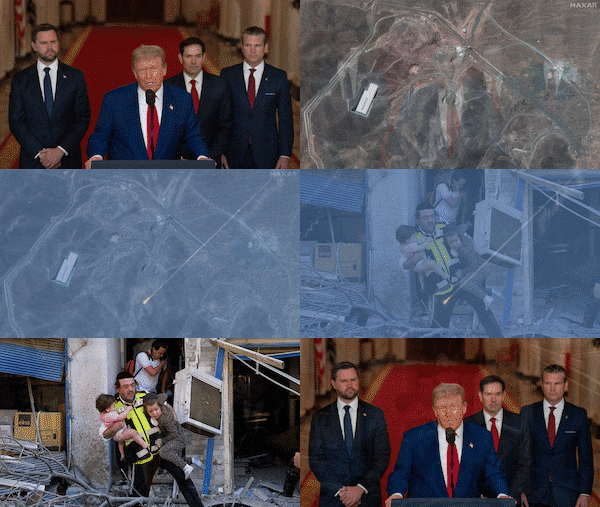
More than 400 people have been killed and 3,500 injured in Iran since Israel began its attacks on June 13, Iranian state media has reported. In Israel, 24 civilians have been killed by Iranian missile attacks, according to local authorities.
The blackout imposed earlier in the week for the more than 90 million people of Iran has left civilians in the dark about when and where the next Israeli strike might occur. Activists describe the move as a form of psychological warfare in a country all too familiar with state-imposed information controls and internet shutdowns during times of unrest.
“It's like waiting outside an operating room, not knowing anything about how the surgery is going,” said Shirin. “The last thing my dad told me before the shutdown was, 'Don't worry, stay where you are and go on with your life. It's all going to be OK.' But, of course, we're completely panicked.”
She said the last time such an internet shutdown occurred was during the Woman, Life, Freedom protests in 2022. Those were among the most significant political uprisings in Iran's recent history, when millions demanded an end to gender-based discrimination. The protests were met with violent repression by authorities.
Shirin is far from alone. Around the world, Iranians are desperately waiting for any news that their loved ones back home are safe, as deadly missile exchanges between Iran and Israel have escalated since June 13, following strikes Israel claimed were aimed at halting Tehran's nuclear programme.
Israeli Prime Minister Benjamin Netanyahu said this week that the change or fall of Iran's leadership was not a goal of Israel's attacks, but could be a result.
Cyber attacks have surged since the conflict began, aimed at Iranian banks and state television networks. On Wednesday, hackers briefly took control of the national TV news channel and broadcast a message calling on people to hold protests, which the network quickly dismissed as an “irrelevant message”.
Prominent internet monitoring organisation NetBlocks said the country had faced significant disruptions since the conflict started. On Saturday, it said internet services partially resumed after a 62-hour, government-imposed shutdown.
These blackouts severely “limit the public's ability to express political viewpoints, communicate freely and follow safety alerts amid continuing conflict with Israel", the group said.
While Iran blocks access to many foreign websites, social media and messaging apps, a wider range of websites could not be reached this week. The slowdown has also reportedly disrupted tools such as virtual private networks (VPNs), which many rely on to access international content.
“This was the worst internet shutdown we’ve ever experienced in Iran,” Amir Rashidi, director of cybersecurity and digital rights at Miaan Group. “Usually, they block access from inside the country to the outside. But in this case, we had no access both ways. We have never had this kind of shutdown before. It meant we had zero visibility into what was happening inside the country.”
He said VPNs were restricted and phone calls from outside Iran were completely blocked, although calls within the country still worked. “There’s been some improvement starting today [June 21],” he added. “But there’s still fear it could come back at any time.”
There is currently a “white-listing” system in place, with only a limited number of websites accessible both inside and outside Iran. “It’s unclear what the exact policy is or how these websites are chosen,” he said.
'Concerning' pattern
Rights organisations have denounced the move to restrict internet access as part of a concerning trend.
“We are deeply worried about the nature and scale of the shutdown, which only adds to the distress of people already grappling with … uncertainty,” Hussein Baoumi, the Middle East and North Africa deputy regional director at Amnesty International, told The National.
“Restricting access to platforms like WhatsApp and other communication tools prevents people from obtaining potentially life-saving information, including warnings about bombings.”
Iranian authorities have cut off internet access at other critical periods in the past. In 2019, Tehran completely shut down access for six days during nationwide protests that reportedly led to the deaths of more than 100 people amid a crackdown by security forces.
“The shutdown also serves to control what can be shared on social media, particularly anything that might challenge the government. We’ve raised concerns about this pattern in the past,” said Mr Baoumi.
Abbas, another Iranian living in Europe, said blackouts occurred every time there was unrest in the country. For him, this reveals the government's true intentions behind the latest restrictions.
“As soon as there are protests, they cut the internet so people can’t communicate, film or share information. They cut it to limit communication with the Iranian diaspora, to block access to information from abroad,” he said. “They cut it because they’re afraid of the people."
The names of the Iranians interviewed by The National have been changed for security reasons

Tomb%20Raider%20I%E2%80%93III%20Remastered
%3Cp%3EDeveloper%3A%20Aspyr%0D%3Cbr%3EPublisher%3A%20Aspyr%0D%3Cbr%3EConsole%3A%20Nintendo%20Switch%2C%20PlayStation%204%26amp%3B5%2C%20PC%20and%20Xbox%20series%20X%2FS%0D%3Cbr%3ERating%3A%203%2F5%3C%2Fp%3E%0A
Mercer, the investment consulting arm of US services company Marsh & McLennan, expects its wealth division to at least double its assets under management (AUM) in the Middle East as wealth in the region continues to grow despite economic headwinds, a company official said.
Mercer Wealth, which globally has $160 billion in AUM, plans to boost its AUM in the region to $2-$3bn in the next 2-3 years from the present $1bn, said Yasir AbuShaban, a Dubai-based principal with Mercer Wealth.
“Within the next two to three years, we are looking at reaching $2 to $3 billion as a conservative estimate and we do see an opportunity to do so,” said Mr AbuShaban.
Mercer does not directly make investments, but allocates clients’ money they have discretion to, to professional asset managers. They also provide advice to clients.
“We have buying power. We can negotiate on their (client’s) behalf with asset managers to provide them lower fees than they otherwise would have to get on their own,” he added.
Mercer Wealth’s clients include sovereign wealth funds, family offices, and insurance companies among others.
From its office in Dubai, Mercer also looks after Africa, India and Turkey, where they also see opportunity for growth.
Wealth creation in Middle East and Africa (MEA) grew 8.5 per cent to $8.1 trillion last year from $7.5tn in 2015, higher than last year’s global average of 6 per cent and the second-highest growth in a region after Asia-Pacific which grew 9.9 per cent, according to consultancy Boston Consulting Group (BCG). In the region, where wealth grew just 1.9 per cent in 2015 compared with 2014, a pickup in oil prices has helped in wealth generation.
BCG is forecasting MEA wealth will rise to $12tn by 2021, growing at an annual average of 8 per cent.
Drivers of wealth generation in the region will be split evenly between new wealth creation and growth of performance of existing assets, according to BCG.
Another general trend in the region is clients’ looking for a comprehensive approach to investing, according to Mr AbuShaban.
“Institutional investors or some of the families are seeing a slowdown in the available capital they have to invest and in that sense they are looking at optimizing the way they manage their portfolios and making sure they are not investing haphazardly and different parts of their investment are working together,” said Mr AbuShaban.
Some clients also have a higher appetite for risk, given the low interest-rate environment that does not provide enough yield for some institutional investors. These clients are keen to invest in illiquid assets, such as private equity and infrastructure.
“What we have seen is a desire for higher returns in what has been a low-return environment specifically in various fixed income or bonds,” he said.
“In this environment, we have seen a de facto increase in the risk that clients are taking in things like illiquid investments, private equity investments, infrastructure and private debt, those kind of investments were higher illiquidity results in incrementally higher returns.”
The Abu Dhabi Investment Authority, one of the largest sovereign wealth funds, said in its 2016 report that has gradually increased its exposure in direct private equity and private credit transactions, mainly in Asian markets and especially in China and India. The authority’s private equity department focused on structured equities owing to “their defensive characteristics.”
Most sought after workplace benefits in the UAE
- Flexible work arrangements
- Pension support
- Mental well-being assistance
- Insurance coverage for optical, dental, alternative medicine, cancer screening
- Financial well-being incentives
The alternatives
• Founded in 2014, Telr is a payment aggregator and gateway with an office in Silicon Oasis. It’s e-commerce entry plan costs Dh349 monthly (plus VAT). QR codes direct customers to an online payment page and merchants can generate payments through messaging apps.
• Business Bay’s Pallapay claims 40,000-plus active merchants who can invoice customers and receive payment by card. Fees range from 1.99 per cent plus Dh1 per transaction depending on payment method and location, such as online or via UAE mobile.
• Tap started in May 2013 in Kuwait, allowing Middle East businesses to bill, accept, receive and make payments online “easier, faster and smoother” via goSell and goCollect. It supports more than 10,000 merchants. Monthly fees range from US$65-100, plus card charges of 2.75-3.75 per cent and Dh1.2 per sale.
• 2checkout’s “all-in-one payment gateway and merchant account” accepts payments in 200-plus markets for 2.4-3.9 per cent, plus a Dh1.2-Dh1.8 currency conversion charge. The US provider processes online shop and mobile transactions and has 17,000-plus active digital commerce users.
• PayPal is probably the best-known online goods payment method - usually used for eBay purchases - but can be used to receive funds, providing everyone’s signed up. Costs from 2.9 per cent plus Dh1.2 per transaction.
More coverage from the Future Forum
57%20Seconds
%3Cp%3E%3Cstrong%3EDirector%3A%3C%2Fstrong%3E%20Rusty%20Cundieff%0D%3Cbr%3E%3Cstrong%3EStars%3A%20%3C%2Fstrong%3EJosh%20Hutcherson%2C%20Morgan%20Freeman%2C%20Greg%20Germann%2C%20Lovie%20Simone%0D%3Cbr%3E%3Cstrong%3ERating%3A%20%3C%2Fstrong%3E2%2F5%0D%3Cbr%3E%0D%3Cbr%3E%3C%2Fp%3E%0A
Fight card
1. Bantamweight: Victor Nunes (BRA) v Siyovush Gulmamadov (TJK)
2. Featherweight: Hussein Salim (IRQ) v Shakhriyor Juraev (UZB)
3. Catchweight 80kg: Rashed Dawood (UAE) v Khamza Yamadaev (RUS)
4. Lightweight: Ho Taek-oh (KOR) v Ronald Girones (CUB)
5. Lightweight: Arthur Zaynukov (RUS) v Damien Lapilus (FRA)
6. Bantamweight: Vinicius de Oliveira (BRA) v Furkatbek Yokubov (RUS)
7. Featherweight: Movlid Khaybulaev (RUS) v Zaka Fatullazade (AZE)
8. Flyweight: Shannon Ross (TUR) v Donovon Freelow (USA)
9. Lightweight: Mohammad Yahya (UAE) v Dan Collins (GBR)
10. Catchweight 73kg: Islam Mamedov (RUS) v Martun Mezhulmyan (ARM)
11. Bantamweight World title: Jaures Dea (CAM) v Xavier Alaoui (MAR)
12. Flyweight World title: Manon Fiorot (FRA) v Gabriela Campo (ARG)
Living in...
This article is part of a guide on where to live in the UAE. Our reporters will profile some of the country’s most desirable districts, provide an estimate of rental prices and introduce you to some of the residents who call each area home.
Normcore explained
Something of a fashion anomaly, normcore is essentially a celebration of the unremarkable. The term was first popularised by an article in New York magazine in 2014 and has been dubbed “ugly”, “bland’ and "anti-style" by fashion writers. It’s hallmarks are comfort, a lack of pretentiousness and neutrality – it is a trend for those who would rather not stand out from the crowd. For the most part, the style is unisex, favouring loose silhouettes, thrift-shop threads, baseball caps and boyish trainers. It is important to note that normcore is not synonymous with cheapness or low quality; there are high-fashion brands, including Parisian label Vetements, that specialise in this style. Embraced by fashion-forward street-style stars around the globe, it’s uptake in the UAE has been relatively slow.
The specs
Engine: 2.0-litre 4-cyl, 48V hybrid
Transmission: eight-speed automatic
Power: 325bhp
Torque: 450Nm
Price: Dh289,000
Specs
Engine: Dual-motor all-wheel-drive electric
Range: Up to 610km
Power: 905hp
Torque: 985Nm
Price: From Dh439,000
Available: Now
GIANT REVIEW
Starring: Amir El-Masry, Pierce Brosnan
Director: Athale
Rating: 4/5
WITHIN%20SAND
%3Cp%3EDirector%3A%20Moe%20Alatawi%3C%2Fp%3E%0A%3Cp%3EStarring%3A%20Ra%E2%80%99ed%20Alshammari%2C%20Adwa%20Fahd%2C%20Muhand%20Alsaleh%3C%2Fp%3E%0A%3Cp%3ERating%3A%203%2F5%3C%2Fp%3E%0A
Key findings of Jenkins report
- Founder of the Muslim Brotherhood, Hassan al Banna, "accepted the political utility of violence"
- Views of key Muslim Brotherhood ideologue, Sayyid Qutb, have “consistently been understood” as permitting “the use of extreme violence in the pursuit of the perfect Islamic society” and “never been institutionally disowned” by the movement.
- Muslim Brotherhood at all levels has repeatedly defended Hamas attacks against Israel, including the use of suicide bombers and the killing of civilians.
- Laying out the report in the House of Commons, David Cameron told MPs: "The main findings of the review support the conclusion that membership of, association with, or influence by the Muslim Brotherhood should be considered as a possible indicator of extremism."
How to apply for a drone permit
- Individuals must register on UAE Drone app or website using their UAE Pass
- Add all their personal details, including name, nationality, passport number, Emiratis ID, email and phone number
- Upload the training certificate from a centre accredited by the GCAA
- Submit their request
What are the regulations?
- Fly it within visual line of sight
- Never over populated areas
- Ensure maximum flying height of 400 feet (122 metres) above ground level is not crossed
- Users must avoid flying over restricted areas listed on the UAE Drone app
- Only fly the drone during the day, and never at night
- Should have a live feed of the drone flight
- Drones must weigh 5 kg or less
