
A composite photo shows a suspected nuclear reactor building in Syria before and after it was bombed by Israel in 2007. US Government via Reuters

Israeli attack on Iran echoes bombings in Iraq and Syria decades ago


Sinan Mahmoud
  • English
  • Arabic

Once again, the skies of the Middle East bore witness to a familiar doctrine: Israel’s decades-long strategy of pre-emptive attacks designed to cripple its regional foes’ nuclear ambitions, which it sees as existential threats.

What came to be known as the “Begin Doctrine” was established in 1981 when Israeli warplanes pierced Iraqi air space and flattened the unfinished Osirak nuclear reactor south-east of Baghdad. Then in 2007, Israel hit a suspected nuclear reactor in Syria.

At dawn on Friday, Israeli fighter jets stunned the world again in a provocative cross-border raid on Iran, unleashing a wave of strikes against dozens of targets, including nuclear facilities and military command centres. These strikes also killed senior figures, among them the armed forces chief and top nuclear scientists.
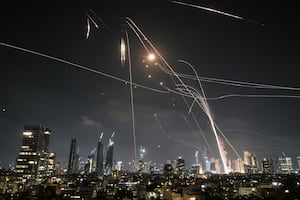
Iran's supreme leader Ayatollah Ali Khamenei warned Israel it faced a “bitter and painful” fate over the attacks, while the Iranian military said there were “no limits” to its response. Israel's military later said Iran launched around 100 drones in retaliation, which air defences intercepted outside Israeli territory.

Prime Minister Benjamin Netanyahu said Israel struck at the “heart of Iran's nuclear enrichment programme”, taking aim at the atomic facility in Natanz and nuclear scientists.

Mr Netanyahu said the strikes would “continue as many days as it takes”, while the military said intelligence showed Iran was approaching the “point of no return” on its nuclear programme.

Emergency workers on top of a building hit by an Israeli strike in Tehran on Friday. AFP

The previous attacks in Iraq and Syria were executed with surgical precision. Dubbed Operation Opera, the raid in Iraq was a watershed moment. Saddam Hussein's power was increasing and Israel feared his nuclear ambition would shift the balance of power in the region. Similarly, Israel launched Operation Orchard against the nuclear facility in Syria in 2007, which was far more secretive.

At that time of the Israeli strikes both Iraq and Syria were isolated and relatively weaker states. Syria never rebuilt its sites, while Iraq attempted to develop its atomic programme but was crippled after the 1991 Gulf War and UN-imposed sanctions.

Today’s wave of attacks on Iran present a far more complex and dangerous scenario. Unlike Iraq and Syria, Iran’s nuclear programme is more advanced with a military capabilities enough to respond, triggering a broader confrontation in the region. From Lebanon to Yemen and Iraq, Tehran runs a network of proxies capable of responding in multiple arenas.

The exact impact of these strikes on the nuclear sites is still unclear. However, the UN nuclear watchdog said there was no radiation leak at the targeted Natanz site and it was working with Iran to monitor radiation levels.

Iranian Muslim pilgrims pray at the Imam Ali Shrine in Najaf on Friday, following Israel's strikes on Iran. AFP

“Iranian authorities have informed the [International Atomic Energy Agency] that the Bushehr nuclear power plant has not been targeted and that no increase in radiation levels has been observed at the Natanz site,” it said, describing the situation as “deeply concerning.”

The IAEA’s general director Rafeal Grossi condemned the attacks. “I have repeatedly stated that nuclear facilities must never be attacked, regardless of the context or circumstances,” Mr Grossi said on Friday.

He warned that “such attacks have serious implications for nuclear safety, security and safeguards, as well as regional and international peace and security”.

The strikes killed Iran's highest-ranking military officers. Maj Gen Hossein Salami, commander of the Islamic Revolutionary Guard Corps, was killed, along with another senior IRGC commander, Maj Gen Gholam Ali Rashid and his son. The chief of staff of Iran's armed forces, Gen Mohammad Bagheri, was also killed state television reported.

“The precise targeting of senior commanders of the Revolutionary Guards, the Iranian military, and nuclear scientists – all of whom were involved in advancing the plan to destroy Israel – sends a strong and clear message: those who work toward Israel's destruction will be eliminated,” Israel's Defence Minister Israel Katz said.

The US insisted that it was not involved in the Israeli action and warned Iran not to attack its personnel or interests. US President Donald Trump told Fox News he had prior knowledge of the Israeli strikes, which Israel said involved 200 fighter jets. Mr Trump also stressed that Tehran “cannot have a nuclear bomb”.

But Tehran said Washington would be “responsible for consequences” as Israel's operation “cannot have been carried out without the co-ordination and permission of the United States”.


UAE%20Warriors%2045%20Results
%3Cp%3E%3Cstrong%3E%0DMain%20Event%0D%3A%20Lightweight%20Title%3C%2Fstrong%3E%0D%3Cbr%3EAmru%20Magomedov%20def%20Jakhongir%20Jumaev%20-%20Round%201%20(submission)%0D%3Cbr%3E%3Cstrong%3ECo-Main%20Event%0D%3A%20Bantamweight%3C%2Fstrong%3E%0D%3Cbr%3ERany%20Saadeh%20def%20Genil%20Franciso%20-%20Round%202%20(submission)%0D%3Cbr%3E%3Cstrong%3ECatchweight%20150%20lbs%3C%2Fstrong%3E%0D%3Cbr%3EWalter%20Cogliandro%20def%20Ali%20Al%20Qaisi%20-%20Round%201%20(TKO)%0D%3Cbr%3E%3Cstrong%3EBantamweight%3C%2Fstrong%3E%0D%3Cbr%3ERenat%20Khavalov%20def%20Hikaru%20Yoshino%20-%20Round%202%20(TKO)%0D%3Cbr%3E%3Cstrong%3EFlyweight%3C%2Fstrong%3E%0D%3Cbr%3EVictor%20Nunes%20def%20Nawras%20Abzakh%20-%20Round%201%20(TKO)%0D%3Cbr%3E%3Cstrong%3EFlyweight%3C%2Fstrong%3E%0D%3Cbr%3EYamato%20Fujita%20def%20Sanzhar%20Adilov%20-%20Round%201%20(submission)%0D%3Cbr%3E%3Cstrong%3ELightweight%3C%2Fstrong%3E%0D%3Cbr%3EAbdullo%20Khodzhaev%20def%20Petru%20Buzdugen%20-%20Round%201%20(TKO)%0D%3Cbr%3E%3Cstrong%3ECatchweight%20139%20lbs%3C%2Fstrong%3E%0D%3Cbr%3ERazhabali%20Shaydullaev%20def%20Magomed%20Al-Abdullah%20-%20Round%202%20(submission)%0D%3Cbr%3E%3Cstrong%3EFlyweight%3C%2Fstrong%3E%0D%3Cbr%3ECong%20Wang%20def%20Amena%20Hadaya%20-%20Points%20(unanimous%20decision)%0D%3Cbr%3E%3Cstrong%3EMiddleweight%3C%2Fstrong%3E%0D%3Cbr%3EKhabib%20Nabiev%20def%20Adis%20Taalaybek%20Uulu%20-%20Round%202%20(submission)%0D%3Cbr%3E%3Cstrong%3ELight%20Heavyweight%3C%2Fstrong%3E%0D%3Cbr%3EBartosz%20Szewczyk%20def%20Artem%20Zemlyakov%20-%20Round%202%20(TKO)%3C%2Fp%3E%0A
UAE currency: the story behind the money in your pockets
T20 World Cup Qualifier fixtures

Tuesday, October 29

Qualifier one, 2.10pm – Netherlands v UAE

Qualifier two, 7.30pm – Namibia v Oman

Wednesday, October 30

Qualifier three, 2.10pm – Scotland v loser of qualifier one

Qualifier four, 7.30pm – Hong Kong v loser of qualifier two

Thursday, October 31

Fifth-place playoff, 2.10pm – winner of qualifier three v winner of qualifier four

Friday, November 1

Semi-final one, 2.10pm – Ireland v winner of qualifier one

Semi-final two, 7.30pm – PNG v winner of qualifier two

Saturday, November 2

Third-place playoff, 2.10pm

Final, 7.30pm

Company profile

Name: Back to Games and Boardgame Space

Started: Back to Games (2015); Boardgame Space (Mark Azzam became co-founder in 2017)

Founder: Back to Games (Mr Azzam); Boardgame Space (Mr Azzam and Feras Al Bastaki)

Based: Dubai and Abu Dhabi 

Industry: Back to Games (retail); Boardgame Space (wholesale and distribution) 

Funding: Back to Games: self-funded by Mr Azzam with Dh1.3 million; Mr Azzam invested Dh250,000 in Boardgame Space  

Growth: Back to Games: from 300 products in 2015 to 7,000 in 2019; Boardgame Space: from 34 games in 2017 to 3,500 in 2019

The%20specs
%3Cp%3E%3Cstrong%3EEngine%3A%3C%2Fstrong%3E%203.0-litre%20six-cylinder%20turbo%20(BMW%20B58)%3Cbr%3E%3Cstrong%3EPower%3A%3C%2Fstrong%3E%20340hp%20at%206%2C500rpm%3Cbr%3E%3Cstrong%3ETorque%3A%3C%2Fstrong%3E%20500Nm%20from%201%2C600-4%2C500rpm%3Cbr%3E%3Cstrong%3ETransmission%3A%3C%2Fstrong%3E%20ZF%208-speed%20auto%3Cbr%3E%3Cstrong%3E0-100kph%3A%3C%2Fstrong%3E%204.2sec%3Cbr%3E%3Cstrong%3ETop%20speed%3A%3C%2Fstrong%3E%20267kph%3C%2Fp%3E%0A%3Cp%3E%3Cstrong%3EOn%20sale%3A%3C%2Fstrong%3E%20Now%3Cbr%3E%3Cstrong%3EPrice%3A%3C%2Fstrong%3E%20From%20Dh462%2C189%3Cbr%3E%3Cstrong%3EWarranty%3A%3C%2Fstrong%3E%2030-month%2F48%2C000k%3C%2Fp%3E%0A
Dunki
%3Cp%3E%3Cstrong%3EDirector%3A%3C%2Fstrong%3E%20Rajkumar%20Hirani%C2%A0%3C%2Fp%3E%0A%3Cp%3E%3Cstrong%3EStarring%3A%3C%2Fstrong%3E%20Shah%20Rukh%20Khan%2C%20Taapsee%20Pannu%2C%20Vikram%20Kochhar%20and%20Anil%20Grover%3C%2Fp%3E%0A%3Cp%3E%3Cstrong%3ERating%3A%3C%2Fstrong%3E%204%2F5%3C%2Fp%3E%0A
Updated: June 14, 2025, 3:22 AM