
The Kurdistan Workers' Party (PKK), which has been in armed conflict with the Turkish state for more than four decades, has announced it will disband and dissolve as part of a peace process with Ankara.
“The PKK’s 12th Congress decided to dissolve the PKK’s organisational structure, end the armed struggle, with the practical process to be managed and carried out by Leader Apo [Abdullah Ocalan], and end the work carried out under the PKK name,” Firat news agency, affiliated with the group, said on Monday.
Turkey's Foreign Minister Hakan Fidan said on Monday that the PKK's decision to disband and end its armed struggle against the Turkish state is of "historic importance" for permanent peace in the region.
-
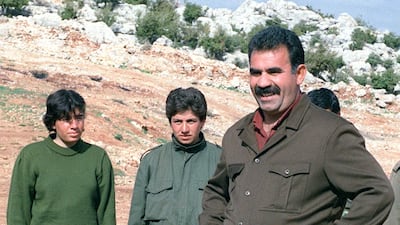
Abdallah Ocalan, leader of the Kurdistan Workers' Party (PKK), with guerrillas at a training camp in Helweh, Lebanon, 2km from the Syrian border, in 1992. AFP -
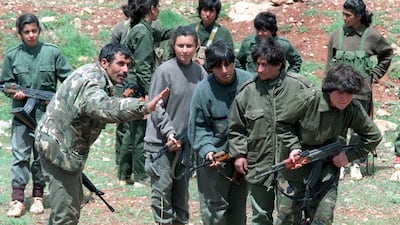
PKK fighters training at Helweh in 1992. AFP -

Turkish army commandos raises their weapons during a military operation aiming to clear the area of PKK guerrillas, in northern Iraq, 1995. Reuters -

Turkish soldiers plant a flag at Zap camp, northern Iraq, after they captured it from the PKK in 1997. Reuters -

The aftermath of a bus explosion in Kirikkale, east of Ankara, in 1998. The blast ripped a hole in its roof, killing four and injuring 20 passengers. Reuters -

Ocalan's lawyers address a press conference in a Rome hotel where the pair said the PKK leader was willing to be prosecuted in a country were he will be judged according to constitutional laws because he has not committed any acts of terrorism, in 1998. Reuters -

Ocalan is bound and blindfolded by special forces in a seat on board a private aircraft in February 1999 following his removal from the Greek embassy in Nairobi, Kenya. Reuters -

Turkish Prime Minister Recep Tayyip Erdogan and US Secretary of State Condoleezza Rice pose for the media before a meeting in Ankara in 2006 to discuss Turkey's opposition to the rebel PKK. Reuters -

A PKK training session in Amedia, northern Iraq, in 2007. AFP -

Armed Kurdish fighters from the PKK march into Heror, northern Iraq, in 2013. AP -
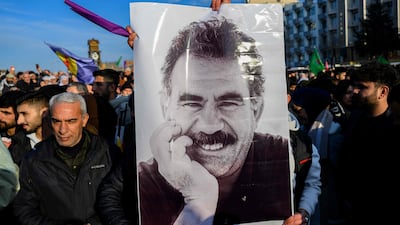
Supporters display a poster depicting jailed PKK leader Ocalan, after he called on the party to lay down its arms and dissolve, in Diyarbakir, Turkey. AFP


Speaking at a joint press conference with his Syrian and Jordanian counterparts, Mr Fidan said there would be practical steps to be taken for the disbandment of the PKK, and that Turkey would follow the process closely.
The group, classified as a terrorist organisation by Turkey, the US and the European Union, held its congress on Friday to heed the call of its jailed leader to lay down arms, disband and enter a peace initiative with the Turkish state.
Omer Celik, spokesman for Turkish President Recep Tayyip Erdogan's Justice and Development Party (AKP), said the PKK's decision was “an important stage in terms of the goal of a 'terror-free Turkey'” – a phrase Turkish government officials have used to describe overtures to the PKK.
Ocalan’s call in February ordering the dissolution came after a months-long process initiated by an ally of Mr Erdogan – the ultranationalist politician Devlet Bahceli – for Abdullah Ocalan to be given greater freedom in exchange for the PKK’s dissolution.
The PKK said it believes Kurdish political parties will fulfil their responsibilities by developing Kurdish democracy to “ensure democratic Kurdish nationhood”.
Kurdish officials, including those in northern Iraq's semi-autonomous Kurdistan region, have framed the talks with Turkey as dialogue aimed at peace and ensuring rights for Turkey's ethnically Kurdish citizens, who make up around one-fifth of the population. Turkey has continued striking the group's positions in the Kurdistan region.

Mr Fidan on Friday said disarmament alone was not sufficient, while Mr Erdogan has continued to publicly call for the group's eradication.
The PKK had previously said it would not heed any calls to disarm unless Ocalan was released from jail and a meeting could take place in person.
Many questions remain about how the PKK disarmament process will work in practice. It remains unclear if members will be granted an amnesty, and if those in Iraq and Syria will be allowed to return to Turkey.
The fate of imprisoned Kurdish politicians and militants also remains unclear. Ocalan is serving a life sentence on the island of Imrali in the Sea of Marmara, south of Istanbul, where he has been imprisoned since he was captured in Kenya in February 1999.
Berkay Mandiraci, Turkey analyst for International Crisis Group, told The National that Ankara's response to the decision will determine what happens next. “The Kurdish side is looking for some kind of a formalisation of the process – a law passed in parliament, so there is more clarity on the process,” he said.
It is difficult to envisage the process being disrupted, he added. Both Ankara and the PKK seem willing to make it work, “which makes one hopeful”, he said.
Turkish politicians have indicated that the disarming and dissolution process will not happen overnight and have said that it must extend to all branches and offshoots of the PKK.
“This decision must be implemented in practice and realised in all its dimensions,” Mr Celik added. “The concrete and complete implementation of the 'dissolution' and 'surrender of arms' decision, which will close all branches and extensions of the PKK and its illegal structures, will be a turning point. This process will be meticulously monitored in the field by our state institutions.”
The PKK was founded by Ocalan in 1978 and has waged an insurgency against the Turkish state for four decades, with about 40,000 killed on both sides. In recent years, the group's activity has been limited to the mountainous areas of the Kurdish region of northern Iraq and Syria, where PKK offshoots developed a presence.
The pro-Kurdish People's Equality and Democracy Party, also known as DEM Party, played a crucial role in mediating between the PKK and Ankara and has welcomed the congress.
On Sunday, the party announced the formation of the Democratic Unity Initiative, describing it as a “civil society platform” aimed at uniting Kurds across Iraq, Syria, Turkey and Iran to “build a democratic life”.
Nechirvan Barzani, President of Iraq's Kurdistan Region, said authorities are ready to offer support “for the success of this historic opportunity”.
He said in a statement posted on X: “Now is the time and all eyes are on this important step to be responded to with further positive and necessary steps by all parties concerned.”
Turkish government director of communications Fahrettin Altun said in a post on X that the process “is not a short-term and shallow process” that had emerged overnight. “Nor is it a process that will end very quickly from today to tomorrow,” he added, indicating that there is work still to be done to ensure that the PKK's pledge to disarm becomes reality.

