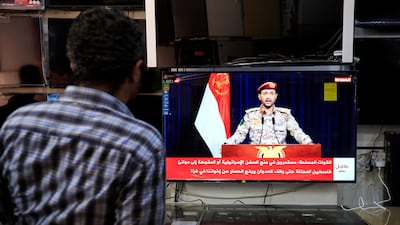
Hodeidah has been a flashpoint since the the Houthis seized control of the port in 2021. AP

Yemen government 'planning to retake Hodeidah port'


Lemma Shehadi
  • English
  • Arabic

A military offensive by Yemen's internationally recognised government to take control of a Red Sea port from the Houthi rebels could begin soon, analysts believe. But there has been little assurance that the operation will receive the US backing needed to be successful.

The Iran-backed Houthis took control of Hodeidah in 2021. It is an entry point for humanitarian aid into Yemen and contains oil storage facilities.

After the US renewed air strikes against the Houthis, armed groups supporting the internationally recognised government have been preparing to march into Hodeidah, analysts said. The attacks on the port city have reportedly killed Houthi figures and weakened the group.

About 80,000 soldiers are being mobilised, said Abdulaziz Sager, founder of the Gulf Research Centre. The operations are not just planned for Hodeidah port, but the surrounding region known as the “fifth district” in western Yemen, and the Taiz province to the south, said Farea Al Muslimi, a fellow at the Chatham House think tank in London.

The capture of Hodeidah would be the “groundwork” for a takeover of the capital Sanaa, which has been under Houthi control since 2014. “It has always been the case that if Hodeidah goes down then Sanaa is next," said Mr Sager, speaking at the same Chatham House event. "We are at the stage of counting down the end of the Houthis.”

The group seized control of northern Yemen in 2014, sparking a civil war. A Saudi-led coalition intervened at the request of the internationally recognised government.

Since 2023, the Houthis have launched attacks on commercial shipping vessels in the Red Sea, actions the group claims are in solidarity with the people of Gaza. The attacks on international shipping prompted the US strikes.

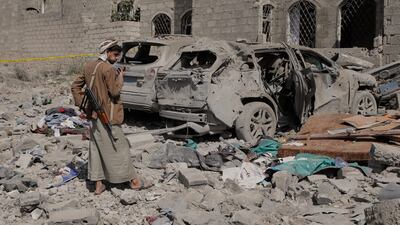
  • A man inspects damage reportedly caused by a new wave of US air strikes in Sanaa, Yemen's capital. AP
    A man inspects damage reportedly caused by a new wave of US air strikes in Sanaa, Yemen's capital. AP
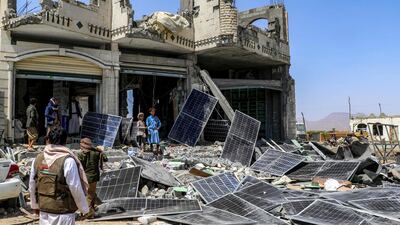
  • A heavily damaged building used to store solar panels was reportedly hit in US attacks on Yemen's northern province of Saada. AFP
    A heavily damaged building used to store solar panels was reportedly hit in US attacks on Yemen's northern province of Saada. AFP
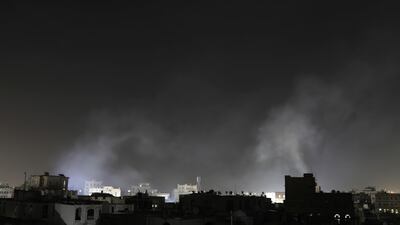
  • Smoke rises over buildings after the strikes in Sanaa. EPA
    Smoke rises over buildings after the strikes in Sanaa. EPA
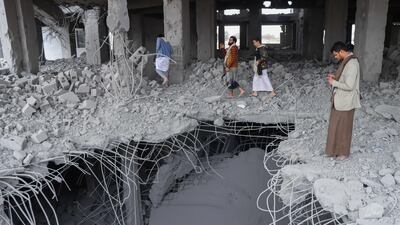
  • Buildings were reduced to rubble in Saada province. AFP
    Buildings were reduced to rubble in Saada province. AFP
  • A woman walks through debris at the site of a strike in Sanaa. Reuters
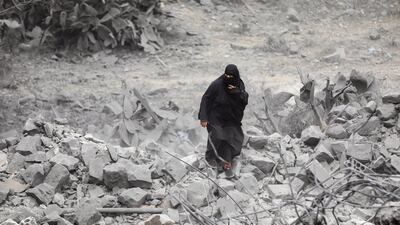
    A woman walks through debris at the site of a strike in Sanaa. Reuters
  • A man checks a damaged window in Yemen's capital city. Reuters
    A man checks a damaged window in Yemen's capital city. Reuters
  • What used to be an events hall in Sanaa now lies in ruins. EPA
    What used to be an events hall in Sanaa now lies in ruins. EPA
  • Smoke from burning buildings in Sanaa. AFP
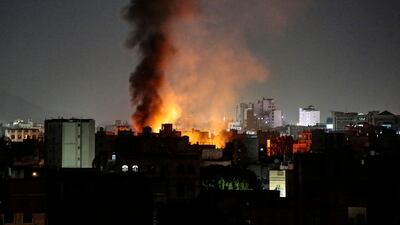
    Smoke from burning buildings in Sanaa. AFP

Post-war concerns

But a push to recapture Hodeidah comes with challenges. US military support is not guaranteed, owing to Washington's “inconsistent” foreign policy on Yemen, Mr Al Muslimi said. “There is a lot of illusion from the Yemeni government that they will be armed by the US or they will be given air cover,” he added.

The US has said it will not become involved in the Yemeni conflict. A Saudi-brokered peace process, which was handed over to the UN last year, has been stalled by the Houthi attacks in the Red Sea.

Gen Michael Kurilla of US Central Command met Lt Gen Sagheer Hamoud Ahmed Aziz, Chief of Staff of Yemen’s armed forces this week, and they discussed "ongoing efforts against the Iran-backed Houthis, including the current operation designed to restore freedom of navigation", Centcom said in a statement.

  • A ship in the Suez Canal heading towards the Red Sea in Ismailia, Egypt. Houthi rebels in Yemen have pledged to disrupt all shipping destined for Israel through the Red Sea and the Suez Canal. Getty Images
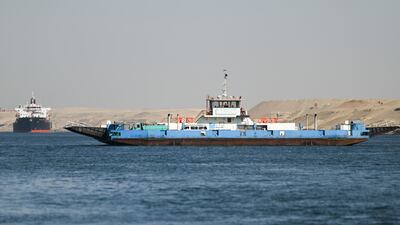
    A ship in the Suez Canal heading towards the Red Sea in Ismailia, Egypt. Houthi rebels in Yemen have pledged to disrupt all shipping destined for Israel through the Red Sea and the Suez Canal. Getty Images
  • Sailors on the USS Mason during Operation Prosperity Guardian. Photo: US Navy
    Sailors on the USS Mason during Operation Prosperity Guardian. Photo: US Navy
  • A ship travelling south through the Suez Canal. Getty Images
    A ship travelling south through the Suez Canal. Getty Images
  • The officer of the watch on the bridge of HMS Diamond in the Red Sea. Reuters
    The officer of the watch on the bridge of HMS Diamond in the Red Sea. Reuters
  • A container ship in the Suez Canal near Ismailia, Egypt. Getty Images
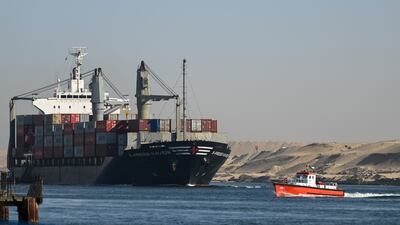
    A container ship in the Suez Canal near Ismailia, Egypt. Getty Images
  • A televised statement by the Houthis' military spokesman Yahya Sarea in Sanaa, Yemen, after a large-scale missile and drone attack by the group against shipping lanes in the Red Sea. EPA
    A televised statement by the Houthis' military spokesman Yahya Sarea in Sanaa, Yemen, after a large-scale missile and drone attack by the group against shipping lanes in the Red Sea. EPA
  • A ship in the Suez Canal heading towards the Red Sea. Getty Images
    A ship in the Suez Canal heading towards the Red Sea. Getty Images
  • On the bridge of HMS Diamond as Sea Viper missiles are fired in the Red Sea to combat a barrage of Houthi drones and missiles. Photo: Ministry of Defence via AP
    On the bridge of HMS Diamond as Sea Viper missiles are fired in the Red Sea to combat a barrage of Houthi drones and missiles. Photo: Ministry of Defence via AP

Rather, US decisions on Yemen would most likely be guided by Washington’s “domestic political calculations” and growing isolationism, Mr Al Muslimi said.

A military operation in Hodeidah would be “politically” difficult because it would breach the 2018 UN-sponsored Stockholm Agreement, he added. This required all parties to the conflict to withdraw from the port city, which the Houthis never did.

Yet there were concerns the internationally recognised government would lack legitimacy in Sanaa and had a limited capacity to govern. Its track record in southern Yemen was plagued by inefficient governance, electricity shortages and rising food prices.

“My honest concern is the next day. If they take Sanaa, what can they deliver to the people that will make them feel that now things are back to normal, there is safety and security, the law is there,” Mr Sager said.

These risks would be amplified by the growing isolation of the US and UK, two of the world's biggest donors to Yemen but that recently decreased foreign aid programmes. “The US is not in the government capacity-building space any more,” said Sanam Vakil, head of the Mena programme at Chatham House.

Mr Al Muslimi urged the US and its allies to turn their attention to Yemen’s peace process. “With some updates, it's still possible in the longer term. Yemen has the better chance of a political process, more than Libya, more than Syria."

Creeping Russian interests

A US navy ship fires missiles at the Houthis in Yemen in April. Centcom; Reuters

A Houthi agreement with Moscow and Beijing to allow their ships to sail through the Bab Al Mandeb strait without being attacked adds further obstacles to a potential offensive on Hodeidah.

It is not known what the terms of the agreement are, but both Russia and China hold veto power at the UN Security Council and there have been Iran-brokered talks for Russia to send advanced anti-ship missiles to the Houthis. There has also been evidence of Houthis recruiting fighters to join the war in Ukraine.

“It is the elephant in the room, a real dark hole,” Mr Al Muslimi said, answering a question from The National, about the potential long-term affects of the Houthi agreement.

With Russia’s hold in Syria weakened by the toppling of former president Bashar Al Assad, Moscow seemed set to shift resources to Yemen. Russian regional experts previously stationed in Damascus were now in Sanaa, Mr Al Muslimi said. “Losing Syria will only make the Russian presence in Yemen stronger,” he added.

Russian humanitarian aid arrives in Sana'a in 2015. AFP

Russia’s recent attempts to open an embassy in Aden – the seat of the internationally recognised government – were mired by a request for free movement, which was rejected by the Yemeni side, Mr Sager said. “The government told them you cannot have free movement, because they know there is some sort of linkage, relations and supply happening,” he said.

Likewise, US President Donald Trump’s trade war with China was likely to make Beijing “more generous” in Yemen, Mr Al Muslimi added.

Update: In an earlier version of this article the quotation "We are at the stage of counting down the end of the Houthis" was wrongly attributed to Farea Al Muslimi. As corrected, above, it was made by another speaker who contributed to this article.


The Saga Continues

Wu-Tang Clan

(36 Chambers / Entertainment One)

'Gold'

Director:Anthony Hayes

Stars:Zaf Efron, Anthony Hayes

Rating:3/5

Notable salonnières of the Middle East through history

Al Khasan (Okaz, Saudi Arabia)

Tamadir bint Amr Al Harith, known simply as Al Khasan, was a poet from Najd famed for elegies, earning great renown for the eulogy of her brothers Mu’awiyah and Sakhr, both killed in tribal wars. Although not a salonnière, this prestigious 7th century poet fostered a culture of literary criticism and could be found standing in the souq of Okaz and reciting her poetry, publicly pronouncing her views and inviting others to join in the debate on scholarship. She later converted to Islam.


Maryana Marrash (Aleppo)

A poet and writer, Marrash helped revive the tradition of the salon and was an active part of the Nadha movement, or Arab Renaissance. Born to an established family in Aleppo in Ottoman Syria in 1848, Marrash was educated at missionary schools in Aleppo and Beirut at a time when many women did not receive an education. After touring Europe, she began to host salons where writers played chess and cards, competed in the art of poetry, and discussed literature and politics. An accomplished singer and canon player, music and dancing were a part of these evenings.


Princess Nazil Fadil (Cairo)

Princess Nazil Fadil gathered religious, literary and political elite together at her Cairo palace, although she stopped short of inviting women. The princess, a niece of Khedive Ismail, believed that Egypt’s situation could only be solved through education and she donated her own property to help fund the first modern Egyptian University in Cairo.


Mayy Ziyadah (Cairo)

Ziyadah was the first to entertain both men and women at her Cairo salon, founded in 1913. The writer, poet, public speaker and critic, her writing explored language, religious identity, language, nationalism and hierarchy. Born in Nazareth, Palestine, to a Lebanese father and Palestinian mother, her salon was open to different social classes and earned comparisons with souq of where Al Khansa herself once recited.

%20Ramez%20Gab%20Min%20El%20Akher
%3Cp%3E%3Cstrong%3ECreator%3A%3C%2Fstrong%3E%20Ramez%20Galal%3C%2Fp%3E%0A%3Cp%3E%3Cstrong%3EStarring%3A%3C%2Fstrong%3E%20Ramez%20Galal%3C%2Fp%3E%0A%3Cp%3E%3Cstrong%3EStreaming%20on%3A%20%3C%2Fstrong%3EMBC%20Shahid%3C%2Fp%3E%0A%3Cp%3E%3Cstrong%3ERating%3A%20%3C%2Fstrong%3E2.5%2F5%3C%2Fp%3E%0A
Ten tax points to be aware of in 2026

1. Domestic VAT refund amendments: request your refund within five years

If a business does not apply for the refund on time, they lose their credit.

2. E-invoicing in the UAE

Businesses should continue preparing for the implementation of e-invoicing in the UAE, with 2026 a preparation and transition period ahead of phased mandatory adoption. 

3. More tax audits

Tax authorities are increasingly using data already available across multiple filings to identify audit risks. 

4. More beneficial VAT and excise tax penalty regime

Tax disputes are expected to become more frequent and more structured, with clearer administrative objection and appeal processes. The UAE has adopted a new penalty regime for VAT and excise disputes, which now mirrors the penalty regime for corporate tax.

5. Greater emphasis on statutory audit

There is a greater need for the accuracy of financial statements. The International Financial Reporting Standards standards need to be strictly adhered to and, as a result, the quality of the audits will need to increase.

6. Further transfer pricing enforcement

Transfer pricing enforcement, which refers to the practice of establishing prices for internal transactions between related entities, is expected to broaden in scope. The UAE will shortly open the possibility to negotiate advance pricing agreements, or essentially rulings for transfer pricing purposes. 

7. Limited time periods for audits

Recent amendments also introduce a default five-year limitation period for tax audits and assessments, subject to specific statutory exceptions. While the standard audit and assessment period is five years, this may be extended to up to 15 years in cases involving fraud or tax evasion. 

8. Pillar 2 implementation 

Many multinational groups will begin to feel the practical effect of the Domestic Minimum Top-Up Tax (DMTT), the UAE's implementation of the OECD’s global minimum tax under Pillar 2. While the rules apply for financial years starting on or after January 1, 2025, it is 2026 that marks the transition to an operational phase.

9. Reduced compliance obligations for imported goods and services

Businesses that apply the reverse-charge mechanism for VAT purposes in the UAE may benefit from reduced compliance obligations. 

10. Substance and CbC reporting focus

Tax authorities are expected to continue strengthening the enforcement of economic substance and Country-by-Country (CbC) reporting frameworks. In the UAE, these regimes are increasingly being used as risk-assessment tools, providing tax authorities with a comprehensive view of multinational groups’ global footprints and enabling them to assess whether profits are aligned with real economic activity. 

Contributed by Thomas Vanhee and Hend Rashwan, Aurifer

The specs
  • Engine: 3.9-litre twin-turbo V8
  • Power: 640hp
  • Torque: 760nm
  • On sale: 2026
  • Price: Not announced yet
Updated: April 13, 2025, 8:33 PM