

Syrian militants said they are advancing in Aleppo province, fending off counter-attacks by forces loyal to President Bashar Al Assad, who claimed to have retaken several towns previously overrun during the insurgency.
Opposition fighters said they have taken control of the whole of Idlib province, including towns such as Saraqib and Khan Sheikhoun, which were centres of the 2011 protests against Mr Al Assad's government in Damascus that spiralled into more than a decade of conflict. Led by the former Al Qaeda affiliate Hayat Tahrir Al Sham, the militants last week launched a major assault, taking the city of Aleppo, Syria’s most important industrial centre.
While the exact death toll from the fighting remains unclear, at least 400 people have been killed, including 61 civilians, a Syria war monitor said on Sunday. The numbers are likely to rise if rebels continue their advance and pro-Assad troops keep attacking opposition-held areas in response. Syrian and Russian air strikes killed at least 25 people across north-western Syria on Sunday, the White Helmets civil defence group said on Monday. The deaths were reported amid a second day of intense bombardment against a shock insurgency.
Rebels say they reacted to pro-government attacks on opposition-held areas and in an attempt to return millions of displaced people sheltering in north-western Syria to their homes. The operations began as Lebanon's Hezbollah has been weakened in more than a year of conflict with Israel, which has also degraded weapons stocks and troops led by Iran in Syria. Hezbollah has been key among the Iran-backed troops in Syria that enabled Mr Al Assad to take and maintain territory from rebels.
The rebel operations essentially broke the long-standing frozen conflict in north-west Syria, resulting from “de-escalation zones” brokered by Syria, Iran, Turkey and Russia in a series of meetings in the Kazakh capital Astana that began in 2017. That process led to north-west Syria being divided into clusters of control under various Islamist groups, some directly backed by Turkey. US-backed Kurdish militias still hold areas of territory in north-western Syria.
-
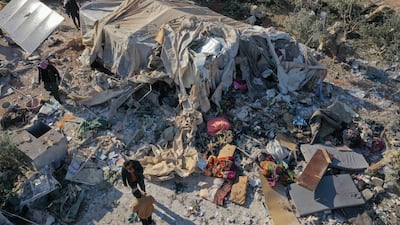
People inspects a camp for internally displaced people destroyed during an air strike near the village of Harbnush, north of Idlib, Syria. AP -
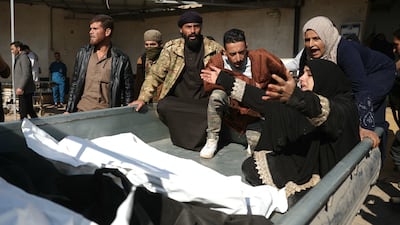
People mourn relatives killed in a reported Syrian regime air strike on Wadi Khaled camp at the SAMS Hospital in Maarat Misrin, a town in Syria's northern Idlib governorate. AFP -
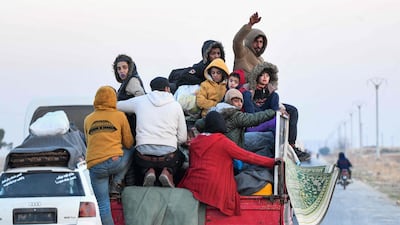
Displaced Syrian Kurds ride in the back of a vehicle loaded with belongings on the Aleppo-Raqqa motorway to flee areas on the outskirts of the northern city of Aleppo after they were seized by Islamist-led rebels. AFP -
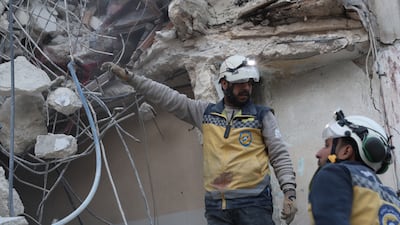
Medics inspect the damaged Ibn Sina Hospital following a Russian air strike, in Idlib, northern Syria. EPA -
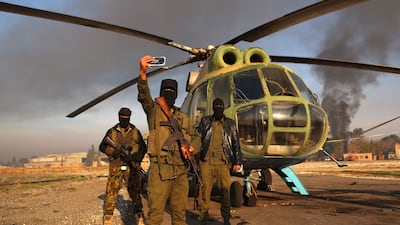
Militants gather at the Nayrab military airport, in the northern Syrian city of Aleppo. AFP -
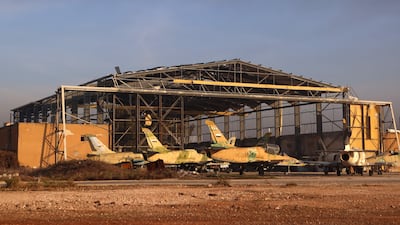
Syrian military aircraft are among the equipment at the airport. Militants have taken control of large parts of Aleppo. AFP -
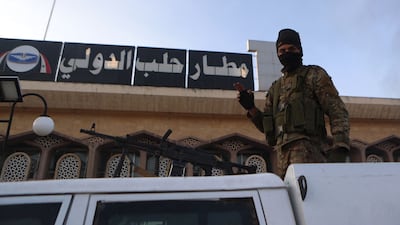
A militant patrols outside the airport. The offensive has resulted in Russian air strikes on Syria. AFP -
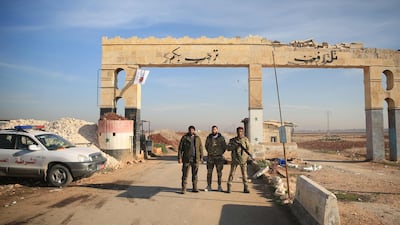
Fighters stand guard outside the northern Syrian town of Tal Rifat. AFP -
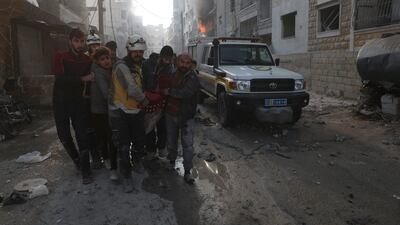
A member of the Syrian White Helmet civil defence helps carry a victim of Syrian government attacks on Idlib city. AP -
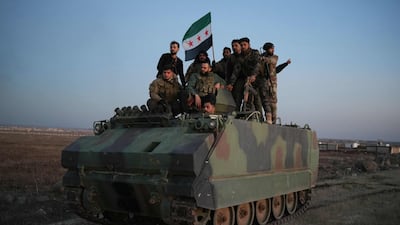
Anti-government fighters reach the motorway near the northern Syrian town of Azaz. AFP -
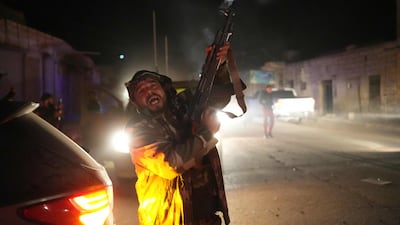
Anti-government fighters celebrate as they take over the northern Syrian town of Tal Rifaat. AFP -
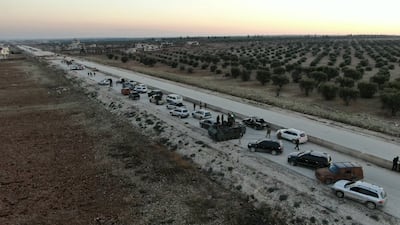
Anti-government fighters swept into the city of Aleppo, east of Idlib province. AFP -
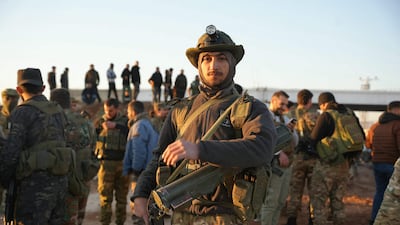
The Syrian army said dozens of its soldiers had been killed in the attack on Aleppo. AFP -
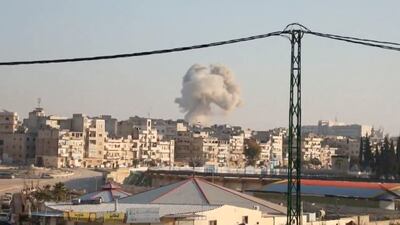
Smoke billows in the aftermath of what the White Helmets say is a strike, in Idlib, Syria. Reuters -

Syria's President Bashar Al Assad meets Iran's Foreign Minister Abbas Araghchi, in Damascus. Reuters -
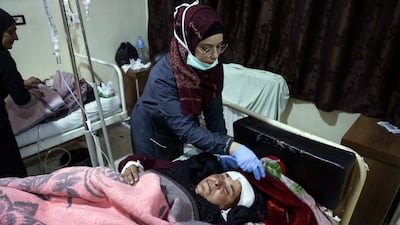
A nurse attends to an injured woman in Idlib, Syria. Government air strikes in Idlib killed at least three civilians, including two children, and wounded 11 others, said the Syrian Civil Defence. AP -
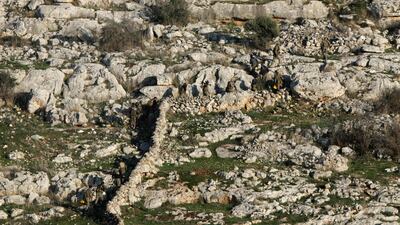
Anti-government fighters take a position near the northern Syrian town of Tal Rifaat. AFP -
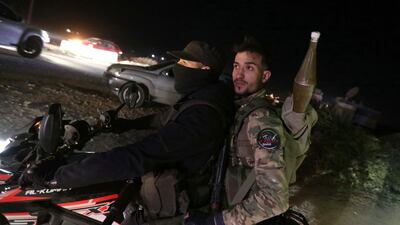
Anti-government fighters ride a motorcycle in the northern Syrian town of Tal Rifaat. AFP -
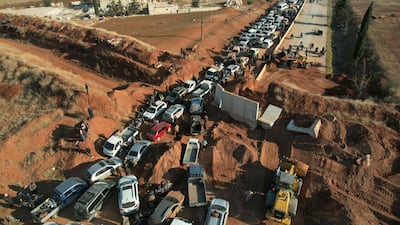
People cross an anti-government checkpoint as they return to the town of Saraqib in the eastern part of Idlib province. AFP -
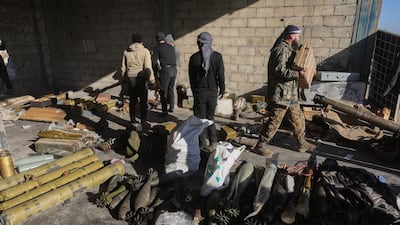
Syrian opposition fighters seize abandoned Syrian army ammunition in the town of Khan Assubul, Syria, southwest of Aleppo. AP


The militants have so far appeared to meet very little resistance from Syrian army troops and Iran-backed militant groups fighting on the side of the government in Damascus. They have taken back a long-stretch of the key M5 motorway that connects the city of Homs, under Syrian government control, to Aleppo. Rebels have released video of dozens of captured pro-government troops. The fate of the detainees fate is not clear as militants have filmed themselves directing sectarian slurs at the captured troops, mostly from the Alawite sect from which Mr Al Assad hails.
Alongside the Hayat Tahrir advance, Turkish-backed rebels in northern Aleppo province reported launching a separate campaign to reclaim a pocket of territory held by Kurdish militias around Tall Rifat. On Sunday evening, a Turkish security official said that the operation was initiated in response to Kurdish efforts to connect the Tall Rifat enclave with wider areas under their control in north-eastern Syria.
“The PKK/YPG … saw the Syrian regime forces leaving the areas under their control as an opportunity and put into action a plan to create a terror corridor between Tel Rifaat and north-eastern Syria,” the official said in written remarks to journalists, using acronyms referring to Kurdish militias in the area. “By cutting the road between Raqqa and Aleppo, [Syrian opposition troops] prevented the PKK/YPG from establishing a terror corridor between Tel Rifaat and north-eastern Syria.”
There has been a flurry of diplomacy around the shock rebel advances. Mr Al Assad has reached out to allies and countries that have normalised relations with Syria. Turkey, whose attempts to restore relations with Mr Al Assad have made little progress this year, seeks to maintain its interests in Syria while avoiding conflict of an intensity that would see more refugees attempt to cross its border.
On Monday, the Hayat Tahrir Al Sham-led operations room announced it would permit any remaining Kurdish fighters in Aleppo city to leave for Kurdish-controlled areas in north-eastern Syria.
Iran's Foreign Minister Abbas Araghchi travelled to Damascus yesterday before arriving in the Turkish capital Ankara this morning. As well as talks with Tehran, Turkish Foreign Minister Hakan Fidan has spoken with Iraqi Foreign Minister, Fouad Hussein, Prince Faisal bin Farhan, Saudi Arabia’s Minister of Foreign Affairs, and US Secretary of State Antony Blinken.
In a joint press conference with Mr Araghchi in Ankara, Mr Fidan said that the widespread conflict in Syria restarting was because of “connected problems” that have remained unsolved since the start of the war. “The opposition's legitimate demands were ignored and the regime did not approach the political process in an authentic way, which was a mistake,” he said.
Mr Araghchi, one of Mr Al Assad’s key allies alongside Russia, said Ankara and Tehran do not agree on all issues related to Syria, where they have supported opposing sides. He blamed the rebel advance on Israel and said the country was using Syria to distract from the situation in Palestine and Lebanon.
Iran would continue to support Damascus, he said, although did not outline specific steps. “As the Islamic Republic of Iran, we have certain support for the Syrian state and army: as we have supported the Syrian people and army so far, we will continue doing the same for the peace and stability of our region,” he told reporters.
Israel has repeatedly struck Iranian weapons stocks in Syria to weaken their efforts to transfer arms across the region and attack Israel. While the Islamist rebels and Israel share an enemy in Damascus, there is no evidence of direction co-ordination between them in the current offensive.
Key questions now include the extent of Damascus' response to the rebel advances, and – having shifted its focus to Ukraine – how willing Russia is to increase support for Mr Al Assad. Hayat Tahrir leader Abu Mohammed Al Jawlani has vowed to take Damascus, but the rebels' ability to do so is less clear cut, especially if government troops rally around the capital.
The fate of many non-Sunni Muslims and Christians now living in territory controlled by Hayat Tahrir, an extremist group, also remains unclear, as does the future of the Kurdish-dominated north-east of Syria.

