
Several Syrian soldiers have been killed as rebel forces opposed to President Bashar Al Assad overran the government-held northern city of Aleppo, the Syrian military said on Saturday.
Mr Al Assad, in his first public comments on the attack, said Syria will continue to “defend its stability and territorial integrity”, state news agency Sana reported.
Syrian opposition groups led by Hayat Tahrir Al Sham infiltrated Aleppo as government troops withdrew on Friday evening. Authorities closed Aleppo International airport and the central roads after several districts were stormed.
“The large numbers of terrorists and the multiplicity of battlefronts prompted our armed forces to carry out a redeployment operation aimed at strengthening the defence lines in order to absorb the attack, preserve the lives of civilians and soldiers, and prepare for a counterattack,” the army said in a first public acknowledgement of the rebel attack.
There were also reports of rebels advancing on Hama – a town 140km south of Aleppo and 213km north of Damascus. Sana reported Syrian “armed units are stationed in their positions in the northern and eastern countryside of Hama governorate and are ready to repel any terrorist attack”.
By Saturday evening, the rebels said they had seized at least four towns in the central Hama province and claimed to have entered the provincial capital.
This was the first major confrontation in the city since government troops and their allies including Russia and Iran retook Aleppo in 2016. Videos and sources within the city confirmed the presence of rebel groups across large parts of Aleppo, Syria’s main industrial and economic centre.
-
Anti-government fighters brandish their guns as they ride a vehicle in Syria's northern city of Aleppo on November 30, 2024. Jihadists and their Turkish-backed allies breached Syria's second city of Aleppo on November 29, as they pressed a lightning offensive against forces of the Iranian- and Russian-backed government. (Photo by Omar HAJ KADOUR / AFP) -
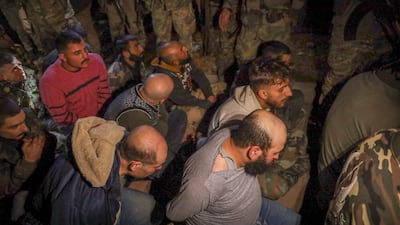
Alleged Syrian army soldiers and allied fighters sit on the floor after being captured by opposition fighters in Aleppo. AP -

Syrian opposition fighters tear up a portrait of Syrian President Bashar Al Assad in central Aleppo. EPA -

Anti-government fighters pose for a picture on a tank on the road leading to Maaret Al Numan in Syria's northwestern Idlib province. AFP -

Opposition fighters patrol the streets after taking control of the city of Maarat Al Numan where the international road M5 passes through it. EPA -

Opposition fighters in Aleppo. EPA -

Opposition fighters pray in Aleppo. EPA -

Insurgents hold a position outside Aleppo, Syria. AP -

An empty street in Aleppo after militants entered the city. AFP -

Anti-government fighters prepare for battle in the northern Syrian city of Idlib. AFP -

Militants set alight a poster of Syrian President Bashar Al Assad in front of a building they seized in the district of Zarbah. AFP -

Militants hold a position on the outskirts of Aleppo. AFP -

Fighters enter the Rashidin district on the outskirts of Aleppo on motorcycles with smoke billowing in the background amid fighting. AFP -

Militants drive through the village of Talhiyah. AFP -
Fighters fire towards Syrian army troops in the Rashidin district on the outskirts of Aleppo city as militants continue their offensive against government forces. AFP -

Anti-regime fighters hold a position on the outskirts of Aleppo. AFP -

Smoke rises during clashes in Aleppo. AFP -

Anti-regime fighters on the outskirts of Aleppo. AFP -

A damaged vehicle belonging to Syrian government troops in the countryside near Aleppo. AFP -

Fighters seize a Syrian Army tank on the international M5 highway in the Zarbah area, south-west of Aleppo city. AFP -

Insurgents on the M5 highway in the Zarbah area. AFP -

Fighters drive along the M5 highway in the Zarbah area. AFP


“Our armed forces fought fierce battles against them at various points of engagement extending over a strip exceeding 100km to stop their advance. During the battles, dozens of our armed forces were martyred and others were wounded,” the military said.
It said that the insurgents had not been able to establish fixed positions in Aleppo city because of the army's bombardment of their positions.
A war monitor said 16 civilians were killed on Saturday when an air strike, likely carried out by Damascus ally Russia, hit an area of Aleppo.
“At least 16 civilians were killed and 20 others wounded” when “warplanes, likely Russian, targeted civilian vehicles” at a roundabout in the city of Aleppo, said the Syrian Observatory for Human Rights, raising the overall toll in heavy fighting since Wednesday to 327.
Thousands of civilian cars were fleeing Aleppo from the main Khanasir Athriya intersection hours after insurgents overran main neighbourhoods, residents told Reuters on Saturday. They were mostly heading to Latakia and Salamiya, they said, with the main Damascus-Aleppo motorway closed.
The rebel forces also captured the city of Maraat Al Numan, south of Idlib city, putting the whole of Idlib province under rebel control, two rebel sources told Reuters.
Fell without fight
Despite the lightning offensive, the city was seemingly taken without a fight as government troops withdrew to the outskirts. Residents told The National that clashes and fighting within Aleppo were at a bare minimum. Many did not know what was happening until they saw militants in their neighbourhoods.

“It’s over. The city has fallen,” one Syrian journalist, who was leaving Aleppo yesterday, told The National. “We’ve fled to a safe house on the outskirts, near the countryside. Hopefully, we will come back soon but for now we just had to get out.”
Another resident who lives in Al Furqan in West Aleppo told The National that they did not see “any real fighting”. “It seems the army withdrew, there were some mortars that hit the area yesterday, but apart from that, it's not been a heavy night of fighting. But we woke up yesterday and there has been a relative calm in the city.
“I saw armed fighters that I didn’t recognise near my house. We couldn’t even leave, it was too late, so like most others we chose to stay at home,” they said.
Former Syrian MP Fares Shehabi, chairman of the Aleppo Chamber of Commerce, said events reminded him of 2014.
“We were let down security-wise in 2012. We were then failed in services, economically, and in living conditions, for years,” he said. “We were let down again yesterday and were handed over quietly in a scene similar to what happened in Mosul in 2014.”
The Kurdish-led Syrian Democratic Forces have taken over Aleppo International Airport and districts including Bustan Al Basha near the Kurdish held area of Sheikh Maqsoud in Aleppo city.
Turkish Minister of Foreign Affairs Hakan Fidan had a telephone conversation with his Russian Foreign Affairs Minister Sergey Lavrov on the situation. The ministers discussed the Astana process, UN-backed peace talks over Syria held in the Kazakh capital, which in 2017 led to the creation of “de-escalation zones” between Russian, Turkish and Syrian forces intended to contain the conflict.
Advances by rebels opposed to the government and its Russian and Iranian allies have disrupted those zones. Turkish-backed rebels based in Aleppo on Saturday launched an operation called Dawn Freedom, aiming to take back areas controlled by Kurdish militias in Aleppo province.
Syrian Observatory director Rami Abdel Rahman told AFP on Saturday that the rebels captured half of Aleppo without meeting significant resistance. There “has been no fighting, not a single shot was fired, as regime forces withdrew”, he said.
Hayat Tahrir said it was launching the offensive in response to intensified strikes in recent weeks against civilians by Russian and Syrian air forces in Idlib. In recent months, people in Idlib have reported drone attacks on civilians using quadcopters rigged with bombs. Syrian troops regularly shell the area, which has also suffered food shortages in recent years.
Dania Abros, an Instagram influencer who remained in the city, told The National that she chose to stay at home. “They [fighters] are roaming around Aleppo, most people who couldn’t leave have just stayed in their houses.”
Queues of cars were seen leaving the city by the long and arduous desert route of Ithriya-Khanaser. Muhamad Bezem, who arrived in Homs early on Saturday, said it was a “nightmare” to escape Aleppo.
“We were stuck for hours trying to find a way out, and we paid four times the normal price for petrol just to leave,” he said. “We will find somewhere to stay in Homs and then I have some friends in Damascus. This is a shock to all of us in Aleppo. Nobody ever imagined that the city would fall within days.”
It is apparent that Syrian military troops decided to withdraw rather than fight in the centre of the city, just days before videos showing convoys of reinforcements being sent to Aleppo led by Suhail Al Hassan, known by the nom de guerre Tiger, who is head of Syrian special forces and the leader of the largest military campaigns in the north.
The element of surprise was one of the main reasons behind the collapse of the city. Syrian troops in Aleppo have not experienced much fighting. The gradual demilitarisation of the Syrian army and the stagnation on the front lines led to the most capable units being confined to base rather than sent to the fronts.
Moreover, the timing of the offensive to coincide with the conclusion of the Lebanon war, when Hezbollah and Iranian forces are preoccupied, and the Russians distracted, left the Syrian military without immediate access to its core shock troops.

Iran and Russia concerned
Even as Aleppo was under pressure, Syrian state media provided little information, Mr Bezem said.
“We looked on the state television, Sama, Ekhbariyeh and the main Syrian channel, they didn’t have any updates, so all of Aleppo was unsure what was happening. We kept hearing reports that they [rebels] infiltrated the city, but its hard to make a split decision and we just decided it was better to leave.”
In a phone call President Sheikh Mohamed and Mr Al Assad discussed the latest developments.
Sheikh Mohamed emphasised the UAE's solidarity with Syria and its support in combating terrorism and extremism. He reaffirmed the UAE's stance supporting all efforts aimed at achieving a peaceful resolution to the Syrian crisis.
The foreign ministers of Russia and Iran have expressed “extreme concern” at the escalating hostilities.
“Strong support for the sovereignty and territorial integrity of the Syrian Arab Republic was reaffirmed,” Moscow's Foreign Ministry said in a readout of a call between Sergey Lavrov and Iranian Foreign Minister Abbas Araghchi.
Iran said Mr Araghchi would travel to Damascus on Sunday for talks on the rebel assault, which saw the Iranian consulate in Aleppo come under attack.
“Syria continues to defend its stability and territorial integrity in the face of all terrorists and their backers, and it is capable, with the help of its allies and friends, of defeating and eliminating them, no matter how intense their terrorist attacks are,” the Syrian president's office quoted him as saying.
David Carden, UN deputy regional humanitarian co-ordinator for the Syria crisis, said the world body was “deeply alarmed by the situation unfolding in north-west Syria”.
“Relentless attacks over the past three days have claimed the lives of at least 27 civilians, including children as young as eight years old,” he said.
Russia, one of Mr Al Assad's main allies, has promised Damascus extra military aid to thwart the rebels, according to a Reuters report.
Iraqi Prime Minister Mohammed Shia Al Sudani also spoke with Mr Al Assad and said Syria's security was key to the stability of the whole region.

