UN Special Rapporteur on the Right to Housing, Balakrishnan Rajagopal, speaks during a press conference at the Asser Institute, in the Hague, Netherlands, in December. EPA

Israel accused of 'domicide' as it flattens homes in Gaza and Lebanon


Anjana Sankar
  • English
  • Arabic

Live updates: Follow the latest on Israel-Gaza

Israel’s recent destruction of villages in southern Lebanon, similar to its “industrial scale” demolition of civilian infrastructure in Gaza, constitutes "domicide" and should be treated as a crime against humanity, a UN expert has said.

Domicide – the systematic destruction of homes to expel civilian populations and render areas uninhabitable – is not recognised as a distinct crime under international law, Prof Balakrishnan Rajagopal, UN Special Rapporteur on the right to housing, told The National in an exclusive interview.

Prof Rajagopal, who teaches law and development at the Massachusetts Institute of Technology in the US, has been actively campaigning for an amendment since October 2022, when he presented a report to the UN General Assembly after the widespread destruction of homes in Ukraine by Russia.

Now, Israel is committing similar crimes in Lebanon and Gaza with impunity, he said.

“I have been advocating for the inclusion of domicide as a crime against humanity because such destruction is not incidental or inadvertent,” he said. "It’s intentional, widespread and often conducted to ensure that people cannot return to their homes. What was going on in Gaza was not even warfare, it was just wanton destruction of buildings and indiscriminate bombing of residential areas.”

About 60 per cent of buildings in Gaza – at least 151,265 structures – and 57 per cent of its agricultural land have been damaged or destroyed in the continuing Israeli military campaign, according to a UN assessment last month. The war has damaged or destroyed more than 92 per cent of Gaza’s main roads and more than 84 per cent of its health facilities, the UN has found. It estimates nearly 70 per cent of Gaza’s water and sanitation plants have been destroyed or damaged.

Israel is already the defendant in a case brought by South Africa to the International Courts of Justice, accusing it of violating its obligations under the Genocide Convention in its war on the Gaza Strip. With Israel invading Lebanon and pounding residential areas with air strikes aimed at what it calls targets related to the militant group Hezbollah, Prof Rajagopal said it is “beginning to look like Israel is conducting a similar campaign of domicide".

'Foundation for future annexation'

“What we are seeing in Lebanon mirrors the destruction in Gaza. It’s an intentional effort to destroy homes, schools, mosques and other basic infrastructure in a way that would prevent people from rebuilding and returning." he said.

Nearly a quarter of southern Lebanon has been damaged following a month of Israeli aggression, with more than 6,000 structures damaged, including mosques and hospitals. Lebanon's disaster risk management unit reported that at least 14 towns had been subjected to a total of 3,809 attacks by Israel over the past year. Experts have raised concerns that Israel may be aiming to create a depopulated buffer zone, a strategy it has already used in northern Gaza.

Areas of Lebanon are now also being razed, such as Douris in the Baalbeck district of eastern Lebanon's Bekaa Valley. AFP

Prof Rajagopal pointed out that Israel’s actions in Lebanon, justified as retaliation for cross-border attacks by Hezbollah, still require adherence to international humanitarian law, which mandates proportionality and civilian protection.

“Israel is engaging in the systematic flattening of villages through what appears to be controlled explosions – this is not proportional and doesn’t distinguish between military targets and civilian life,” he said.

With the massive displacement orders across the Bekaa Valley between the Blue Line and the Litani river, and the destruction of empty buildings, Prof Rajagopal said Israel was “laying the groundwork for annexation” in the future.

“So clearly, what’s going on is a territorial conquest. Annexation through the use of force of a territory that doesn’t belong to you is about as serious a violation of international law as it gets. I’m just astonished that the world is going to stand by and allow this.”

He said it sets an “astonishingly bad message” for every powerful country in the world that they are free to invade a weaker neighbour and seize whatever territory is needed.

  • The southern Lebanese village of Al Taybeh is shrouded by smoke during an air strike as Israeli forces seek out Hezbollah. AFP
    The southern Lebanese village of Al Taybeh is shrouded by smoke during an air strike as Israeli forces seek out Hezbollah. AFP
  • The sister, mother and the partner of Mohammad Farhat, a major with the Lebanese Army who was killed in an Israeli strike with two other soldiers on the outskirts of the village of Yater in southern Lebanon, attend an official memorial in Beirut. Reuters
    The sister, mother and the partner of Mohammad Farhat, a major with the Lebanese Army who was killed in an Israeli strike with two other soldiers on the outskirts of the village of Yater in southern Lebanon, attend an official memorial in Beirut. Reuters
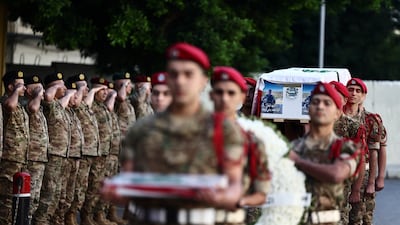
  • Lebanese Army soldiers take part in an official ceremony to pay tribute after the death of Maj Mohammad Farhat. Reuters
    Lebanese Army soldiers take part in an official ceremony to pay tribute after the death of Maj Mohammad Farhat. Reuters
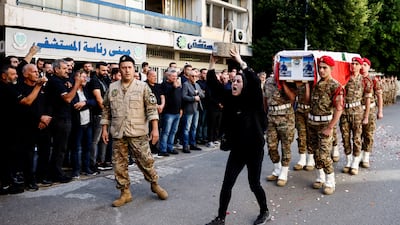
  • Lebanese Army soldiers carry the coffin of Maj Mohammad Farhat during an official ceremony to pay tribute in Beirut, Lebanon. Reuters
    Lebanese Army soldiers carry the coffin of Maj Mohammad Farhat during an official ceremony to pay tribute in Beirut, Lebanon. Reuters
  • Emotions ran high at a memorial for Lebanese Army Maj Mohammad Farhat, who was killed in an Israeli strike with two other soldiers on the outskirts of the village of Yater in southern Lebanon. Reuters
    Emotions ran high at a memorial for Lebanese Army Maj Mohammad Farhat, who was killed in an Israeli strike with two other soldiers on the outskirts of the village of Yater in southern Lebanon. Reuters
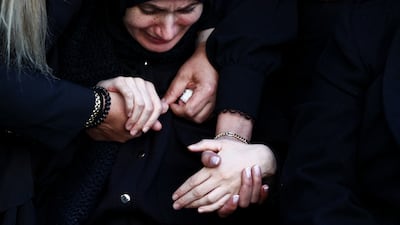
  • The relatives of Maj Mohammad Farhat are comforted by friends at a memorial in Beirut. Reuters
    The relatives of Maj Mohammad Farhat are comforted by friends at a memorial in Beirut. Reuters
  • The sister of Maj Mohammad Farhat at the official memorial to her brother in Beirut. Reuters
    The sister of Maj Mohammad Farhat at the official memorial to her brother in Beirut. Reuters
  • Mourners at the official ceremony to pay tribute to Maj Mohammad Farhat of the Lebanese Army, who was killed in an Israeli strike with two other soldiers on the outskirts of the village of Yater in southern Lebanon. Reuters
    Mourners at the official ceremony to pay tribute to Maj Mohammad Farhat of the Lebanese Army, who was killed in an Israeli strike with two other soldiers on the outskirts of the village of Yater in southern Lebanon. Reuters

Gap in international law

While the term domicide remains new in international law discussions, Prof Rajagopal said the practice it describes is being used on a scale, and with intent, in modern warfare such that it requires legal recognition. He proposes it should be defined as the deliberate destruction of housing during armed conflict, where the primary goal is to make areas permanently uninhabitable.

Civilian homes are currently protected by international law in conflicts between states. Purposeful destruction of them is considered a war crime but not a crime against humanity, which covers conflicts within a state or involving non-state actors, such as those between Israel and the Hamas militant group, or Myanmar’s military and rebel forces.

Prof Rajagopal is campaigning for amendments to the Rome Statute of the International Criminal Court to recognise domicide as a stand-alone crime against humanity. Such amendments have been made before; the same statute initially listed starvation as a tool of conflict as a war crime but in 2022 it upgraded it to a crime against humanity.

His mission initially gained traction in response to Russia’s bombing of Ukrainian cities in 2022. However, he pointed out an apparent “double standard” in how international leaders respond to allegations of domicide by Israel.

“There is selective silence when it comes to Israel,” he said. “Western countries that praised the concept when I applied it to Ukraine are now silent. But Middle Eastern countries and those from the Global South are very receptive.”


Ten tax points to be aware of in 2026

1. Domestic VAT refund amendments: request your refund within five years

If a business does not apply for the refund on time, they lose their credit.

2. E-invoicing in the UAE

Businesses should continue preparing for the implementation of e-invoicing in the UAE, with 2026 a preparation and transition period ahead of phased mandatory adoption. 

3. More tax audits

Tax authorities are increasingly using data already available across multiple filings to identify audit risks. 

4. More beneficial VAT and excise tax penalty regime

Tax disputes are expected to become more frequent and more structured, with clearer administrative objection and appeal processes. The UAE has adopted a new penalty regime for VAT and excise disputes, which now mirrors the penalty regime for corporate tax.

5. Greater emphasis on statutory audit

There is a greater need for the accuracy of financial statements. The International Financial Reporting Standards standards need to be strictly adhered to and, as a result, the quality of the audits will need to increase.

6. Further transfer pricing enforcement

Transfer pricing enforcement, which refers to the practice of establishing prices for internal transactions between related entities, is expected to broaden in scope. The UAE will shortly open the possibility to negotiate advance pricing agreements, or essentially rulings for transfer pricing purposes. 

7. Limited time periods for audits

Recent amendments also introduce a default five-year limitation period for tax audits and assessments, subject to specific statutory exceptions. While the standard audit and assessment period is five years, this may be extended to up to 15 years in cases involving fraud or tax evasion. 

8. Pillar 2 implementation 

Many multinational groups will begin to feel the practical effect of the Domestic Minimum Top-Up Tax (DMTT), the UAE's implementation of the OECD’s global minimum tax under Pillar 2. While the rules apply for financial years starting on or after January 1, 2025, it is 2026 that marks the transition to an operational phase.

9. Reduced compliance obligations for imported goods and services

Businesses that apply the reverse-charge mechanism for VAT purposes in the UAE may benefit from reduced compliance obligations. 

10. Substance and CbC reporting focus

Tax authorities are expected to continue strengthening the enforcement of economic substance and Country-by-Country (CbC) reporting frameworks. In the UAE, these regimes are increasingly being used as risk-assessment tools, providing tax authorities with a comprehensive view of multinational groups’ global footprints and enabling them to assess whether profits are aligned with real economic activity. 

Contributed by Thomas Vanhee and Hend Rashwan, Aurifer

TECH%20SPECS%3A%20APPLE%20WATCH%20SERIES%209
%3Cp%3E%3Cstrong%3EDisplay%3A%3C%2Fstrong%3E%2041mm%20%E2%80%93%20352%20x%20430%3B%2045mm%20%E2%80%93%20396%20x%20484%3B%20always-on%20Retina%20LTPO%20OLED%2C%202000%20nits%20max%3B%20Ion-X%20glass%20(aluminium%20cases)%2C%20sapphire%20crystal%20(stainless%20steel%20cases)%3C%2Fp%3E%0A%3Cp%3E%3Cstrong%3EProcessor%3A%3C%2Fstrong%3E%20Apple%20S9%2064-bit%2C%20W3%20wireless%2C%202nd-gen%20Ultra%20Wideband%3C%2Fp%3E%0A%3Cp%3E%3Cstrong%3ECapacity%3A%3C%2Fstrong%3E%2064GB%3C%2Fp%3E%0A%3Cp%3E%3Cstrong%3EMemory%3A%3C%2Fstrong%3E%201GB%3C%2Fp%3E%0A%3Cp%3E%3Cstrong%3EPlatform%3A%3C%2Fstrong%3E%20watchOS%2010%3C%2Fp%3E%0A%3Cp%3E%3Cstrong%3EHealth%20metrics%3A%3C%2Fstrong%3E%20Blood%20oxygen%20sensor%2C%20electrical%20heart%20sensor%20and%20ECG%2C%203rd-gen%20optical%20heart%20sensor%2C%20high%20and%20low%20heart%20rate%20notifications%2C%20irregular%20rhythm%20notifications%2C%20sleep%20stages%2C%20temperature%20sensing%3C%2Fp%3E%0A%3Cp%3E%3Cstrong%3EEmergency%20services%3A%3C%2Fstrong%3E%20Emergency%20SOS%2C%20international%20emergency%20calling%2C%20crash%20detection%2C%20fall%20detection%3C%2Fp%3E%0A%3Cp%3E%3Cstrong%3EConnectivity%3A%3C%2Fstrong%3E%20GPS%2FGPS%20%2B%20cellular%3B%20Wi-Fi%2C%20LTE%2C%20Bluetooth%205.3%2C%20NFC%20(Apple%20Pay)%3C%2Fp%3E%0A%3Cp%3E%3Cstrong%3EDurability%3A%3C%2Fstrong%3E%20IP6X%2C%20water%20resistant%20up%20to%2050m%2C%20dust%20resistant%3C%2Fp%3E%0A%3Cp%3E%3Cstrong%3EBattery%3A%3C%2Fstrong%3E%20308mAh%20Li-ion%2C%20up%20to%2018h%20regular%2F36h%20low%20power%3B%20wireless%20charging%3C%2Fp%3E%0A%3Cp%3E%3Cstrong%3ECards%3A%3C%2Fstrong%3E%20eSIM%3C%2Fp%3E%0A%3Cp%3E%3Cstrong%3EFinishes%3A%3C%2Fstrong%3E%20Aluminium%20%E2%80%93%20midnight%2C%20pink%2C%20Product%20Red%2C%20silver%2C%20starlight%3B%20stainless%20steel%20%E2%80%93%20gold%2C%20graphite%2C%20silver%3C%2Fp%3E%0A%3Cp%3E%3Cstrong%3EIn%20the%20box%3A%3C%2Fstrong%3E%20Watch%20Series%209%2C%20woven%20magnetic-to-USB-C%20charging%20cable%2C%20band%2Floop%3C%2Fp%3E%0A%3Cp%3E%3Cstrong%3EPrice%3A%3C%2Fstrong%3E%20Starts%20at%20Dh1%2C599%20(41mm)%20%2F%20Dh1%2C719%20(45mm)%3C%2Fp%3E%0A
Benefits of first-time home buyers' scheme
  • Priority access to new homes from participating developers
  • Discounts on sales price of off-plan units
  • Flexible payment plans from developers
  • Mortgages with better interest rates, faster approval times and reduced fees
  • DLD registration fee can be paid through banks or credit cards at zero interest rates
AL%20BOOM
%3Cp%20style%3D%22text-align%3Ajustify%3B%22%3E%26nbsp%3B%26nbsp%3B%26nbsp%3BDirector%3AAssad%20Al%20Waslati%26nbsp%3B%3C%2Fp%3E%0A%3Cp%20style%3D%22text-align%3Ajustify%3B%22%3E%0DStarring%3A%20Omar%20Al%20Mulla%2C%20Badr%20Hakami%20and%20Rehab%20Al%20Attar%0D%3Cbr%3E%0D%3Cbr%3EStreaming%20on%3A%20ADtv%0D%3Cbr%3E%0D%3Cbr%3ERating%3A%203.5%2F5%0D%3Cbr%3E%0D%3Cbr%3E%3C%2Fp%3E%0A
Updated: November 05, 2024, 9:28 AM