
Live updates: Follow the latest on Israel-Gaza
At least nine people, including paramedics, were killed in an Israeli strike on central Beirut overnight, while two Lebanese army soldiers were killed in separate Israeli attacks on Thursday, as Israel continued its ground invasion of Lebanon backed by its air force.
Around 97 medical workers have been killed in direct Israeli attacks on ambulance workers across Lebanon since October 8, when the present conflict between Israel and Hezbollah began, Lebanon's Minister of Health Firas al Abiad said.
Around 40 rescue workers, including paramedics and firefighters, have been killed by Israeli fire in the past three days alone following Israel’s escalation of fighting with Hezbollah and invasion into Lebanese territory, Mr Abiad added.
The strike on a building in the central Beirut neighbourhood of Bachoura killed at least nine people and injured 14, according to Lebanon's Ministry of Health. The strikes hit the second floor of a residential building housing an office for the Islamic Health Committee, which in a statement identified seven of those killed in the attack as "a group of its leaders and paramedics".
The Bachoura neighbourhood is adjacent to the capital’s downtown and only half a kilometre away from the Prime Minister’s official headquarters and the Lebanese parliament. It is highly populated, having recently welcomed thousands of people displaced from south Lebanon and other parts of the country affected by the Israeli bombardment.
Paramedics, regardless of political affiliation, are protected under international human rights law.
“The same scenario that happened in Gaza is happening in Lebanon now,” said Hezbollah MP Ibrahim Moussawi, addressing a crowd outside the strike site on Thursday afternoon. “The international community, it’s the time - it has always been the time - that they must assume their responsibilities and stop the killing machine that is being run by the Israelis and Netanyahu.”
In a separate incident, one Lebanese soldier was killed on Thursday afternoon when the Israeli army targeted a convoy from the Red Cross while evacuating casualties from the border area of Taybeh in south Lebanon. Four Red Cross rescue workers were injured in the attack.
The Red Cross confirmed the toll in a statement and said its movements had been co-ordinated in advance with the United Nations Interim Force in Lebanon. The Lebanese Armed Forces said one of its soldiers were killed and another injured "while carrying out an evacuation and rescue mission with the participation of the Lebanese Red Cross in the town of Taybeh – Marjeyoun".
A second Lebanese soldier was killed on Thursday when an Israeli strike hit an army centre in the Bint Jbeil area. In response, the Lebanese army said it returned fire at Israel – marking the first time the Lebanese army clashed with Israel since the conflict began on October 8. Caretaker Prime Minister Najib Mikati had previously given army commander Gen. Joseph Aoun authorisation to take “whatever action he deems necessary to protect Lebanon and the military institution”.
Striking central Beirut, near downtown
The attack on Bachoura shook buildings, with nearby residents reporting that they heard the missile crossing over their homes.
Abu Mahdi, a sixth-floor resident who also owns a water pipe store underneath the health centre, said it was well known the second floor housed an office belonging to the Islamic Health Committee.
"Their ambulances are always parked out front. It was a health and ambulance centre," he told The National. "People from the area come here whenever they need medical care or medicine."
He and his family can no longer sleep in their home on the sixth floor following the attack because the stairway was damaged in the blast. Abu Mahdi said they had relocated to a nearby school for the time being.
"On top of that, we had ten people staying with us who were displaced from the south. So it's not just us but them too who have nowhere else to go.
"Israel is doing what it does in Gaza," he added. "Israel forcibly displaces people to certain areas, and then it hits those exact 'safe' areas where the displaced people have gone."
The force of the blast on the health centre sent iron and concrete flying into the cemetery across the street, desecrating several graves.
"Israel won't even let the dead sleep," Abu Mahdi told The National.
The assault near downtown Beirut came after Israeli forces suffered their deadliest day on the Lebanese front in a year, when eight Israeli soldiers were killed in clashes with Hezbollah after invading southern Lebanon.
Strikes on Beirut's southern suburbs continued throughout the day, with the building housing Hezbollah's media relations headquarters.
Israel conducted overnight announced the army’s intention to bomb three neighbourhoods in Dahieh – Haret Hreik, Burj Al Barajneh and Hadath – and warned residents to flee “immediately”. The military said regular infantry and armoured units joined the ground raids.
Three missiles struck Dahieh, where Hezbollah leader Hassan Nasrallah was killed last week, and loud explosions were heard, Lebanese security officials said. On Wednesday, the southern suburbs of Beirut were hit with more than a dozen Israeli strikes, and the assault continued overnight with 17 other attacks, Lebanon’s state news agency said.
"We are at the height of a difficult war against Iran's axis of evil, which wants to destroy us," Israeli Prime Minister Benjamin Netanyahu said in a condolence video. "This will not happen because we will stand together and with God's help, we will win together.”
-
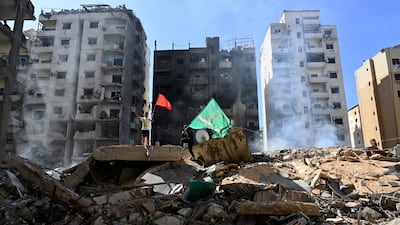
Damage in Beirut after an overnight Israeli strike. EPA -
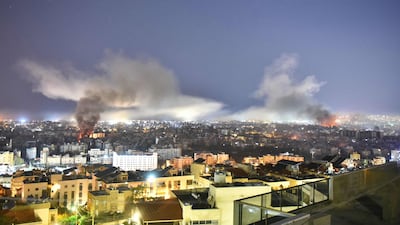
Smoke rises from the site of an Israeli strike in the south of Lebanon's capital. AFP -
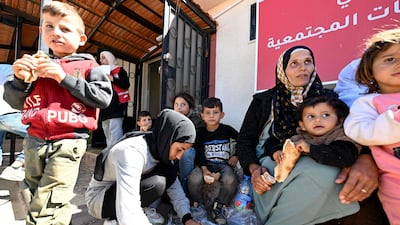
Displaced Syrians and Lebanese enter Syria from Lebanon at the Jusiyah border crossing. AFP -

The site of the Israeli air strike that killed Hezbollah leader Hassan Nasrallah, in Beirut. AP -
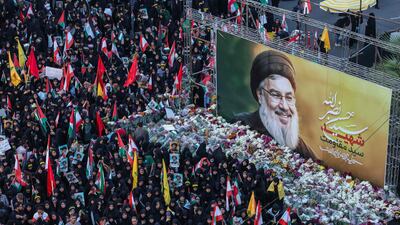
Iranians lay flowers before a portrait of Nasrallah. AFP -

Smoke billows over Tyre, southern Lebanon following an Israeli strike. Reuters -
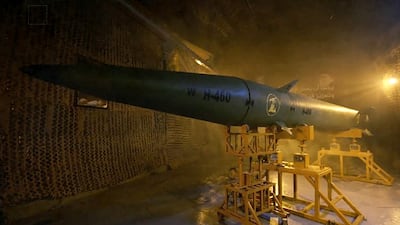
A Qader 1 ballistic missile from Hezbollah's arsenal. AFP -
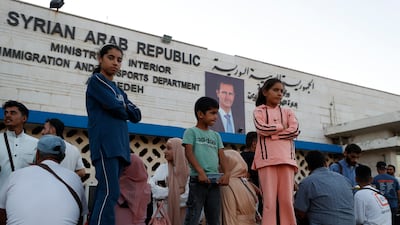
Syrians fleeing the war in Lebanon arrive at the Syrian-Lebanese border crossing in Jdeidet Yabous. AP -
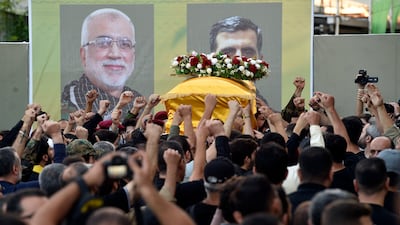
Hezbollah fighters carry the coffin of Hezbollah commander Ibrahim Qubaisi during his funeral in Beirut. EPA -
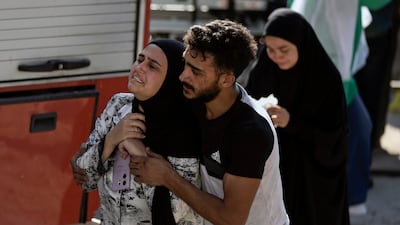
People react at the scene of an Israeli air strike in the town of Maisara, north of Beirut. AP -
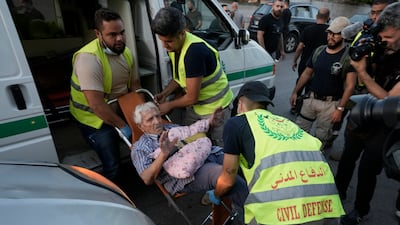
Civil defence workers carry an elderly man who fled from the south of Lebanon, as he arrives at a school turned into a displaced shelter in Beirut. AP -
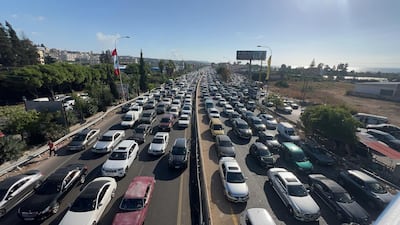
A traffic jam in Ghazieh as people fleeing from the south of Lebanon drive towards Sidon and Beirut. EPA -
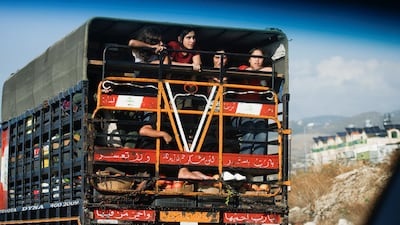
People in heavy traffic drive north from Lebanon's southern coastal city of Sidon, as they flee Israeli bombardment. Reuters -
Smoke billows over southern Lebanon following Israeli strikes, as seen from Tyre. Reuters -
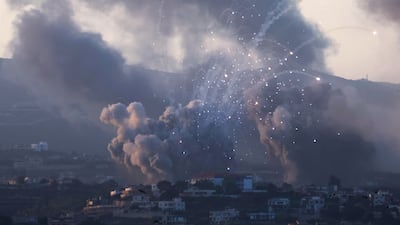
Smoke billows over southern Lebanon following Israeli strikes, as seen from Tyre. Reuters -
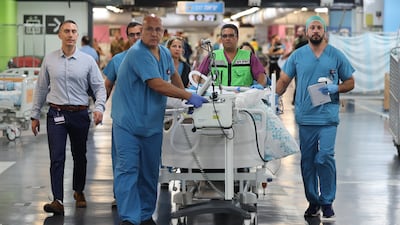
Medics move patients at Rambam Hospital's underground emergency centre, in Haifa, northern Israel. EPA -
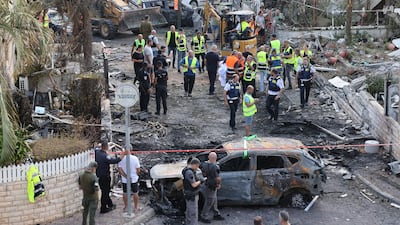
Israeli emergency teams work at the scene of a missile strike on a residential neighbourhood in Kiryat Bialik, northern Israel. EPA -
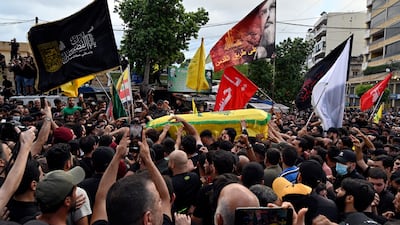
Hezbollah fighters carry the coffin of the group's senior commander Ibrahim Aqil, who was killed in an Israeli strike on September 20, in Beirut. EPA -
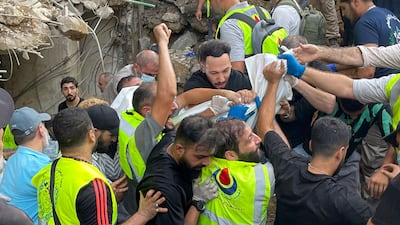
Rescuers carry a body at the scene of a missile strike in the southern suburbs of Beirut. AP


The clash came a day after Iran fired about 200 missiles into Israel, its second missile attack on the country in six months, increasing world oil prices and raising concern that the Middle East could become embroiled in a wider conflict.
The military has said its ground incursion was largely aimed at destroying tunnels and other infrastructure on the border and said there were no plans for a wider operation targeting Beirut or major cities in the south.
Hezbollah said its fighters engaged the Israeli forces inside Lebanon. It was the first report by the militant group of ground clashes since Israeli forces pushed over the border on Monday. It said it had destroyed three Israeli Merkava tanks with rockets near the border town of Maroun El Ras and repelled Israeli forces near several border towns while firing rockets at military posts inside Israel.
The Lebanese Health Ministry said early on Thursday that 46 people had been killed and 85 wounded in Israeli strikes on Lebanon in the past 24 hours.
More than 1,900 people have been killed and over 9,000 wounded in Lebanon in almost a year of cross-border fighting, with most of the deaths occurring in the past two weeks, according to Lebanese government statistics.
Hezbollah began low-intensity strikes on Israeli troops in October last year in support of Hamas after the Gaza-based militant group staged its cross-border attack on Israel.
Caretaker Lebanese Prime Minister Najib Mikati has said about 1.2 million Lebanese have been displaced by Israeli attacks on his country in the past two weeks.

