

Live updates: Follow the latest on Israel-Gaza
Hezbollah confirmed the death of its leader Hassan Nasrallah on Saturday, hours after the Israeli military announced he had been killed in a strike targeted at the central headquarters of the Lebanese militant group in Beirut on Friday.
In a statement, the group vowed to continue its battle against Israel “in support of Gaza and Palestine, and in defence of Lebanon”.
Earlier, the Israeli army said: “Yesterday, September 27, 2024, Hassan Nasrallah, the leader of the Hezbollah terrorist organisation and one of its founders, was eliminated by the IDF.” Its statement, added that the attack also killed Ali Karaki, the Commander of Hezbollah’s Southern Front, and another Hezbollah commander.
Iran's Islamic Revolutionary Guard Corps deputy commander for operations Brig Gen Abbas Nilforooshan was also killed in Friday's strike on Beirut, Iranian media reported.
The Israeli army said its fighter jets conducted a targeted strike on the central headquarters of Hezbollah “which was located underground embedded under a residential building” in Dahieh. Six buildings were almost entirely destroyed in the attack, leaving huge craters behind.
At least six people were killed and 91 wounded in the attack in Beirut's southern suburbs, Lebanon’s Health Ministry said, but the death toll is likely to rise significantly as rescue teams comb through the rubble.
“The strike was conducted while Hezbollah’s senior chain of command were operating from the headquarters and advancing terrorist activities against the citizens of the State of Israel,” the Israeli army said in the statement.
The death of Hezbollah's leader marks a significant Israeli blow to the group and to the Iran-backed “Axis of Resistance.” Iran's supreme leader Ali Khamenei said on Saturday that all the resistance forces in the region stand by Hezbollah and support it. He called on all Muslims to support the people of Lebanon in confronting Israel.
“The Zionist criminals must know that they are too small to cause significant harm to the strong structure of the Lebanese Hezbollah,” he said shortly after the Israeli announcement.
The Iranian foreign ministry said Hezbollah would carry on despite the death of its leader. “The glorious path of the leader of the resistance, Hassan Nasrallah, will continue and his sacred goal will be realised in the liberation of Quds [Jerusalem], God willing,” the ministry's spokesman Nasser Kanani said in a post on social media platform X.
Israel launches wave of strikes on Hezbollah targets – in pictures
-

An explosion in the southern suburbs of Beirut, Lebanon, during an Israeli air strike on Saturday, September 28. AP Photo -

Rockets from Israel's Iron Dome air defence system over the city of Haifa on Friday September 27. Reuters -
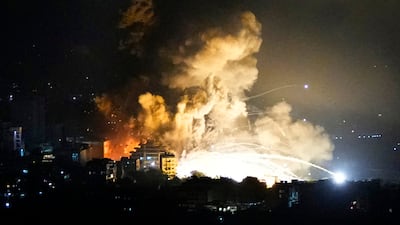
An early morning Israeli attack in south Beirut on September 28. AP Photo -
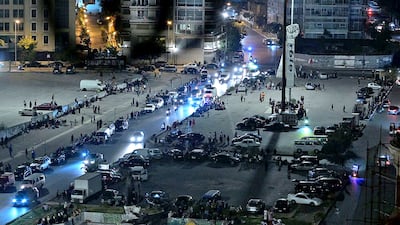
Beirut residents flee the southern suburbs and gather in Martyrs' Square. EPA -

Smoke is seen following strikes over Beirut's southern suburbs. Reuters -

Smoke over south Beirut as seen from Sin El Fil, Lebanon, on September 28. Reuters -
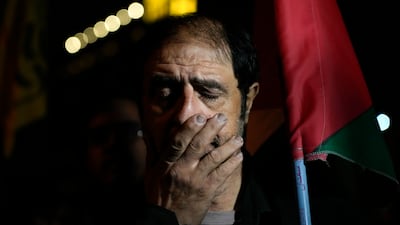
An Iranian demonstrator listens to news from Beirut during a gathering in support of Hezbollah at Felestin (Palestine) Square in Tehran on September 28. AP Photo -
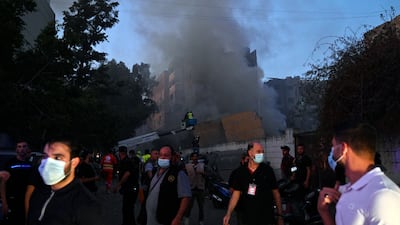
Ruins of a building in Dahieh, Beirut, on September 27 after what Israel called 'a precise strike on the central headquarters of the Hezbollah'. EPA -
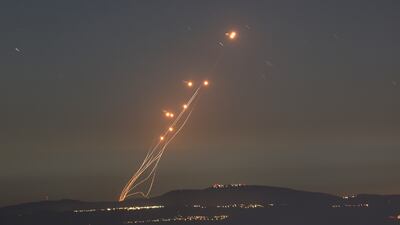
Israeli air defences in Upper Galilee, northern Israel, respond to rocket fire from southern Lebanon on September 27. EPA -
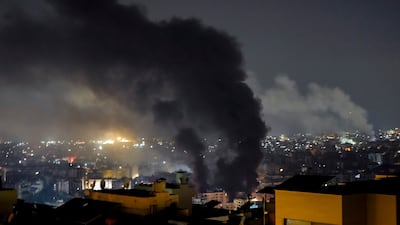
Smoke rises from Israeli airstrikes in Beirut's southern suburbs, Lebanon, Saturday, Sept. 28, 2024. (AP Photo/Hassan Ammar) -
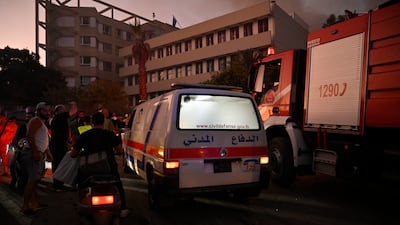
Ambulances attend to the injured following an Israel strike in Dahieh, south Beirut, on September 27. EPA -
Lebanese forced from their homes on September 28 gather at Beirut's Martyrs' Square as Israel attacks the southern suburbs. Reuters -
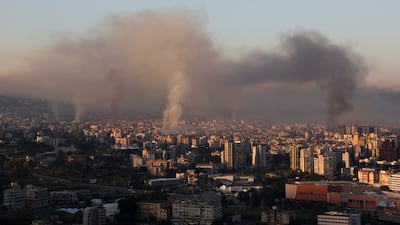
South Beirut as seen from Sin El Fil, Lebanon, on September 28. Reuters -

An ambulance carries injured following an Israel strike in Dahieh, Beirut. EPA -
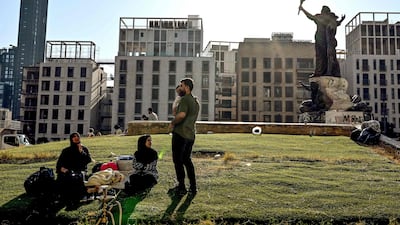
Members of a family who fled Israeli bombardment on Beirut's southern suburbs with some of their belongings in Martyrs Square in the centre of the Lebanese capital on September 28. AFP -
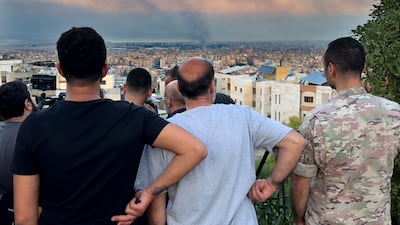
Lebanese citizens watch smoke rise from Israeli air strikes in the southern suburbs of Beirut. AP Photo -
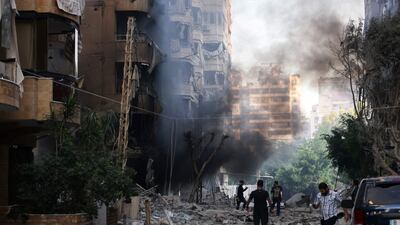
Residents check the damaged in the aftermath of overnight Israeli bombardment in Beirut's southern suburbs, on September 28. Israel claimed its warplanes targeted Hezbollah chief Hassan Nasrallah. AFP -
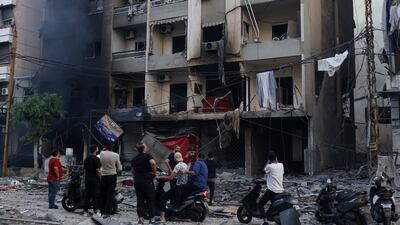
Beirut's southern suburbs after a night of Israeli attacks. AFP -

Smoke rises from an Israeli airstrike in the southern suburbs of Beirut, Lebanon. AP Photo -
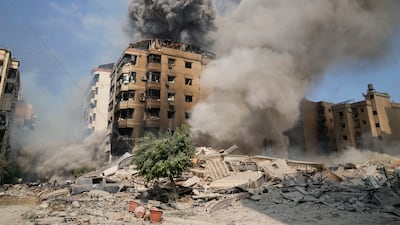
Smoke rises from Israeli air strikes in Beirut's southern suburbs. AP Photo -
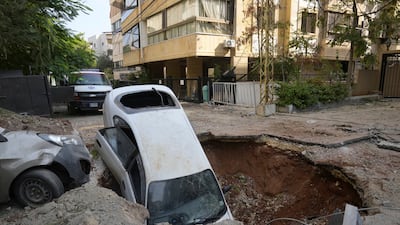
A car sits in a crater in Beirut's southern suburbs. AP Photo


Thousands of people have fled the area of the attack, congregating in squares, parks and on pavements in downtown Beirut and seaside areas.
Mr Nasrallah became the leader of Hezbollah following the assassination of his mentor Sheikh Abbas Al Musawi by Israel in 1992, 10 years after the Israeli invasion of Lebanon that sparked the group's inception. Hezbollah has since become the strongest political power in Lebanon, arguably better armed than the country's own forces, and a foe of the Israeli military in the south, notably during the month-long 2006 war. Israel tried and failed to assassinate Mr Nasrallah in 2006, destroying his offices and home.
He had become an increasingly elusive figure, despite appearing regularly on television to give briefings. He had not been spotted in public for years.
Hezbollah began low-intensity attacks across the border a day after its Palestinian ally Hamas staged an unprecedented attack on Israel on October 7, killing 1,200 people and kidnapping 251, taking them into Gaza.
Israel has bombarded the Gaza Strip daily in the year since, killing more than 41,500 people and displacing millions multiple times. Hezbollah has said it will not end its assaults over the border – which have been reaching further into Israeli territory – until Israel stops its attacks on Gaza.

It has in the past days shifted the focus of its operation from Gaza to Lebanon, where heavy bombing has killed more than 1,000 people and sparked an exodus of around 118,000. The bombing followed an Israeli operation which blew up thousands of walkie talkies and radios owned by the group, killing 42 and injuring thousands.
According to figures released by the Lebanese Health Ministry on Saturday, between September 16 and 27, Israeli strikes killed 1,030 people, including 56 women and 87 children. More than 6,300 people have been injured.
In a statement, Hamas condemned the Israeli attacks on residential buildings in the southern Beirut suburb and the killing of Mr Nasrallah. “We consider this a cowardly terrorist act, a massacre and a heinous crime that proves once again the bloodiness and brutality of this [Israeli] occupation.”
Yemen's Houthis said Mr Nasrallah's death would strengthen their determination to confront “the Israeli enemy”.
The Israeli army's chief of staff said it had not emptied its “toolbox” with his killing. “This is not the end of our toolbox. The message is simple, anyone who threatens the citizens of Israel – we will know how to reach them,” Herzi Halevi said in a statement.
US President Joe Biden called Israel's killing of Nasrallah "a measure of justice for his many victims", including Americans, Israelis and Lebanese people, "over a four-decade reign of terror".
In his statement, Mr Biden called for the region to "de-escalate" through diplomatic resolutions the US and other allies are pushing.
Strikes continued into Saturday morning on dozens of Hezbollah targets in the area of Bekaa in eastern Lebanon and across the south, its military said, adding it had targeted launchers aimed at Israeli civilians, weapons storage and Hezbollah's infrastructure.
The Israeli military said it carried out another round of strikes on Dahieh on Saturday afternoon.
Strikes hit two storage areas near Beirut airport on Saturday evening, a Lebanese security source told The National. "Strikes, presumably carried out by Israel, hit two storage areas that were reportedly used to store ceramics and steel," said the source. "They are located near the airport," added the source.
Hezbollah had launched a surface-to-surface missile from Lebanese territory into central Israel, which fell in an open area, the Israeli military said, adding it had called up three reserve battalions for operational activities and to strengthen the defence in the central command.
Hezbollah on Saturday claimed a rocket attack on northern Israel, the first after heavy Israeli strikes pounded Beirut's southern suburbs overnight. Its fighters targeted Kibbutz Kabri in northern Israel “with a salvo of Fadi-1 rockets”, the group said in a statement.
Israel has approved battle plans for its campaign on the northern border with Lebanon, its military chief said. Lt Gen Herzi Halevi did not give details about the plans but said in a statement that “challenging days await us”. He added that the military is at “peak readiness” and that Israeli is “determined to continue destroying the Hezbollah terrorist organisation and to keep fighting”.
The escalation has sharply increased fears the conflict could spiral out of control, potentially drawing in Iran, Hezbollah's principal backer, as well as the US.

