


A state company running part of Jordan's sole port in Aqaba has been undergoing major changes to resolve problems after a chlorine gas explosion two years ago, as authorities renew efforts to attract international investment into the Red Sea area.
“We had to look into human resources and general safety,” Mahmood Khelayfat, general manager of the Aqaba Company for Ports Operation and Management, told The National this week.
“A restructuring has been needed for years.”
His predecessor was dismissed after the June 2022 explosion, Jordan's worst accident in years, which killed 13 people.
For decades, authorities in the kingdom have grappled with streamlining a mammoth public sector to control public debt, one of the requirements to gain access to funding from international financial institutions.
Gross state debt comprises 108 per cent of Jordan's economy, according to the International Monetary Fund.
The bureaucracy largely comprises members of the country’s influential tribes. And public sector reform plans have been tempered with caution so as not to alienate a major constituency.
But in Aqaba, Mr Khelayfat's company, which has 2,100 workers, is one of the last state-owned enterprises to operate a major part of the harbour.
APM Terminals, a division of Danish group AP Moller-Maersk, has a 25-year contract to manage the container terminal since 2006, when privatisation of most port operations began.

The state company still operates the general cargo quays, which handle car, steel and coal imports, as well as cattle and other agriculture exports.
Its quays also house a liquefied petroleum gas terminal and an oil complex through which Jordan receives most of its crude oil imports from Saudi Arabia.
After the 2022 explosion, which was in the general cargo section of the port, a government investigation determined that negligence was to blame, with officials revealing widespread absenteeism and mismanagement in the company.
The accident occurred as authorities were focused on making Aqaba home to the kingdom’s biggest potential projects in the desalination, green hydrogen, property and transport sectors.
-

Jordanian emergency services and forensics experts inspect the site of a toxic gas explosion in the Red Sea port of Aqaba. AFP -

At least 13 people were killed and 250 injured. AFP -
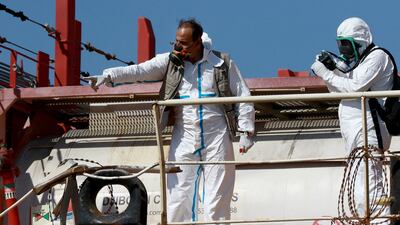
Shipping was halted and beaches evacuated near the country's only port. AFP -

The chlorine gas explosion took place on Monday. AFP -

Authorities investigate the scene of the aftermath of the explosion of a tank containing large amounts of the toxic chlorine gas in Aqaba. EPA -

Jordanian Prime Minister Bisher Al Khasawneh talks to reporters as he visits the scene. AFP -

Jordanian state TV footage shows the moment a large cylinder falls from a crane and hits a moored vessel, causing a violent explosion. AFP -

The explosion was one of Jordan's worst accidents in recent years and more deaths could be linked to the blast. Photo: Jordan TV -

An injured man is transported to hospital after the explosion. AFP -

People injured in the explosion receive medical care at the Jordanian Islamic Hospital in Aqaba. EPA -

A man injured in the explosion receives medical care at the Jordanian Islamic Hospital in Aqaba. EPA -

One of the people injured in the explosion lies in a hospital bed in Aqaba. EPA -

People stand outside a hospital after the toxic gas leak. Reuters -

According to official sources, Aqaba's southern beach was evacuated following the incident. AFP -

The government has urged citizens not to approach the site of the accident and added that medical reinforcements are being sent to Aqaba. AFP -

The tank that fell while being transported, causing a toxic gas leak in Jordan's Aqaba port. AFP -

A military helicopter is pictured near a hospital after the toxic gas leak. Reuters -
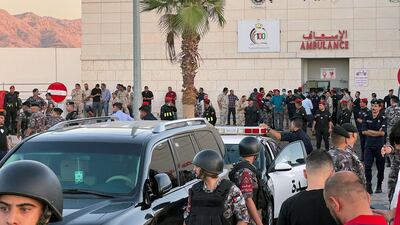
Members of the Jordanian Gendarmerie stand outside a hospital after the toxic gas leak. Reuters


On Monday, the Aqaba Special Economic Zone Authority, which oversees the area's major projects, will announce a new strategy backed by the US.
In December 2021, it signed a deal with Abu Dhabi Ports to develop land, logistics, transport and digital infrastructure in Aqaba, including modernising the general cargo section of the port.
Mr Khelayfat, who refused to comment on the deal, said he has been focused on setting up a safety department and solving the significant problem of absenteeism.
He brought in an outside company to assess equipment, and promoted engineer Tamara Al Khdour to the position of public safety chief, in an effort to ensure compliance with maritime standards.
The company “cannot afford to be exposed to another accident like the last one”, he said.
A number of people who have been paid for years without showing up for work have been dismissed, he said.
Financial incentives for early retirement were offered to another 400 workers, which they are expected to take up.
Cost reductions were also needed to compete with other ports in the region, he said.
However, Gaza-related disruptions have caused a 10 per cent reduction in volumes processed by the company at Aqaba since the war began last October.
Aqaba is at the end of a gulf bordered by Jordan, Israel, Egypt and Saudi Arabia, with countries such as Turkey also competing for transit business, especially to Iraq.
“The throughput has dropped for sure, but not massively,” he said, adding that “confusion” had affected ship arrival timings because of Houthi attacks in the Red Sea.

