

Live updates: Follow the latest on Israel-Gaza
Palestinian civilians returned to their ruined homes in Khan Younis on Monday after Israeli forces withdrew from the city to prepare for a much-feared assault on the nearby city of Rafah.
Israeli Defence Minister Yoav Gallant said the withdrawal of Israeli troops was to prepare for a future "mission in the Rafah area", where about 1.3 million people are taking shelter near the Egyptian border.
“The forces came out [of Gaza] and are preparing for their future missions, we saw examples of such missions in action at Shifa [Hospital], and also for their future mission in the Rafah area,” Mr Gallant said, following an assessment at the army's Southern Command.
"We will reach a situation where Hamas does not control the Gaza Strip and where it does not function as a military framework," he said on Sunday evening.
On Monday, Prime Minister Benjamin Netanyahu said a date has been set for the assault on Rafah, just hours after the White House said there were no indications Israel was planning an "imminent" offensive.
"I received a detailed report on the talks in Cairo, we are working all the time to achieve our goals, first and foremost the release of all our hostages and achieving a complete victory over Hamas," Mr Netanyahu said in a video message posted to X.
"This victory requires entry into Rafah and the elimination of the terrorist brigades there. It will happen - there is a date," he said.
The prospect of an Israeli attack on Rafah has raised global alarm, including from Israel's most important ally, the US, which has demanded evidence of a credible plan to protect civilians.
Israel says Hamas is still operating out of Rafah. The city is bordered by the sea to the west and Egypt to the south, leaving civilians with nowhere to go if Israel does launch a ground offensive.
Israeli military officials say they have significantly reduced the number of forces on the ground in Gaza in the past few months.
In their wake they have left scenes of vast destruction.
Mahmoud Abdel Ghani, who fled Khan Younis in December when Israel began its ground invasion, said on his return to the city that entire areas had been completely destroyed.
"Many areas, especially the city centre, have become unfit for life," he told AFP.
"I found that my house and my neighbours’ houses turned to rubble."
Videos and images showed Palestinians walking past destroyed buildings. Dr Muhammad Al Mughayir, spokesman for the civil defence in southern Gaza, told local media that 20 bodies were recovered from the rubble in the first hours after Israeli troops withdrew.
Many of the bodies had started to decompose due to the length of the Israeli operation in the city, he said.
-

Gazans walk past buildings destroyed by the Israeli military during attacks on the southern city of Khan Younis. All photos: AFP -
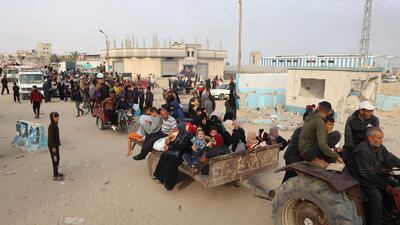
Palestinians return to Khan Younis after the withdrawal of Israeli troops. -
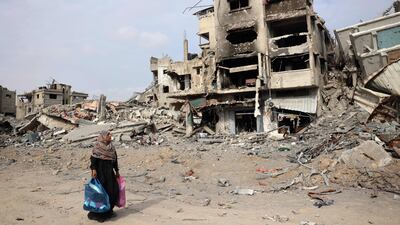
Khan Younis was for months the site of intense Israeli military operations, including raids on hospitals. -
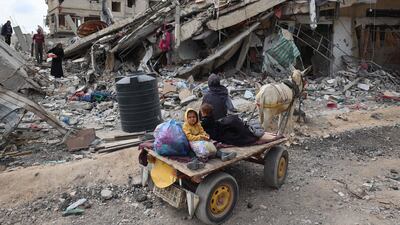
Israel says the months-long attack on the city 'achieved what it set out to do'. -

Palestinians return to Khan Younis to inspect the homes they abandoned amid the Israeli attacks. -
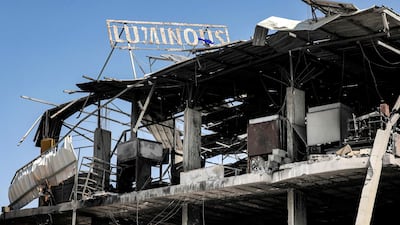
The US says Israel's partial withdrawal from Gaza is meant to 'rest and refit' troops after months of war. -
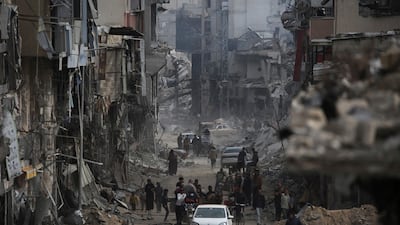
Palestinians are surrounded by devastation after returning to Khan Younis, in southern Gaza. -
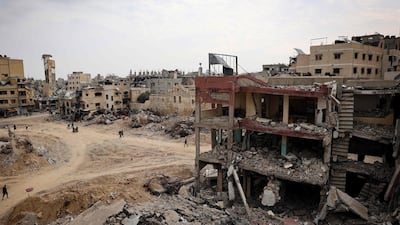
Buildings and homes have been reduced to rubble during the Israeli assault on the city. -

More than 33,100 Gazans have been killed since the war began on October 7. -
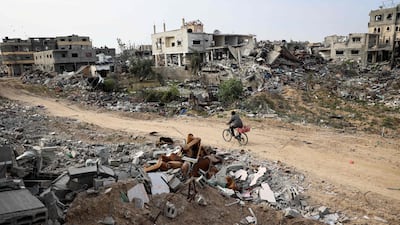
Displaced people have returned to Khan Younis, but Israeli troops are in place to prevent any from travelling back to northern Gaza.


The rotation of Israeli forces brings the troop presence in the territory to one of its lowest levels since the war began on October 7.
More than 20,000 Israeli soldiers were part of the ground offensive into the enclave on October 21, following weeks of bombardment that killed thousands of civilians.
On Sunday, the army said it had withdrawn its ground forces from Khan Younis, after months of intense fighting. Israel's 98th division said it had “concluded its mission” in city and was leaving the Gaza Strip to “recuperate and prepare for future operations”.
A brigade would remain to preserve the military’s "freedom of action and its ability to conduct precise intelligence based operations", the Israeli army said in a statement.
Military officials, speaking on condition of anonymity under army policy, told the Associated Press a “significant force” remained in Gaza to continue targeted operations including in Khan Younis, hometown of senior Hamas official Yahya Sinwar.
Israel has come under mounting pressure over the conduct of its armed forces in Gaza.
More than 33,200 Palestinians have been killed and at least 75,933 injured in Israel's campaign, most of them civilians killed by air strikes or shelling. International observers say the ratio of civilians killed is disproportionately high, with Israel carrying out indiscriminate bombing.
A recent report, denied by the Israeli military, accused it of using an artificial intelligence system to identify targets for air strikes in Gaza that permitted the mass killing of civilians.
The Israeli military has also admitted to carrying out three strikes that killed six foreign aid workers in Gaza last week, describing it as a "grave mistake". The death of the aid workers sparked international outcry and intensified pressure on Mr Netanyahu to agree to a ceasefire.
Mr Netanyahu on Sunday said Israel would not agree to a ceasefire in Gaza without the return of the hostages still held by Hamas.
The Prime Minister added that US President Joe Biden and his administration support this position.
The latest round of talks over a potential truce and hostage and detainee swap began in Egypt on Sunday.
Egypt, Qatar and the US have mediated several rounds of indirect talks between Israel and Hamas, all of which have failed to secure a temporary ceasefire.
Israel's Foreign Minister said the talks had reached a "critical point" on Monday.
“If matters work out, a large number of hostages will return home and then, in stages, everyone. But remember that we are dealing with Hamas and there is not a lot of time," Foreign Minister Israel Katz told Army Radio. "I am more optimistic than I was.”
A spokesman for Qatar's Ministry of Foreign Affairs said he was optimistic about the most recent talks.
“If you ask me if I’m more optimistic today than I was a couple of days ago, I would say, yes,” Dr Majed Al Ansari told the BBC.
But a Hamas official told Reuters "there is no progress yet" in the talks.
"There is no change in the position of the occupation and, therefore, there is nothing new in the Cairo talks," the official added.
Sources with direct knowledge of the latest negotiations said Israel and Hamas remained sharply at odds over the return of Palestinians displaced from northern Gaza to their homes, but are showing flexibility on other issues.
The current proposals are for an initial six-week truce, during which a hostage and prisoner exchange would take place, followed by the potential for a longer ceasefire.
The sources said Israel would only accept 60,000 Palestinians, without any fighting-age males, to return home after being screened at checkpoints during the initial six weeks. Hamas is resisting pressure to accept the proposal on the displaced and is demanding guarantees that all the Palestinians displaced to southern Gaza will be able to return to the north of the enclave after the six-week truce, said the sources.

They also said that Israel has tentatively agreed to withdraw from Gaza during the second phase of the deal but only after creating a buffer zone running along the entire border, with a depth of 2km inside the enclave. Hamas has not agreed to that proposal, the sources said.
Israel also remains opposed to the release of Marwan Barghouti, a senior Fatah leader widely believed to be a possible successor to President Mahmoud Abbas, as part of any hostage and prisoner exchange.
Hamas, showing flexibility, says it is prepared to forgo that proposal for now, provided he and other high-profile Palestinians serving life or long jail terms are part of the final stages of the proposed hostage and prisoner swap, according to the sources.
Mr Netanyahu's far-right Israeli allies have repeatedly voiced opposition to any deal with Hamas and said Israel should attack Rafah.
"If the Prime Minister decides to end the war without a broad attack on Rafah in order to defeat Hamas, he will not have a mandate to continue serving as Prime Minister," the far-right National Security Minister, Itamar Ben-Gvir, posted on X on Monday.

